
Quality Management System

Essential GMP Principles for Pharma Industry Professionals

Dr. Michael Lee

CA, USA


Introduction

Medicines are unlike most products people buy. Patients cannot see, taste, or test a tablet or injection to know whether it is safe and effective. They trust that the product contains the right ingredient, in the right amount, free from harmful contaminants, every time. Good Manufacturing Practice (GMP) is the system that earns and protects that trust.

GMP is the part of quality assurance that ensures medicinal products are consistently produced and controlled to the quality standards appropriate for their intended use. It is not a single procedure or a checklist for inspectors. It is a way of working that applies to everyone, from the operator weighing raw materials to the senior manager approving a budget.

This article outlines the essential GMP principles every pharmaceutical professional should understand, why each matters, and how to apply them in daily work.


1. Why GMP Exists

GMP regulations grew out of tragedies. Contaminated and poorly made medicines have harmed and killed patients throughout the twentieth century, and each major incident pushed regulators to tighten the rules. The Elixir Sulfanilamide poisoning in the United States in 1937, the thalidomide disaster of the early 1960s, and later contamination events involving sterile products and diethylene glycol in liquid medicines all shaped modern requirements.

The lesson from this history is that quality cannot be tested into a product. Final testing examines only a small sample and can miss problems that are unevenly distributed in a batch. Quality must be built in through controlled materials, validated processes, qualified equipment, trained people, and reliable records. GMP provides the framework for doing exactly that.


2. The Foundation: Pharmaceutical Quality System and Quality Management

GMP operates inside a broader Pharmaceutical Quality System (PQS), described in ICH Q10. The PQS defines how the organization manages quality: through leadership commitment, clear responsibilities, documented procedures, and continual improvement.

Core expectations include:

  • Management responsibility. Senior leaders must provide the resources, structure, and support for compliance, and they remain accountable for it.
  • An independent quality unit. The quality function must have the authority to approve or reject materials, batches, and procedures without pressure from production or commercial teams.
  • Risk-based decision-making. Resources and controls are directed to where the risk to patients is highest.
  • Continual improvement. Deviations, complaints, audit findings, and trends feed back into better processes.

Without this foundation, individual GMP practices tend to become isolated rules followed inconsistently.


3. Personnel: Training, Hygiene, and Responsibility

People are the most important and the most variable element in any manufacturing process. GMP therefore sets clear expectations for them.

Qualified and Trained Staff

Every facility needs enough qualified personnel to perform the work correctly. Employees should have defined roles, job descriptions, and documented training that covers:

  • Initial GMP training on joining the company.
  • Job-specific training on the procedures they perform.
  • Ongoing refresher training, including updates when procedures or regulations change.
  • Specialized training for higher-risk areas such as sterile manufacturing, potent compounds, or laboratory operations.

Training is only effective when it is assessed. Signing an attendance sheet proves presence, not competence. Observation, practical demonstration, and performance review are stronger evidence.

Personal Hygiene and Health

Operators are a potential source of contamination. GMP requires hygiene programs that cover handwashing, appropriate clothing and gowning, restrictions on jewelry and cosmetics in production areas, and prohibitions on eating, drinking, and smoking in manufacturing zones. Employees should report illnesses or open wounds that could compromise product quality. In sterile areas, gowning and aseptic technique are qualified and monitored.

Shared Responsibility

Although the quality unit has formal authority, quality is everyone’s responsibility. Operators should feel empowered to stop a process when something looks wrong, and supervisors should support that decision.


4. Premises and Facility Design

Facilities must be designed, located, constructed, and maintained to suit the operations performed in them. Good design prevents mix-ups, cross-contamination, and errors before they occur.

Key principles include:

  • Logical flow. Materials, personnel, and waste should move in a way that minimizes the risk of contamination and mix-ups.
  • Segregation. Areas for receiving, quarantine, sampling, production, packaging, storage, and quality control should be separated or controlled appropriately.
  • Surfaces and finishes. Walls, floors, and ceilings should be smooth, impervious, and easy to clean and disinfect.
  • Environmental control. HVAC systems regulate temperature, humidity, air quality, and pressure differentials between rooms.
  • Dedicated facilities where needed. Highly sensitizing or hazardous products, such as certain penicillins, cephalosporins, or potent compounds, may require dedicated or strictly segregated facilities.
  • Pest control and maintenance. Buildings should be kept in good repair, with effective pest control programs.

Cleanrooms are classified by airborne particle limits and microbial limits, and sterile operations rely on unidirectional airflow, pressure cascades, and environmental monitoring to maintain control.


5. Equipment: Qualification, Calibration, and Maintenance

Equipment must be suitable for its purpose and must not adversely affect product quality. GMP expects a lifecycle approach:

  • Design and selection. Equipment should be made of materials that do not react with, add to, or absorb from the product.
  • Qualification. Installation Qualification (IQ), Operational Qualification (OQ), and Performance Qualification (PQ) demonstrate that equipment is installed correctly and performs as intended.
  • Calibration. Measuring and control instruments, such as balances, thermometers, and pressure gauges, are calibrated against traceable standards at defined intervals.
  • Preventive maintenance. Scheduled maintenance reduces breakdowns and drift, and records show what was done and when.
  • Status labeling. Equipment should be clearly labeled as clean, in use, under maintenance, or out of service.
  • Cleaning procedures. Written, validated procedures describe how equipment is cleaned between batches and between products.

Computerized systems that control equipment or generate GMP data must also be validated, following the principles of GAMP 5 and Annex 11 of the EU GMP guidelines.


6. Materials Management

Product quality starts with the quality of materials. GMP requires control from the moment a material arrives until it is used or disposed of.

  • Approved suppliers. Suppliers of active substances, excipients, and primary packaging are qualified, and quality agreements define responsibilities.
  • Receipt and quarantine. Incoming materials are inspected, identified, and held in quarantine until released.
  • Sampling and testing. Samples are tested against approved specifications. Identity testing of every container, or a justified alternative approach, guards against mix-ups and adulteration.
  • Storage. Materials are stored under labeled, controlled conditions, with clear separation of quarantined, approved, and rejected stock.
  • Stock rotation. First-expired, first-out (FEFO) or first-in, first-out (FIFO) systems reduce the use of old stock.
  • Traceability. Each container is labeled with its name, batch number, status, and expiry or retest date.
  • Rejected materials. Rejected items are clearly identified and segregated to prevent accidental use.

Because supply chains are global and complex, risk-based supplier oversight, including audits, is increasingly important.


7. Documentation: The Backbone of GMP

An old GMP saying holds that “if it isn’t written down, it didn’t happen.” Documentation describes what to do, and records prove that it was done.

Types of Documents

  • Specifications for materials, intermediates, and finished products.
  • Master formulae and manufacturing instructions that define how a product is made.
  • Standard Operating Procedures (SOPs) that describe routine tasks.
  • Batch manufacturing and packaging records that capture what actually happened for each batch.
  • Logbooks and test records for equipment use, cleaning, calibration, and laboratory work.
  • Validation protocols and reports.

Good Documentation Practices

Documents should be clear, approved, version-controlled, and available at the point of use. Entries should be made at the time of the activity, in indelible ink or validated electronic systems. Corrections should never obscure the original entry: a single line, the date, the initials, and the reason should be recorded. Blank spaces should not be left where data might be added later.

Data Integrity

Regulators place heavy emphasis on data integrity, summarized by the ALCOA+ principles. Data must be Attributable, Legible, Contemporaneous, Original, and Accurate, as well as Complete, Consistent, Enduring, and Available. Electronic systems need unique user accounts, access controls, secure audit trails, and regular audit trail review. Practices such as testing into compliance, deleting raw data, sharing passwords, or backdating records are serious violations and have led to some of the most severe regulatory actions in recent years.


8. Production Controls

Production is where materials become medicines, and GMP requires that it be carried out according to approved, validated instructions.

Essential controls include:

  • Line clearance. Before starting a new batch or product, the area and equipment are checked to confirm that all materials, documents, and labels from the previous operation have been removed.
  • Verified dispensing. Weighing and dispensing are checked by a second person or by a validated electronic system.
  • Defined process parameters. Critical parameters such as mixing time, temperature, compression force, and fill volume are specified, monitored, and recorded.
  • In-process controls. Checks during production, such as tablet weight, hardness, pH, or fill volume, detect problems early.
  • Yield reconciliation. Actual yields are compared with theoretical yields, and unexplained discrepancies are investigated.
  • Prevention of cross-contamination. This involves technical measures such as dedicated equipment, closed systems, and air handling, and organizational measures such as campaign production, cleaning verification, and cleaning validation.
  • Labeling of intermediates and bulk products. Clear identification prevents mix-ups.

Any deviation from approved instructions must be documented and, where appropriate, investigated and approved by the quality unit.


9. Validation and Qualification

Validation provides documented evidence that a process, procedure, or system consistently leads to the expected results.

  • Process validation follows a lifecycle approach: process design, process qualification, and continued process verification. It confirms that the commercial process reliably produces product that meets its specifications.
  • Cleaning validation demonstrates that cleaning procedures remove product residues, cleaning agents, and microbial contaminants to acceptable limits, with limits increasingly derived from toxicological, health-based assessments.
  • Analytical method validation confirms that test methods are accurate, precise, specific, linear, and robust for their intended purpose.
  • Computerized system validation ensures that software is fit for purpose and protects data integrity.
  • Equipment and facility qualification confirms that utilities, equipment, and cleanrooms perform as required.

Validation is not a one-time event. Changes must be evaluated through change control, and revalidation is performed when they could affect product quality.


10. Quality Control and Laboratory Practices

The quality control laboratory verifies that materials and products meet their specifications. GMP expects laboratories to operate with the same discipline as production.

  • Approved methods. Only validated or verified methods are used.
  • Qualified instruments. Equipment is qualified, calibrated, and maintained.
  • Reference standards and reagents. These are properly sourced, labeled, stored, and used within their expiry.
  • Representative sampling. Sampling plans and techniques ensure samples reflect the whole batch or lot.
  • Stability testing. Stability programs establish shelf life and storage conditions and continue after commercial launch.
  • Out-of-specification (OOS) investigations. A failing result must trigger a structured, documented investigation rather than repeated testing until a passing result appears. Invalidating a result requires an assignable, scientifically justified cause.
  • Retention samples. Samples of starting materials and finished products are kept for defined periods to support investigations.

The laboratory must also maintain its own data integrity controls, including audit trail review and restricted access to results.


11. Deviations, CAPA, and Change Control

Even well-run facilities face unexpected events. GMP does not assume perfection. It requires that problems are detected, reported, investigated, and prevented from recurring.

Deviation Management

Any departure from approved procedures or specifications is recorded, assessed for impact on product quality, and investigated in proportion to its risk. Prompt reporting matters. A culture that punishes honest reporting produces hidden problems.

Root Cause Analysis and CAPA

Investigations should identify the true root cause rather than stopping at “operator error.” Tools such as the 5 Whys and fishbone diagrams help. Corrective and Preventive Actions (CAPA) then address the cause, with assigned owners, due dates, and follow-up to confirm that the actions worked.

Change Control

Changes to processes, materials, equipment, facilities, methods, or software are proposed, assessed for risk and regulatory impact, approved by the quality unit, implemented in a controlled manner, and verified afterward. Uncontrolled change is among the most common causes of unexpected quality failures.


12. Packaging and Labeling Controls

Packaging and labeling errors are a leading cause of product recalls. A wrong label or leaflet can cause serious harm, so GMP sets strict controls.

  • Segregation and line clearance between packaging runs.
  • Reconciliation of printed materials, including labels and cartons, with documented investigation of any discrepancy.
  • Verification of printed details, such as batch number, expiry date, and product name, at start-up and at intervals during the run.
  • Automated inspection, such as vision systems and barcode verification, where appropriate.
  • Secure storage and control of printed packaging materials, with destruction of surplus coded items.
  • Serialization and track-and-trace requirements, where applicable, to help protect the supply chain from counterfeit products.

13. Complaints, Recalls, and Product Quality Review

GMP does not end when a batch is released.

  • Complaint handling. Complaints are recorded, evaluated, and investigated, and trends are reviewed. Complaints related to potential quality defects may trigger batch investigations and, where needed, recalls.
  • Recall procedures. Companies must have a tested, documented plan to remove defective products from the market quickly, with clear responsibilities and communication channels.
  • Product Quality Review (PQR) or Annual Product Review (APR). A periodic review of each product examines data such as batch results, deviations, changes, stability, complaints, and trends to confirm the process remains in control and to identify improvements.

These activities close the loop by using real-world performance to improve future manufacturing.


14. Contract Manufacturing and Outsourced Activities

Many companies use contract manufacturers and laboratories. GMP is clear that the contract giver remains responsible for the quality of products made on its behalf.

Good practice includes:

  • Assessing and approving contract acceptors before use.
  • Establishing a written quality agreement that defines responsibilities for manufacturing, testing, change notification, deviations, and release.
  • Conducting periodic audits and performance reviews.
  • Keeping open communication channels for changes and problems.

Outsourcing the activity does not outsource the accountability.


15. Self-Inspection and Audits

Regular self-inspections (internal audits) let a company identify and correct weaknesses before regulators find them. A strong program is risk-based, covers all GMP areas, uses trained and objective auditors, and leads to documented corrective actions with management oversight. Supplier audits and third-party audits complement internal programs.

Effective audits look at how work is actually performed, not just whether procedures exist. Observing operations, speaking with staff, and examining records provide a realistic picture of compliance.


16. Building a Culture of GMP Compliance

Regulatory inspectors increasingly look beyond documents to assess quality culture, meaning the shared attitudes and behaviors toward quality and compliance. A strong culture has recognizable features:

  • Visible leadership commitment, including willingness to delay a shipment rather than compromise quality.
  • Openness. Employees can raise concerns and report mistakes without fear of unfair blame.
  • Accountability. People understand their roles and take ownership of quality.
  • Learning orientation. Errors are studied to improve systems.
  • Consistency. Procedures are followed whether or not an inspector is present.

The practical test of culture is what happens when quality conflicts with schedule or cost. The answer shows what the organization truly values.


17. Everyday Practices for Pharma Professionals

GMP principles become real through daily habits. Some practical guidelines for anyone working in the industry:

  1. Follow the current approved procedure. If it does not work, raise a change request rather than improvising.
  2. Document as you go. Record data at the time of the activity, accurately and completely.
  3. Never falsify or backdate. Honest documentation of a mistake is always better than concealment.
  4. Report deviations promptly. Early reporting allows better containment.
  5. Keep your area clean and organized. Good housekeeping prevents contamination and mix-ups.
  6. Stay current with training. Understand the reasons behind procedures, not only the steps.
  7. Question what seems wrong. If a result, instruction, or situation looks unusual, stop and ask.
  8. Think of the patient. Every action, however small, ultimately affects someone relying on the product.

Conclusion

GMP is often seen as a burden of rules, but its purpose is simple and meaningful: protect patients by ensuring that every medicine is safe, effective, and of consistent quality. The essential principles covered here, including a strong quality system, trained personnel, suitable facilities and equipment, controlled materials, reliable documentation, validated processes, rigorous laboratory practices, effective handling of deviations and change, and a genuine culture of quality, work together as a single system. Weakness in one area can undermine the others.

For pharmaceutical professionals, understanding GMP means understanding not only what the rules require but why they exist. That understanding turns compliance from a checklist exercise into a professional commitment. Regulations will continue to evolve with new technologies such as continuous manufacturing, digital systems, and advanced therapies, but the underlying principles of control, documentation, risk management, and patient focus will remain constant.


Guideline References

  1. ICH Q7 – Good Manufacturing Practice Guide for Active Pharmaceutical Ingredients.
  2. ICH Q8 (R2) – Pharmaceutical Development.
  3. ICH Q9 (R1) – Quality Risk Management.
  4. ICH Q10 – Pharmaceutical Quality System.
  5. US FDA, 21 CFR Part 210 – Current Good Manufacturing Practice in Manufacturing, Processing, Packing, or Holding of Drugs: General.
  6. US FDA, 21 CFR Part 211 – Current Good Manufacturing Practice for Finished Pharmaceuticals.
  7. US FDA (2011) – Guidance for Industry: Process Validation: General Principles and Practices.
  8. US FDA (2018) – Guidance for Industry: Data Integrity and Compliance With Drug CGMP: Questions and Answers.
  9. US FDA (2022) – Guidance for Industry: Investigating Out-of-Specification (OOS) Test Results for Pharmaceutical Production.
  10. European Commission, EudraLex Volume 4 – EU Guidelines for Good Manufacturing Practice for Medicinal Products for Human and Veterinary Use, including Part I (Basic Requirements for Medicinal Products), Annex 1 (Manufacture of Sterile Medicinal Products), Annex 11 (Computerised Systems), and Annex 15 (Qualification and Validation).
  11. WHO Technical Report Series No. 986, Annex 2 – WHO Good Manufacturing Practices for Pharmaceutical Products: Main Principles.
  12. PIC/S PE 009 – Guide to Good Manufacturing Practice for Medicinal Products.
  13. PIC/S PI 041 – Good Practices for Data Management and Data Integrity in Regulated GMP/GDP Environments.
  14. ISPE GAMP 5 (Second Edition) – A Risk-Based Approach to Compliant GxP Computerized Systems.
  15. MHRA (2018) – GXP Data Integrity Guidance and Definitions.

Essential GMP Principles for Pharma Industry Professionals Read More »
Building a Strong Quality Management System

Dr. Sarah Ahmed

Karachi, Pakistan


Introduction

Every organization promises something to its customers: a product that works, a service that arrives on time, a result that can be trusted. A Quality Management System (QMS) is how an organization turns that promise into a repeatable reality. It is the set of policies, processes, responsibilities, and records that direct and control how an organization meets customer and regulatory requirements and improves over time.

Many organizations treat quality as a department, a binder of procedures, or a certificate on the wall. Those organizations often find that quality problems keep returning no matter how many procedures they write. A strong QMS is different. It is woven into daily work, supported by leadership, and built around learning from data and mistakes.

This article explains what makes a QMS strong, the core building blocks, a practical path to implementation, and the pitfalls that commonly undermine even well-intentioned efforts.


1. What a Quality Management System Really Is

A QMS is not a single document or software tool. It is an integrated system that answers a few fundamental questions:

  • What do our customers and regulators require of us?
  • What processes must we run to meet those requirements?
  • Who is responsible for each process, and how do we know it is working?
  • What do we do when something goes wrong?
  • How do we get better over time?

The international standard ISO 9001:2015 describes a QMS framework that can be applied to any organization, regardless of size or sector. Regulated industries add their own requirements on top. Medical device manufacturers follow ISO 13485, pharmaceutical manufacturers follow Good Manufacturing Practice and ICH Q10, and other sectors such as aerospace and automotive have their own standards. The underlying logic across all of them is the same: define your processes, control them, measure them, and improve them.


2. The Seven Quality Management Principles

ISO 9000:2015 and ISO 9001:2015 rest on seven principles that serve as the philosophical foundation of a strong QMS:

  1. Customer focus. The primary aim is to meet customer requirements and strive to exceed expectations. Every other principle serves this one.
  2. Leadership. Leaders establish unity of purpose and direction and create conditions in which people are engaged in achieving quality objectives.
  3. Engagement of people. Competent, empowered, and engaged people at all levels are essential to creating and delivering value.
  4. Process approach. Consistent and predictable results are achieved when activities are understood and managed as interrelated processes that function as a coherent system.
  5. Improvement. Successful organizations have an ongoing focus on improvement.
  6. Evidence-based decision making. Decisions based on the analysis and evaluation of data are more likely to produce desired results.
  7. Relationship management. Organizations manage their relationships with interested parties, such as suppliers, to sustain success.

These are not slogans. Each one translates into specific system requirements, and a QMS that ignores any of them tends to develop weak spots. For example, a system with excellent procedures but disengaged leadership will stall, and a system with strong leadership but poor data will make decisions on guesswork.


3. Leadership: The Foundation of Everything

The single most important factor in a strong QMS is top management commitment. Quality systems fail most often not because the procedures are flawed but because leadership treats quality as someone else’s job.

Effective leaders do several things:

  • Set a clear quality policy that reflects the organization’s purpose and is communicated and understood at every level.
  • Establish measurable quality objectives aligned with business strategy, such as reducing customer complaints by a defined percentage or improving on-time delivery.
  • Provide resources, including people, time, training, equipment, and technology.
  • Assign clear roles and authorities, including a quality function with enough independence and standing to raise concerns without fear.
  • Participate in management review, using the meeting to make real decisions rather than rubber-stamp reports.
  • Model the behavior they expect. If leaders bypass procedures under schedule pressure, employees will learn that quality is optional.

A useful test is to ask what happens when quality conflicts with a shipment deadline. The answer reveals the true priorities of the organization, regardless of what the policy says.


4. Understanding Context, Stakeholders, and Scope

A QMS should be designed for the organization it serves rather than copied from a template. ISO 9001 asks organizations to begin by understanding their context: the internal and external factors that affect their ability to deliver quality results. These include market conditions, technology, regulatory changes, organizational culture, and resource constraints.

Organizations must also identify interested parties (customers, regulators, employees, suppliers, shareholders, and the community) and determine which of their needs and expectations become requirements. This analysis then defines the scope of the QMS, meaning which products, services, sites, and processes it covers.

Skipping this step is a common mistake. A scope that is too narrow leaves important risks unmanaged, and a scope that is too broad creates bureaucracy without benefit. Time spent here saves rework later.


5. The Process Approach

A strong QMS treats the organization as a network of processes, each with inputs, activities, outputs, owners, and performance measures. Rather than organizing quality around departments, the process approach follows work as it flows from customer need to customer satisfaction.

Building a process-based system typically involves:

  • Mapping core processes, such as design and development, purchasing, production or service delivery, inspection and testing, and complaint handling.
  • Identifying support processes, such as training, maintenance, calibration, document control, and information technology.
  • Defining interactions, meaning where the output of one process becomes the input of another.
  • Assigning process owners who are accountable for performance and improvement.
  • Setting process metrics, such as yield, defect rate, cycle time, or first-pass success.

Process maps, flowcharts, and SIPOC diagrams (Suppliers, Inputs, Process, Outputs, Customers) are helpful tools. The goal is clarity: anyone should be able to see how work moves through the organization and where quality is won or lost.


6. Risk-Based Thinking

Modern quality standards put risk at the center of the system. ISO 9001:2015 builds risk-based thinking into planning, and ICH Q9 offers a detailed framework for Quality Risk Management in pharmaceutical settings. The idea is simple: anticipate what could go wrong and focus effort where the consequences would be greatest.

A practical risk approach includes:

  • Identifying risks and opportunities at the organizational, process, and product levels.
  • Assessing the likelihood and severity of each, often using a scoring matrix.
  • Prioritizing and deciding whether to eliminate, reduce, transfer, or accept each risk.
  • Planning actions proportionate to the risk, then integrating them into the QMS.
  • Reviewing risks regularly, because they change as products, suppliers, and markets change.

Tools such as FMEA (Failure Mode and Effects Analysis) and HACCP help structure this thinking. A well-run risk process prevents the trap of treating every issue as equally urgent, which wastes resources and dilutes attention from what matters most.


7. Documented Information and Document Control

Documentation is often what people picture when they think of a QMS, and for good reason. Documents communicate requirements, ensure consistency, and provide evidence that work was done as intended. But more documentation does not mean a stronger system.

A strong approach follows these principles:

  • Document what adds value. Write procedures where consistency matters, where errors are costly, or where regulations require them.
  • Keep them usable. Procedures should be short, clear, and written in language that operators actually use. Visuals, checklists, and work instructions often work better than long prose.
  • Control versions. Only current, approved documents should be available at points of use, and obsolete ones should be withdrawn.
  • Maintain records. Records such as inspection results, training files, calibration certificates, and audit reports demonstrate that the system is working.
  • Protect integrity. Records should be accurate, legible, secure, and retrievable for their required retention period. In regulated industries, electronic records need validated systems, access control, and audit trails.

A good test of documentation quality is whether the people doing the work helped write it and can follow it without a supervisor explaining it.


8. People, Competence, and Culture

Even the best-designed system depends on the people who run it. Building competence and culture is therefore central.

Competence. Organizations should define the skills and knowledge each role requires, assess gaps, provide training, and evaluate whether the training worked. Attendance at a session is not proof of competence. Observation, testing, and performance data are better indicators.

Awareness. Employees should understand the quality policy, how their work affects quality objectives, and the consequences of not following requirements.

Communication. Information must flow in all directions. Frontline staff often see problems first, so there must be safe and simple ways to raise them.

Culture. A strong quality culture is one where people take ownership, report errors openly, and focus on fixing systems rather than blaming individuals. Blame-heavy cultures drive problems underground, which is one of the most dangerous conditions for any QMS. When employees fear punishment, deviations go unreported, and small issues grow into major failures.

Leaders can build culture by recognizing good catches, closing the loop on employee suggestions, and treating investigations as learning opportunities.


9. Supplier and Outsourced Process Control

Few organizations make everything themselves. Raw materials, components, software, testing services, and contract manufacturing all come from outside, and quality problems at suppliers become the organization’s own problems.

A strong QMS manages external providers through:

  • Selection and qualification, based on capability, quality history, financial stability, and regulatory compliance.
  • Clear requirements, communicated through specifications, quality agreements, and purchase terms.
  • Ongoing monitoring, through incoming inspection, scorecards, audits, and performance reviews.
  • Corrective action processes to resolve supplier nonconformities.
  • Risk-based oversight, applying the most control to the most critical suppliers.

In regulated industries, responsibility cannot be outsourced. Manufacturers remain accountable for the quality of products made or tested on their behalf.


10. Operational Control: Delivering Consistent Results

Operational control is where the QMS meets daily work. Whether the output is a product or a service, the organization needs to plan and control delivery so that results are consistent.

Elements of strong operational control include:

  • Clear requirements for each product or service, agreed with the customer.
  • Design and development controls, including defined inputs, reviews, verification, validation, and change management.
  • Controlled conditions, such as qualified equipment, calibrated measuring instruments, suitable environments, and trained personnel.
  • In-process monitoring at critical points, rather than relying only on final inspection.
  • Identification and traceability, so that materials and outputs can be tracked when needed.
  • Handling of nonconforming output, including segregation, evaluation, and disposition so defective items do not reach customers.
  • Change control, ensuring that modifications to processes, materials, or systems are evaluated and approved before implementation.

The guiding idea is prevention. It is far cheaper to build quality into a process than to detect defects afterward and far cheaper still than to handle a recall or a lost customer.


11. Measuring Performance: Data, Audits, and Management Review

You cannot manage what you do not measure. A strong QMS uses data to see whether it is working and to drive decisions.

Key Performance Indicators

Useful quality metrics vary by organization but often include:

  • Customer satisfaction and complaint rates.
  • First-pass yield and defect rates.
  • On-time delivery.
  • Cost of poor quality (scrap, rework, returns, warranty).
  • Supplier performance.
  • Audit findings and closure times.
  • CAPA effectiveness and recurrence rates.

Metrics should be few enough to be understood, tied to objectives, and reviewed regularly. A dashboard full of numbers nobody acts on is worse than no dashboard.

Internal Audits

Internal audits, guided by ISO 19011, check whether the QMS conforms to requirements and is effectively implemented. Good audits go beyond box-ticking. They follow real processes, interview people, and examine evidence. Audit programs should be risk-based, giving more attention to high-risk or poorly performing areas, and auditors should be objective and trained.

Management Review

At planned intervals, top management reviews the QMS to confirm it remains suitable, adequate, and effective. Inputs include audit results, customer feedback, process performance, status of corrective actions, supplier performance, and changes in context or risk. The output should be concrete decisions about improvements, resource needs, and changes to the system.


12. Nonconformity, Corrective Action, and Continual Improvement

Problems are inevitable. What distinguishes a strong QMS is how it responds to them.

Correction deals with the immediate problem, such as quarantining a defective batch. Corrective action goes further by eliminating the cause to prevent recurrence. Preventive action, reflected in modern standards through risk-based thinking, addresses potential problems before they occur.

An effective CAPA process includes:

  1. Clear problem definition, with facts rather than assumptions.
  2. Containment, to protect customers and patients.
  3. Root cause analysis, using tools such as the 5 Whys, fishbone (Ishikawa) diagrams, or fault tree analysis.
  4. Action planning, with owners and due dates.
  5. Implementation and verification, confirming that the actions were completed.
  6. Effectiveness checks, confirming that the problem has not returned.

Weak CAPA systems are a leading cause of regulatory findings. Common failures include stopping at “operator error” as the root cause, closing actions without verifying results, and letting overdue actions pile up.

Continual improvement extends beyond fixing failures. The Plan-Do-Check-Act (PDCA) cycle provides a simple engine for it: plan a change, test it, check the results, and standardize what works. Lean, Six Sigma, and Kaizen methods offer additional structured approaches to eliminating waste and variation.


13. Technology and Digital Tools

Electronic quality management software can make a QMS more efficient and transparent. Modern platforms integrate document control, training management, deviation and CAPA tracking, audit management, supplier quality, and analytics in one place.

Benefits include faster workflows, automatic reminders, better traceability, and real-time visibility into quality performance. Advanced analytics can highlight trends that humans might miss, such as early signs of equipment drift or rising defect rates at a particular supplier.

However, technology does not fix a broken process. Digitizing a confusing procedure only makes the confusion faster. Organizations should simplify and standardize processes first, then choose tools that fit. In regulated settings, software used for quality records must also be validated and meet data integrity expectations.


14. A Practical Roadmap to Build a QMS

For organizations starting from scratch or rebuilding, a phased approach works best:

Phase 1: Commit and plan. Secure leadership commitment, appoint a quality lead, define scope, and identify applicable standards and regulations.

Phase 2: Assess the current state. Perform a gap analysis against the chosen standard to see what exists, what is missing, and what is not working.

Phase 3: Design the system. Map processes, define ownership, set the quality policy and objectives, and identify risks. Keep the design as simple as the organization allows.

Phase 4: Document and train. Develop the necessary procedures and records with input from the people who do the work, then train everyone on their responsibilities.

Phase 5: Implement. Run the processes, collect records, and refine procedures based on real-world experience.

Phase 6: Verify. Conduct internal audits and a management review to confirm the system works and to find weaknesses.

Phase 7: Certify or seek approval (if applicable). Undergo a third-party certification audit or regulatory inspection.

Phase 8: Sustain and improve. Keep monitoring, auditing, and improving. A QMS is never finished.

Expect the initial build to take several months for a small organization and longer for a large or highly regulated one. Rushing tends to produce paper systems that look good but are not used.


15. Common Pitfalls to Avoid

Even well-meaning organizations stumble on predictable problems:

  • Quality as a department, not a shared responsibility. When only the quality team cares about quality, the system becomes policing rather than prevention.
  • Over-documentation. Excessive procedures that no one reads or follows create a gap between paper and practice.
  • Copy-and-paste systems. Templates adopted without adaptation fail to reflect how work is actually done.
  • Audit-driven compliance. Systems that come alive only before an audit collapse in between.
  • Ignoring data. Collecting metrics without analyzing or acting on them wastes effort.
  • Superficial root cause analysis. Blaming individuals allows the underlying system flaw to persist.
  • Neglecting change management. Uncontrolled changes to processes, suppliers, or software are a frequent source of unexpected failures.
  • Lack of follow-through. Actions that are assigned but never verified make the system look healthy while problems grow.

Avoiding these comes down to honesty, simplicity, and discipline. The QMS should reflect reality, be as simple as possible, and be used every day.


Conclusion

A strong Quality Management System is not built by writing procedures alone. It grows from committed leadership, a clear understanding of customer and regulatory needs, well-defined processes, sensible risk management, competent and engaged people, reliable data, and a culture that treats problems as opportunities to learn. Each element supports the others. Processes without leadership drift, leadership without data guesses, and data without a culture of openness never tells the full story.

Organizations that invest in a real QMS gain more than certificates or clean inspection reports. They see fewer defects, less rework, more satisfied customers, stronger supplier relationships, and greater resilience when conditions change. Most importantly, they build the trust that every customer, patient, and regulator places in them.

Quality is not a destination but a continuing practice. The organizations that thrive are those that keep asking how they can do things better, and build systems that make the answer part of everyday work.


Guideline References

  1. ISO 9001:2015 – Quality management systems – Requirements.
  2. ISO 9000:2015 – Quality management systems – Fundamentals and vocabulary.
  3. ISO 9004:2018 – Quality management – Quality of an organization – Guidance to achieve sustained success.
  4. ISO 19011:2018 – Guidelines for auditing management systems.
  5. ISO 31000:2018 – Risk management – Guidelines.
  6. ISO 10002:2018 – Quality management – Customer satisfaction – Guidelines for complaints handling in organizations.
  7. ISO 13485:2016 – Medical devices – Quality management systems – Requirements for regulatory purposes.
  8. ICH Q9 (R1) – Quality Risk Management.
  9. ICH Q10 – Pharmaceutical Quality System.
  10. US FDA, 21 CFR Part 820 – Quality Management System Regulation (QMSR), incorporating ISO 13485:2016 by reference.
  11. US FDA, 21 CFR Parts 210 and 211 – Current Good Manufacturing Practice for Finished Pharmaceuticals.
  12. European Commission, EudraLex Volume 4, Part I, Chapter 1 – Pharmaceutical Quality System.
  13. WHO Technical Report Series No. 986, Annex 2 – WHO Good Manufacturing Practices for Pharmaceutical Products: Main Principles.

Building a Strong Quality Management System Read More »

What is a Fishbone Diagram, how is it used?

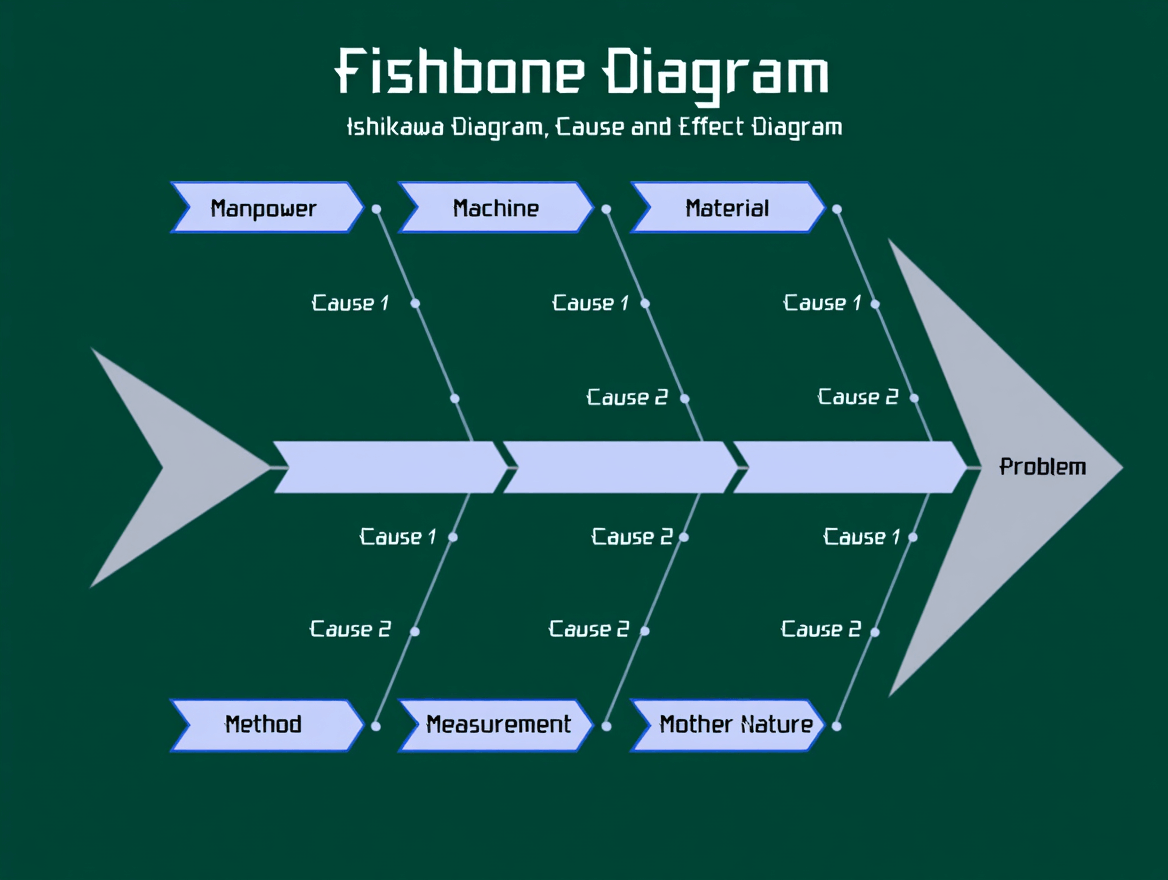
A Fishbone Diagram (also called Ishikawa Diagram or Cause-and-Effect Diagram) is a visual tool used to systematically identify and organize all possible causes of a specific problem or effect. It was developed by Dr. Kaoru Ishikawa in the 1960s.

The diagram looks like a fish skeleton:

  • The “head” of the fish is the problem/effect you want to solve.
  • The “bones” branching off the spine are the major categories of causes.
  • Smaller bones branching off are the specific causes within each category.

Why use it?

  • Forces teams to think through all possible causes (not just the obvious ones)
  • Prevents jumping to conclusions
  • Encourages cross-functional collaboration
  • Very useful in root cause analysis (RCA), quality improvement, Six Sigma, Lean, etc.

How to Create and Use a Fishbone Diagram (Step-by-Step)

  1. Define the problem clearly
    Write it in a box on the right (the “head”). Be specific.
    Example: “Customer complaints about late deliveries increased by 40% in Q3”
  2. Draw the main spine
    A horizontal arrow pointing to the problem.
  3. Identify major cause categories (the big bones)
    Common categories (the 6 Ms for manufacturing, or adapt to your industry):

    • Man (People)
    • Method (Processes)
    • Machine (Equipment/Technology)
    • Material
    • Measurement
    • Mother Nature (Environment)

    For service/industry, people often use:

    • People, Policies, Procedures, Plant/Technology, etc.
  4. Brainstorm all possible causes
    Ask “Why does this happen?” repeatedly (5 Whys technique helps).
    Write each cause as a branch off the relevant category.
  5. Go deeper
    For each cause, ask “Why?” again and add sub-causes (smaller bones).
  6. Analyze and prioritize
    Circle the most likely root causes (use voting, data, Pareto, etc.).
  7. Develop action plan
    Address the confirmed root causes.

Practical Case Study: Restaurant Getting Complaints About Cold Food

Problem (Head of the fish):
“Customers frequently complain that food arrives cold” (complaints rose from 3 to 18 per week)

Fishbone Diagram Categories Used:
We used 6 categories suitable for a restaurant:

  1. People (Staff)
    • Servers forget to check food temperature before leaving kitchen
    • New staff not trained on urgency
    • Kitchen and serving staff not communicating
    • Too few servers during peak hours → delay
  2. Processes (Methods)
    • No standard procedure for checking food temperature
    • Food waits too long on the pass before being served
    • Tickets not prioritized correctly during rush
    • No “food ready” notification system between kitchen and floor
  3. Equipment (Machines)
    • Heat lamps broken or insufficient
    • Plates not pre-heated
    • Delivery trays too small → food stacked and cools faster
    • Old warming drawers not maintaining temperature
  4. Materials
    • Some dishes (e.g., pasta) cool faster than others
    • Large portion sizes take longer to eat → perceived as cold
  5. Environment (Mother Nature/Place)
    • Dining room AC set too low near some tables
    • Long walking distance from kitchen to farthest tables
    • Draft from entrance door
  6. Measurement (or Management)
    • No tracking of time from “food ready” to “delivered to table”
    • No temperature checks logged
    • No customer feedback analyzed by dish/table location

Root Causes Identified After Investigation (circled on the diagram):

  • Heat lamps were broken for 3 weeks (maintenance backlog)
  • No policy to pre-heat plates
  • Average time from kitchen to table was 4.5 minutes during peak (target should be <2 min)
  • Servers overloaded: 1 server handling 9 tables instead of max 6

Actions Taken:

  1. Repaired/replaced heat lamps same week
  2. Implemented plate pre-heating in salamander broiler
  3. Added a runner position during peak hours
  4. Created a simple checklist: food temperature >60°C before leaving pass
  5. Installed digital ticket system with timers

Result:
Cold food complaints dropped from 18 to 2 per week within one month.

What is a Fishbone Diagram, how is it used? Read More »