Validation

Process Validation: Ensuring Consistency and Compliance

Dr. Emily Davis

Senior Validation and Quality Assurance Consultant

Charlotte, North Carolina


Introduction

When a patient takes a medicine, they rely on an unspoken promise: this tablet or injection is the same as the one that was tested, studied, and approved. Keeping that promise across thousands of batches, years of production, and changes in people, materials, and equipment is one of the central challenges of pharmaceutical manufacturing.

Process validation is the discipline that meets this challenge. It provides documented evidence, supported by scientific data, that a process consistently produces a product meeting its predetermined specifications and quality attributes. It is both a regulatory requirement and a practical tool for preventing failures, reducing waste, and understanding how a process really behaves.

This article explains what process validation is, how the lifecycle approach works, how to plan and execute validation, and how to avoid common pitfalls.


1. What Is Process Validation?

The US FDA defines process validation as the collection and evaluation of data, from the process design stage through commercial production, which establishes scientific evidence that a process is capable of consistently delivering quality product. The EU definition is similar: documented evidence that the process, operated within established parameters, can perform effectively and reproducibly to produce a medicinal product meeting its predetermined specifications and quality attributes.

Three ideas are central to these definitions:

  • Documented evidence. Claims of quality must be supported by records and data.
  • Consistency. One good batch proves little. Validation must show that success is repeatable.
  • Scientific basis. Decisions should rest on process understanding, not on tradition or a fixed number of batches.

Validation is not a paperwork exercise performed once before launch. It is a continuing demonstration that the process remains in a state of control.


2. Why Process Validation Matters

Protecting Patients

Finished product testing samples only a small fraction of a batch and cannot guarantee that every unit meets requirements. If a process is poorly understood or uncontrolled, defects can exist in untested units. Validation shifts the focus from testing quality in to building quality in.

Meeting Regulatory Expectations

Regulators require validated processes. Failure to validate, or inadequate validation, is a common inspection finding and can lead to warning letters, import alerts, delayed approvals, and recalls. Under US regulations, drug products are considered adulterated if the manufacturing processes do not conform to current good manufacturing practice.

Reducing Cost and Risk

Well-validated processes have fewer failed batches, less rework, fewer investigations, and more predictable yields. The investment in understanding a process early pays back through stable operations later.

Supporting Continuous Improvement

The data generated through validation reveals variability and opportunities for improvement, which feeds into better process control over a product’s life.


3. The Evolution: From Three Batches to Lifecycle Thinking

For many years, the industry treated validation as a one-time event, typically three consecutive successful batches at commercial scale. This “three-batch” approach became a habit but was never a scientific requirement. It gave no assurance that the process was well understood, and it encouraged a mindset of passing the test rather than learning about the process.

The FDA’s 2011 guidance, Process Validation: General Principles and Practices, changed this by describing a lifecycle approach linked to product and process development. The EU adopted a comparable approach in Annex 15, and ICH guidelines Q8, Q9, Q10, and Q11 provide supporting concepts. The lifecycle model has three stages:

  1. Stage 1: Process Design
  2. Stage 2: Process Qualification
  3. Stage 3: Continued Process Verification

Each stage builds on the one before it, and together they create a continuous chain of evidence from development to the end of a product’s commercial life.


4. Stage 1: Process Design

The goal of Stage 1 is to define the commercial manufacturing process based on knowledge gained through development and scale-up.

Building Process Understanding

Developers study how material attributes and process parameters affect product quality. Central concepts from Quality by Design (ICH Q8) include:

  • Quality Target Product Profile (QTPP): the intended characteristics of the product, including dosage form, strength, release profile, and quality criteria.
  • Critical Quality Attributes (CQAs): physical, chemical, biological, or microbiological properties that must be within limits to ensure product quality, such as assay, dissolution, content uniformity, impurities, and sterility.
  • Critical Material Attributes (CMAs): properties of inputs, such as API particle size or excipient moisture, that affect CQAs.
  • Critical Process Parameters (CPPs): process variables, such as mixing time, compression force, or sterilization temperature, whose variability affects CQAs and therefore must be monitored or controlled.

Using Risk Assessment and Experimentation

Quality risk management (ICH Q9) tools such as FMEA, fishbone diagrams, and risk ranking help identify which attributes and parameters are most likely to affect quality. Design of Experiments (DoE) then tests multiple factors and their interactions efficiently, revealing which variables matter and establishing acceptable operating ranges. The result may be a design space, a multidimensional region within which quality is assured.

Establishing a Control Strategy

The control strategy describes the planned set of controls, derived from product and process understanding, that ensures process performance and product quality. It can include controls on material attributes, process parameters, in-process checks, equipment and facility conditions, finished product specifications, and the frequency of monitoring.

Outputs of Stage 1

By the end of this stage, the manufacturer should have a documented process description, identified CQAs, CMAs, and CPPs, a risk assessment, a preliminary control strategy, and the data to justify them. A weak Stage 1 makes later stages difficult and expensive.


5. Stage 2: Process Qualification

Stage 2 confirms that the process design is capable of reproducible commercial manufacturing. It has two elements.

Design and Qualification of Facilities, Utilities, and Equipment

Before process performance can be evaluated, the supporting infrastructure must be qualified:

  • Design Qualification (DQ): confirms the design meets requirements.
  • Installation Qualification (IQ): verifies correct installation.
  • Operational Qualification (OQ): confirms equipment operates as intended across its operating ranges.
  • Performance Qualification (PQ) of equipment and utilities: shows stable performance under realistic conditions.

Utilities such as purified water, compressed air, steam, and HVAC systems must be qualified, along with calibrated instruments and validated computerized systems.

Process Performance Qualification (PPQ)

PPQ is the stage that most people mean when they say “process validation.” It combines the qualified facilities, trained personnel, and commercial manufacturing process, using commercial raw materials and commercial-scale equipment, to demonstrate that the process performs as expected.

Protocol. A written, pre-approved PPQ protocol defines:

  • The manufacturing conditions, parameters, and material specifications.
  • The number of batches and the scientific rationale for that number.
  • Sampling plans, including locations, frequency, and sample sizes.
  • Tests to be performed and acceptance criteria.
  • Statistical methods used to evaluate results.
  • Criteria for what constitutes success and what happens if the criteria are not met.

Number of batches. Current guidance does not specify a fixed number. The number should be justified by the level of process understanding, the variability observed, product complexity, and risk. Many companies still run three PPQ batches, but the decision should rest on scientific rationale and statistical confidence, not habit.

Enhanced sampling and monitoring. PPQ typically involves more extensive sampling than routine production, including sampling to demonstrate intra-batch and inter-batch consistency. For example, a blend uniformity study might sample multiple locations in a blender, and a tablet compression run may be sampled at the beginning, middle, and end.

Execution and report. Batches are executed per the protocol, deviations are documented and investigated, and a final report summarizes data, evaluates results against acceptance criteria, and concludes whether the process is validated. Quality unit approval is required before commercial distribution, although in some cases distribution may occur once the manufacturer has high confidence based on earlier data and regulators’ expectations are met.

Outputs of Stage 2

A successful PPQ shows that the process is reproducible, that the control strategy is effective, and that the commercial process is ready for routine production with ongoing monitoring.


6. Stage 3: Continued Process Verification (CPV)

Validation does not end with PPQ. Processes drift over time because of changes in raw material lots, equipment wear, seasonal variation, operator changes, and minor modifications. Continued Process Verification provides ongoing assurance that the process remains in a state of control during routine manufacturing.

Elements of an Effective CPV Program

  • Data collection. Process parameters, in-process results, finished product test results, and material attributes are collected systematically.
  • Statistical analysis. Control charts, capability indices (Cp, Cpk, Ppk), trend analysis, and other statistical process control (SPC) tools detect shifts, trends, and unusual variation.
  • Defined triggers. Rules for out-of-trend results, control limit violations, and shifts prompt investigation.
  • Review frequency. Data is reviewed at defined intervals by cross-functional teams, and results feed into the annual product quality review.
  • Action and feedback. Findings lead to investigations, corrective actions, or process improvements, and significant changes are handled through change control.

Process Capability

Capability indices quantify how well a process fits within its specification limits. A process with a high Cpk has room to absorb normal variation, while a low Cpk signals that defects become likely. Tracking capability over time shows whether the process is improving, stable, or degrading.

Value of CPV

CPV detects problems before they lead to batch failures, provides data for justifying process changes, and supports regulatory confidence. For well-controlled processes, it can justify reduced testing or real-time release approaches.


7. Validation Approaches

Different situations call for different validation strategies.

Prospective Validation

Validation conducted before commercial distribution of a product. This is the preferred and most common approach for new products and processes.

Concurrent Validation

Validation carried out during routine production, with batches released based on ongoing data. It is used only in exceptional circumstances, such as a product with a critical medical need or very low-volume production, and requires strong justification and documentation.

Retrospective Validation

Based on the analysis of historical data for processes already in commercial use. Regulators view it as no longer acceptable for new products, and it is largely replaced by CPV for legacy products, although historical data still supports lifecycle assessments.

Revalidation

Repeating validation activities when changes occur or when monitoring shows the process is no longer in control. Triggers include changes in equipment, site, batch size, critical materials, or process parameters, as well as adverse trends.


8. Related Validation Activities

Process validation depends on several supporting validation and qualification activities.

Cleaning Validation

Cleaning validation shows that cleaning procedures consistently remove product residues, cleaning agents, and microbial contamination to acceptable levels, preventing cross-contamination between batches and products. Acceptance limits are increasingly derived from health-based exposure limits, such as permitted daily exposure (PDE), rather than arbitrary limits. Worst-case product selection, swab and rinse sampling, and validated analytical methods are standard components.

Analytical Method Validation

Test methods must be accurate, precise, specific, linear, and robust. ICH Q2 describes the validation characteristics, and ICH Q14 adds guidance on analytical procedure development. Without reliable methods, process validation data is meaningless.

Computerized System Validation

Systems that control processes or generate GMP data, such as manufacturing execution systems and laboratory software, must be validated to ensure correct functioning and data integrity.

Aseptic Process Validation

For sterile products, media fills (process simulations) demonstrate that aseptic processing can maintain sterility. Sterilization processes such as steam sterilization and filtration are validated separately, including filter integrity and bacterial retention studies.

Shipping and Transport Validation

For temperature-sensitive products, validation confirms that packaging and distribution conditions preserve product quality.


9. Statistical Tools in Validation

Statistics give validation its rigor. Key tools include:

  • Descriptive statistics: mean, standard deviation, and relative standard deviation to summarize data.
  • Control charts: plots showing variation over time against control limits, helping distinguish normal variation from special causes.
  • Process capability analysis: Cp, Cpk, Pp, and Ppk, which compare process spread to specification limits.
  • Confidence intervals and tolerance intervals: quantify uncertainty and support sampling plan decisions.
  • Acceptance sampling and sampling plans: ensure that sample sizes provide adequate confidence in batch quality.
  • ANOVA and regression analysis: identify significant sources of variation, such as differences between batches or within a batch.
  • Design of Experiments: supports process characterization and determination of robust operating ranges.

Applying statistics well requires understanding the data’s distribution, independence, and measurement variability. Using statistics incorrectly can create false confidence, so input from trained statisticians is valuable.


10. Planning and Documenting a Validation Program

A structured, well-documented approach makes validation efficient and inspection-ready.

Validation Master Plan (VMP)

The VMP is a high-level document describing the company’s validation philosophy, scope, organization, responsibilities, documentation formats, and approach to qualification and validation. It gives inspectors and staff a clear view of how validation is managed.

Key Documents

  • Validation protocols: pre-approved plans stating objectives, methods, acceptance criteria, and responsibilities.
  • Raw data and batch records: complete, contemporaneous, and attributable.
  • Deviation and investigation records: showing how unexpected events were handled.
  • Validation reports: summarizing results, discussing deviations, and concluding on the validated state.
  • Traceability matrices: linking requirements to tests and results.

Roles and Responsibilities

Successful validation is cross-functional. Development provides process knowledge, manufacturing executes the batches, quality control performs testing, engineering supports equipment and utilities, statisticians assist with analysis, and quality assurance reviews and approves documents and ensures compliance.


11. Change Control and Maintaining the Validated State

A process that was validated once can lose that status through uncontrolled change. A robust change control system is essential to maintaining the validated state.

Effective change control involves:

  • Formal proposal and evaluation of every change to materials, equipment, methods, process parameters, facilities, or software.
  • Risk assessment to determine impact on product quality and whether revalidation or additional studies are needed.
  • Regulatory assessment to determine whether regulators must be notified or approve the change before implementation.
  • Quality approval before implementation.
  • Post-implementation verification to confirm the change achieved its purpose without unintended effects.

Periodic review of the validation status, combined with CPV, provides assurance that the process remains suitable.


12. Data Integrity in Validation

Validation results are only as reliable as the data behind them. Regulators expect validation data to comply with ALCOA+ principles: Attributable, Legible, Contemporaneous, Original, and Accurate, plus Complete, Consistent, Enduring, and Available.

Good practices include:

  • Using validated systems with audit trails and access controls.
  • Recording data at the time of activity.
  • Avoiding selective reporting, repeated testing without justification, or exclusion of inconvenient data.
  • Reviewing raw data and audit trails as part of validation report approval.
  • Investigating all deviations and unexpected results thoroughly.

Falsified or manipulated validation data has been the basis for many serious enforcement actions.


13. Common Challenges and Pitfalls

Even experienced organizations can struggle with process validation. Frequent problems include:

  • Treating validation as a one-time event. Skipping CPV or ignoring change control erodes the validated state.
  • Weak process understanding. Rushing through Stage 1 leads to surprises in Stage 2 or commercial production.
  • Poorly defined acceptance criteria. Vague or overly loose criteria make validation meaningless, while unrealistic criteria cause unnecessary failures.
  • Inadequate sampling plans. Sampling that does not represent the batch may hide variability.
  • Ignoring variability. Focusing on averages instead of variation can mask risk.
  • Failing to justify batch numbers. Choosing a number without rationale is a common inspection finding.
  • Incomplete deviation handling. Failed PPQ batches must be investigated, not ignored or repeated until they pass.
  • Weak technology transfer. Incomplete knowledge transfer from development to manufacturing leads to scale-up issues.
  • Documentation gaps. Missing signatures, unapproved protocols, or changes made without documentation undermine credibility.
  • Over-reliance on paper. Reports that look complete but are not supported by real process understanding fail in practice.

Addressing these issues requires leadership support, cross-functional collaboration, and a culture that values learning from data rather than merely achieving a passing result.


14. Emerging Trends

Continuous Manufacturing

Continuous processes change how validation is approached. Rather than discrete batches, validation focuses on demonstrating control over extended runs, including start-up, steady state, and shutdown, with real-time monitoring and control.

Process Analytical Technology (PAT)

In-line and at-line sensors allow real-time measurement of critical attributes. This supports real-time release testing and more dynamic process control, and it provides rich data for validation and CPV.

Digital Validation and Data Analytics

Electronic validation management systems, digital twins, and machine learning tools are increasingly used to manage validation documents, monitor trends, and predict process behavior. They improve efficiency but must themselves be validated and compliant with data integrity expectations.

Advanced Therapies

Cell and gene therapies challenge traditional validation concepts because of small batch sizes, variable starting materials, and short shelf lives. Validation strategies in this area emphasize comparability, robust control strategies, and process understanding.

Risk-Based and Knowledge-Driven Approaches

Regulators continue to encourage reliance on scientific knowledge, risk management, and data rather than fixed rules, rewarding organizations that can justify their approach with evidence.


15. Practical Tips for Success

  1. Start early. Build validation thinking into development, not after it.
  2. Understand your process. Invest in risk assessments, DoE, and characterization studies.
  3. Write clear protocols. Define objectives, acceptance criteria, and sampling plans before execution.
  4. Justify decisions. Explain why you chose a particular batch number, sampling plan, or acceptance limit.
  5. Involve the right people. Include manufacturing, QC, engineering, statistics, and QA from the start.
  6. Investigate everything. Treat deviations as information about the process, not obstacles to close.
  7. Keep monitoring. Make CPV a living program with actionable metrics.
  8. Control change. Assess and document every change, however small it seems.
  9. Protect data integrity. Ensure data is trustworthy, traceable, and complete.
  10. Stay current. Regulatory expectations evolve, so monitor updates to guidelines and industry practice.

Conclusion

Process validation is fundamentally about confidence: confidence that every batch of medicine will be as safe and effective as the last one. The lifecycle approach, which links process design, process qualification, and continued process verification, turns validation from a one-time hurdle into an ongoing source of knowledge and control.

Organizations that approach validation as an opportunity to understand their processes, rather than simply to satisfy an inspector, gain tangible benefits: fewer failures, more predictable operations, faster problem-solving, and stronger regulatory relationships. As manufacturing technology advances with continuous processing, real-time monitoring, and digital tools, the core principles remain constant: understand the process, control it, verify it continually, and use data honestly.

Ultimately, validation serves the patient. When it is done well, it ensures that consistency is not an accident but a designed, demonstrated, and maintained property of the process.


Guideline References

  1. US FDA (2011) – Guidance for Industry: Process Validation: General Principles and Practices.
  2. European Commission, EudraLex Volume 4, Annex 15 – Qualification and Validation.
  3. EMA (2016) – Guideline on Process Validation for Finished Products: Information and Data to be Provided in Regulatory Submissions.
  4. ICH Q8 (R2) – Pharmaceutical Development.
  5. ICH Q9 (R1) – Quality Risk Management.
  6. ICH Q10 – Pharmaceutical Quality System.
  7. ICH Q11 – Development and Manufacture of Drug Substances.
  8. ICH Q2 (R2) and Q14 – Validation of Analytical Procedures and Analytical Procedure Development.
  9. ICH Q7 – Good Manufacturing Practice Guide for Active Pharmaceutical Ingredients.
  10. US FDA, 21 CFR Part 211 – Current Good Manufacturing Practice for Finished Pharmaceuticals.
  11. US FDA, 21 CFR Part 210 – Current Good Manufacturing Practice in Manufacturing, Processing, Packing, or Holding of Drugs: General.
  12. WHO Technical Report Series No. 992, Annex 3 – WHO Good Manufacturing Practices: Validation.
  13. PIC/S PI 006 – Recommendation on Validation Master Plan, Installation and Operational Qualification, Non-Sterile Process Validation, Cleaning Validation.
  14. PIC/S PI 041 – Good Practices for Data Management and Data Integrity in Regulated GMP/GDP Environments.
  15. ISPE GAMP 5 (Second Edition) – A Risk-Based Approach to Compliant GxP Computerized Systems.
  16. ISPE Baseline Guide, Volume 5 – Commissioning and Qualification.

Process Validation: Ensuring Consistency and Compliance Read More »
Analytical Method Validation: A Step-by-Step Approach

Muhammad Raheel

Sr. Manager Validation Abbott, Pakistan


Introduction

Every pharmaceutical product is judged by the results of analytical tests. Assay, related substances, dissolution, content uniformity, and identification tests decide whether a batch is released, whether a stability study supports a shelf life, and whether a generic product is equivalent to its reference. If the method behind a result is not reliable, the result is not reliable either.

Analytical method validation is the process of demonstrating, through documented laboratory studies, that a method is suitable for its intended purpose. It is a regulatory expectation under GMP, and it is also good science. A validated method protects patients, protects the company from costly out-of-specification investigations, and gives analysts confidence in what they report.

This article walks through validation step by step, from defining the purpose of the method to maintaining it over its lifecycle, and explains what each validation parameter means and how it is tested in practice.


What Is Analytical Method Validation?

Validation answers one question: is this method fit for its intended use? The answer is never “yes” or “no” in the abstract. It depends on what the method is for. A method to quantify the active ingredient in a tablet needs different performance characteristics than a method to detect a trace impurity at 0.05%.

Three related terms are often confused:

  • Method development is where the procedure is designed and optimised: choosing the column, mobile phase, wavelength, sample preparation, and so on.
  • Method validation is the formal demonstration that the finished method meets predefined criteria.
  • Method verification applies to a compendial or already validated method used for the first time in a new laboratory. The lab confirms that the method performs as expected under its own conditions, without repeating the whole validation.

A fourth term, method transfer, describes the documented process of qualifying a receiving laboratory to use a validated method from another site.

Modern guidance, especially ICH Q14 and the revised ICH Q2(R2), treats these as connected stages of one analytical procedure lifecycle, not isolated events. Validation is a key milestone, but it is not the end of the story.


When Is Validation Required?

Validation is expected for methods used to release and monitor drug substances and drug products. It is typically required:

  • Before a new method is used for routine GMP testing
  • When a method is changed beyond its approved range, for example a new column type, a different detection principle, or a change in the sample matrix
  • When the product formulation or manufacturing process changes in a way that could affect the method
  • When a compendial method is used outside its stated scope

Which parameters you validate depends on the type of method. ICH categorises analytical procedures broadly as:

  1. Identification tests
  2. Quantitative tests for impurities
  3. Limit tests for impurities
  4. Assay, including dissolution (measurement only) and content or potency

An identification test needs mainly specificity. An assay needs accuracy, precision, linearity, range, and specificity. A quantitative impurity method needs all of these plus a limit of quantitation.


Step 1: Define the Purpose and Performance Requirements

Validation starts before any experiment. The first step is to write down clearly what the method must achieve. ICH Q14 calls this the Analytical Target Profile (ATP): a statement of what is to be measured, over what range, and with what required quality of result.

A simple ATP might read: “Quantify drug X in 250 mg tablets over 80–120% of the label claim, with accuracy within ±2% and precision of not more than 2% RSD, in the presence of excipients and known degradation products.”

Defining this up front has two benefits. It guides method development toward the right design, and it gives you objective acceptance criteria, so you are not deciding after the fact whether the data “look good enough.”

Questions to settle at this stage:

  • What is the analyte, and in what matrix?
  • What concentration range must be covered?
  • Is the method for release, stability, cleaning verification, or in-process control?
  • What are the specification limits, and how tight must the method be to make sound decisions against them?

Step 2: Develop and Optimise the Method

A method that is poorly developed will struggle in validation. Good development includes understanding how the method behaves before you commit to formal studies. This usually means:

  • Selecting the technique (HPLC, GC, UV, dissolution, titration, and so on) on the basis of the analyte’s properties
  • Optimising chromatographic conditions, sample preparation, and detection
  • Running forced degradation (stress) studies to generate degradants and confirm the method can separate them from the main peak
  • Evaluating the robustness of key parameters early, for example pH, column temperature, and flow rate, using structured experiments (design of experiments) where appropriate
  • Defining system suitability criteria that will confirm the system works correctly on each day of analysis

Documenting the development work matters. Inspectors often ask how the final conditions were chosen, and a well-written development report is the best answer. It also supports later changes within an established range.


Step 3: Conduct a Risk Assessment

Before writing the protocol, consider which parts of the method are most likely to affect the result. A simple risk assessment, using a fishbone diagram or an FMEA, can identify critical variables such as sample preparation, extraction time, filter type, standard stability, or column batch.

Risk assessment helps in two ways. It shows which robustness factors deserve testing, and it helps define appropriate controls in the final method. The depth of validation should reflect the risk: a stability-indicating impurity method for a potent drug deserves more rigor than a simple identification test.


Step 4: Write the Validation Protocol

A validation protocol is an approved document, written and signed before experiments begin. It is the plan against which results will be judged. A good protocol includes:

  • Title, objective, and scope, and the method being validated
  • The analytical procedure, with reference to the approved version
  • The responsibilities of the people involved
  • Materials: reference standards (with purity and potency), reagents, samples, and placebo
  • Instruments and equipment, with confirmation they are qualified and calibrated
  • The validation parameters to be tested, the design of each experiment, and the predefined acceptance criteria
  • How deviations will be handled
  • How results will be calculated and reported, including any statistical tools

Setting acceptance criteria before you see the data is essential. Criteria written afterwards, to fit the results, are a serious data integrity concern. If a criterion must change, it should be done through a documented protocol amendment with justification.


Step 5: Confirm Equipment Readiness and System Suitability

Before generating validation data, confirm that all instruments are qualified and calibrated, that analysts are trained, and that reference standards and reagents are in date. Validation data generated on uncontrolled equipment has no value.

System suitability testing (SST) is performed at the start of each analytical run, including every validation experiment, to confirm the whole system works on that day. Typical SST parameters for HPLC include:

  • Resolution between critical peaks, often ≥ 2.0
  • Tailing factor, often ≤ 2.0
  • Theoretical plates (column efficiency)
  • Repeatability of replicate standard injections, often RSD ≤ 2.0% for assay

SST is not a substitute for validation, but it proves that the validated conditions are working when the method is used.


Step 6: Execute the Validation Parameters

This is the core of validation. The following parameters are defined in ICH Q2 and widely followed by regulators, including the USP and WHO. Not every parameter applies to every method, and the protocol should state which are included and why.

6.1 Specificity (Selectivity)

Specificity is the ability to measure the analyte unequivocally in the presence of other components that may be present: impurities, degradation products, excipients, and matrix.

How it is tested:

  • Inject blank, placebo, standard, and sample, and show no interference at the analyte’s retention time
  • Spike the sample with known impurities and degradants and show adequate resolution
  • For stability-indicating methods, analyse stressed samples (acid, base, oxidation, heat, light) and demonstrate peak purity using a photodiode array or mass spectrometry detector
  • Check that the analyte peak is pure and that mass balance is reasonable

If a method is not specific, none of the other parameters mean much, so this is usually evaluated first.

6.2 Linearity and Range

Linearity is the ability to obtain results that are directly proportional to the analyte concentration. The range is the interval between the lowest and highest concentration for which the method has suitable accuracy, precision, and linearity.

How it is tested:

  • Prepare at least five concentration levels across the intended range
  • Plot response against concentration and calculate the regression line: slope, intercept, and correlation coefficient (r or R²)
  • Examine the residual plot, not just the correlation coefficient, since a high r can hide curvature

Typical ranges, which should be justified for the specific method:

  • Assay of drug substance or product: 80–120% of the test concentration
  • Content uniformity: 70–130% of the test concentration
  • Dissolution: ±20% over the specified range of the profile
  • Impurities: from the reporting level to 120% of the specification limit

A common acceptance criterion for linearity is r ≥ 0.999 for assay, with y-intercept not significantly different from zero. Criteria should match the method’s purpose.

6.3 Accuracy

Accuracy is the closeness of the measured value to the true value, or to an accepted reference value.

How it is tested:

  • For drug products, spike placebo with known amounts of the active ingredient at three levels (for example 80%, 100%, and 120%), with three replicates at each level, for at least nine determinations
  • For impurities, spike the sample with known amounts of the impurity across the range
  • Calculate the percentage recovery and its confidence interval

For an assay, recovery within 98.0–102.0% is a common expectation. For impurities at low levels, wider limits are acceptable and should be justified. Where a placebo cannot be prepared, comparison with a second well-characterised method may be used.

6.4 Precision

Precision is the closeness of agreement among a series of measurements from the same homogeneous sample. It has three levels:

  • Repeatability (intra-assay precision): same analyst, same instrument, same day. Usually six determinations at 100% of the test concentration, or nine determinations across the range.
  • Intermediate precision: variation within a laboratory, such as different days, analysts, and instruments. This shows the method stays consistent in normal routine use.
  • Reproducibility: precision between laboratories, typically assessed during method transfer or collaborative studies.

Results are expressed as relative standard deviation (% RSD). For drug product assay, an RSD of not more than 2.0% is a common benchmark, while impurity methods at low levels may allow higher variability.

6.5 Detection Limit (LOD) and Quantitation Limit (LOQ)

The limit of detection is the lowest amount of analyte that can be detected but not necessarily quantified. The limit of quantitation is the lowest amount that can be measured with acceptable accuracy and precision.

These apply mainly to impurity and trace-level methods. Common approaches include:

  • Signal-to-noise ratio: typically about 3:1 for LOD and 10:1 for LOQ
  • Standard deviation of the response and the slope: LOD = 3.3σ/S and LOQ = 10σ/S

Whichever approach is used, confirm the LOQ experimentally by analysing samples at that concentration and showing acceptable accuracy and precision. The LOQ must also sit at or below the reporting threshold for the impurity.

6.6 Robustness

Robustness measures the method’s capacity to remain unaffected by small, deliberate variations in method parameters. It gives an indication of reliability during normal use.

Examples for HPLC: mobile phase pH (±0.2 units), organic composition (±2%), flow rate (±10%), column temperature (±5 °C), detection wavelength (±2 nm), and different column lots or brands.

Robustness is best studied during development, but it should be documented in the validation package. The results support setting meaningful SST limits and define which parameters the analyst must control carefully.

6.7 Solution Stability

A parameter that is easy to forget but often causes problems in routine testing is the stability of standard and sample solutions. Test solutions at intervals, such as 0, 12, 24, and 48 hours, under defined storage conditions, and confirm the results stay within an acceptable range of the initial value. This determines how long prepared solutions can safely be held, and it prevents invalid results caused by degradation on the autosampler.


Step 7: Evaluate Data and Apply Acceptance Criteria

When experiments are complete, compare every result against the criteria in the protocol. Good practice includes:

  • Using validated calculations or software, and validated, locked spreadsheets where used
  • Reviewing raw data and audit trails, not just summary tables
  • Reporting all results, including any invalid runs, with justification
  • Investigating any failure or unexpected result through a documented deviation

If a criterion is not met, the method may need to be modified and revalidated, or the criterion may need scientific re-evaluation through a formal amendment. Repeating experiments until a pass is obtained, without explanation, is unacceptable and is a classic data integrity failure.


Step 8: Write the Validation Report

The validation report summarises the work and concludes whether the method is suitable for its intended use. It should include:

  • Reference to the protocol and the method version
  • A summary of each parameter, with the results, acceptance criteria, and conclusion
  • Representative chromatograms, spectra, and calibration plots
  • Any deviations, and how they were resolved
  • The final validated conditions, SST criteria, and the validated range
  • Approval signatures from the analyst, reviewer, and quality assurance

A clear, accurate report is the document inspectors will review first. The raw data, notebooks, and electronic records must be retained and readily available to support every number in the report.


Step 9: Implement the Method under Change Control

Once validated and approved, the method is released for use through the quality system. Analysts are trained, the method becomes an effective controlled document, and any future change follows change control. Even a small change, such as a new column supplier or modified diluent, should be assessed to decide whether it needs partial or full revalidation.

For products that are filed with regulatory authorities, changes to the registered method may also need notification or approval.


Step 10: Manage the Method over Its Lifecycle

Validation is not a one-off. Over time, instruments age, reagents change, and products evolve. A good lifecycle approach includes:

  • Ongoing performance monitoring: trending SST results, control sample results, and out-of-specification or out-of-trend investigations that point to method weakness
  • Method transfer to other sites or laboratories, with a pre-approved protocol and comparative testing
  • Verification of compendial methods in the user’s laboratory
  • Revalidation when changes occur, or periodically where warranted by risk

ICH Q14 introduces the idea of an established condition and a structured approach to post-approval changes, which can make managing change more predictable when well-developed knowledge is documented.


Common Pitfalls in Method Validation

Even experienced laboratories encounter recurring problems:

  • Starting validation before development is complete. A method that keeps changing during validation wastes effort and creates confusion.
  • Vague acceptance criteria, or criteria defined after data are generated.
  • Inadequate specificity studies, particularly missing forced degradation or peak purity for stability-indicating methods.
  • Using the correlation coefficient alone to judge linearity.
  • Ignoring solution stability, which later leads to unexplained variability in routine testing.
  • Poorly characterised reference standards or expired materials.
  • Unvalidated spreadsheets or uncontrolled processing of chromatographic data, including undocumented manual integration.
  • Weak documentation, such as unsigned protocols, missing raw data, or inconsistent records.
  • Treating validation as a paperwork exercise rather than understanding what the method can and cannot do.

Most of these can be avoided by planning carefully, involving experienced reviewers early, and applying data integrity principles throughout.


Practical Tips for a Smooth Validation

  1. Invest time in development. An hour of optimisation often saves days of failed validation.
  2. Write the protocol with the end in mind. Think about how each experiment will be executed and calculated, and let another analyst review the plan.
  3. Use a single, well-characterised batch of reference standard and samples where possible, to avoid unnecessary variability.
  4. Randomise and organise the run sequence so that days, analysts, and instruments are documented clearly for intermediate precision.
  5. Record everything contemporaneously, and retain all raw data, including failed runs.
  6. Review as you go. Checking results after each parameter allows issues to be fixed early, through documented deviations and not last-minute surprises.
  7. Keep the method simple enough to be routine. A method that only works in the hands of its developer is not a validated method in any practical sense.

Conclusion

Analytical method validation is the foundation for trustworthy pharmaceutical data. By following a structured approach, defining the purpose, developing a sound method, assessing risk, writing a protocol with predefined criteria, testing each relevant parameter, evaluating results honestly, reporting clearly, and managing the method through its lifecycle, laboratories can be confident that their results are accurate, reproducible, and defensible.

The regulatory landscape continues to evolve, with ICH Q2(R2) and Q14 placing more emphasis on scientific understanding, risk-based decisions, and lifecycle management. The underlying goal is unchanged: to show that a method does what it is meant to do, every time it is used. A well-validated method is an investment that pays back through fewer investigations, smoother inspections, and, most importantly, reliable assurance of medicine quality for patients.


Guideline References

  1. ICH. Q2(R2): Validation of Analytical Procedures. International Council for Harmonisation, adopted November 2023.
  2. ICH. Q14: Analytical Procedure Development. International Council for Harmonisation, adopted November 2023.
  3. ICH. Q2(R1): Validation of Analytical Procedures: Text and Methodology. November 2005 (superseded by Q2(R2) as it is implemented).
  4. U.S. FDA. Analytical Procedures and Methods Validation for Drugs and Biologics: Guidance for Industry. July 2015.
  5. USP. General Chapter <1225> Validation of Compendial Procedures; <1226> Verification of Compendial Procedures; and <621> Chromatography. United States Pharmacopeia.
  6. WHO. Guidelines on Validation, Appendix 4: Analytical Method Validation. WHO Technical Report Series No. 1019, Annex 3, 2019.
  7. European Commission. EudraLex Volume 4, EU GMP Guidelines, Annex 15: Qualification and Validation.
  8. EMA. ICH Guideline Q2(R2) on Validation of Analytical Procedures: Scientific Guideline. European Medicines Agency.
  9. U.S. FDA. Data Integrity and Compliance With Drug CGMP: Questions and Answers. December 2018.

Analytical Method Validation: A Step-by-Step Approach Read More »

Validation Master Plan, How to write for a GMP compliance firm

Validation Master Plan[VMP] encompass all type of validation activates of a site especially for the new firm, the firm must be validated before run any routine commercial production. The validation activities which consider the major area as Facility, Utility, Machine, Process etc.. Facility, utility, and machine must be validated before run the production operation.

Validation procedure and Validation Master plan is not the same and doesn’t implies the same thing. Validation protocol describe the specific procedure to perform the specific activities where as Validation Master Plan is the series of plan/schedule which describe the plan with a tentative define timeline. Any plan/schedule may be change which to be cover by raising deviation management with proper justification and action to be triggered followed by CAPA.

Validation Master Plan is beneficial for planning purpose and subsequently identifying the related resources to complete the assigned activates on due time. It covers the all type of major documentation like procedures, processes, product, facilities, utilities and equipment.

How a Validation Master Plan works?

Validation master plan is the core guidance of the firm which implies that how the validation activates of the firm will perform within a time frame. It details the activities of the all functional department like production, quality control, Engineering will operate their activities regarding validation events.

The plan demonstrate by the Validation master plan is set upon the agreement of the all functional department and any type of failure is properly justified which satisfy the regulatory body. The proper implementation of the VMP of the respective firm denote that they have the proper control over their quality system.

Functions of the Validation Master Plan

Management learning

Top management of the company is not concern about the requirement of the qualification and validation activities of the respective firm. Here VMP plays the major role and provide the essential information to the company top management. The content of the VMP describe the total quality requirement events of the validation process. It also denote that only the properly validated facility can provide the repeated/continuous quality product through daily activities.

Project nursing and management

By preparing the Gantt chart from the content of the VMP, the management can track the activities of the new facility and set a tentative deadline for the competition of the defined activities. Everyone will be proactive when set a tentative deadline with proper justification through a site quality review meeting. Assigned personnel must be monitored for the progression of the events by daily /weekly /fortnightly/ monthly then VMP will be fully effective and action will cover on due date.

Conducting the validation program

Validation master plan describe the all events in the validation process and the qualification of the processing equipment’s and utilities. As the VMP provide the timeline for the completion of the defined activates base on the criticality. All related resource must be on site to conduct the validation activities and recheck/double/ triple check may be conduct before starting validation activities, for any shortcoming notify the same and after solving the events proceed to validation activities.

Planning purposes

As the VMP detect the list of resources which is required to perform the validation activities in a time line then the list of document may affect by this activity-

  • Equipment
  • Facilities
  • Product
  • Processes
  • Procedures
  • Utilities
Criteria of a Validation Master Plan

VMP require specific preparedness and vigorous planning of different steps in the particular process. All type of activates need to perform in due time as per approved working plan avoiding any type of major/critical deviations. Beside this a VMP is generally written off as-

Multidisciplinary methodology:

This is not the one man job, its require multidepartment involvement, various type of SME [Subject Matter Expert] from various department are involve to perform the specific job. Expert such as chemical analysts, pharmacists, microbiologists, technologists, engineers, metrologists, and SME from QA departments must involve to this activities.

Time bound:
Any type of validation

Generally validation work is submitted to rigorous time schedules. These studies are always the last stage prior to taking new processes, facilities into routine operation.

Costing matters:

To run a successful validation activities to the site, huge resources and expert personnel are involve so that no deviation occur on the site. Lot of financial involvement require to perform the designated activities. A new machine/equipment may be involve to solve the emergency issue.

List of critical point of Standard VMP

All VMPs must include the following:

Title page with Authorization where appropriate signing with date will be present. Title page must be include title of the document, document number and version no. and Signature from the appropriate body including Head of site quality. List content to be present on a VMP-

  • Table of contents
  • Abbreviations and glossary
  • Validation plan
  • Purpose and approach to validation
  • Scope of validation
  • Roles and responsibilities
  • Outsourced services
  • Deviation management in validation
  • Change control in validation
  • Risk management principles in validation
  • Training
  • Validation matrix
  • References
Table of contents

The table content is the brief of the major substance/content present in the VMP. It contains all of the critical area of VMP. Page no. to be mentioned on the table of the content page along with the major content. It will denote where will find the major content of the VMP.

Abbreviations and glossary

Abbreviations and glossary provides necessary information’s to the reader regarding the various term or short/abbreviate form use in the VPM which may not familiar to the respective reader.

Validation plan

A VMP implies that what should be validated and when, where, how and why it should be executed. Critical process mention on the VMP must breakdown into several parts and criticality must identified to perform require validation.

Purpose and approach to validation

Purpose provides an overview of the every process also describe validation approach with supporting data. It must be sum up clearly so that the respective user can understand the actual process/procedure by tracking the document. Validation approach states the persistence of the VMP denoting critical process, equipment and system as described.

This methodology confirm that all validation events to be conducted in prospective manner following approved protocols. VMP speaks about the change control and qualification of equipment and systems and confirm the stipulated events has been done based on existing policies and procedures.

Scope of validation

Scope of the VMP describe all evets relating to the processes, systems, equipment, utilities, and procedures which may affect the quality of the product at the manufacturing site.

Specific equipment, utilities, systems, and procedure be mentioned properly and validation execution to be done based on the documented risk assessment. Define clearly which area will be under validation and where not under the scope. Procedure to be describe in such a way so that anyone possess the same understanding to coverage VMP.

Roles and responsibilities

This area specially denote the dedicated responsibility for the designated department. Generally validation department/team is responsible for preparing all type of validation protocols, validation reports, List of SOP’s deviation reporting, and change control procedure and achieving, storage of validation related all documents.

Generally, Engineering, Production, QC, Microbiology and QA personnel prepare the validation documents as when required based on define timeframe subsequently. Quality Assurance department is responsible to review the all protocol, reports, SOP’s etc. then approve the same.

Outsourced services

Any type of out sources activities regarding qualification and validation must be mention the validation master plan and record/supporting documents/agreements must be keep the same. Certified vendor to be involve to the validation activities, before engage the validation/qualification activities vendor competency certificate to be check.

Deviation management in validation

Any deviation regarding validation to be address and record must be keep for further clarification, if machine involve then call the supplier to resolve the problem. All of critical deviation must be investigate and corrective action to be taken. All validation report to be approve before starting the operation.

Change control in validation

VMP must implies all change management which have the potential impact on the validated process/system must be notify and it should be handle with the existing change management procedure.

Risk management principles in validation

Quality Risk Management Procedure to be define on the Validation Master Plan as to perform the validation activities, quality risk may be the major to be notify same and record must be done and impact to be analyze properly through FMEA[Failure mode and effects analysis] method.

Training

The defined personnel who will perform the validation activates must be trained properly and to be ensure that they have the proper knowledge and skill to perform the right job at the right time.

All validations

This include the following area-

  • Analytical method
  • Cleaning
  • Computer validation
  • Equipment
  • Premises
  • Processes
  • Qualification
  • Revalidation
  • Utilities

The description of the major area must be include VMP such as Manufacturing, Material Management, Facilities, and Central Plant. Attachment with VMP must define the GMP compliance area and non-GMP compliance areas. Describe the cleaning validation strategy and manufacturing process steps, use process flow diagram to describe the specific product manufacturing activities with major equipment involvement on the diagram. Performance qualification of the major equipment to be done showing that it repeats its intended use subsequently.

Validation matrix

Performing an effective validation matrix by prioritizing the critical validation at first then the next one. In this way the VMP activities may be more fruitful. List the all critical validation then perform the task as per justified time frame.

References

List of references to be add at the end of the VMP documentation. Proper guideline reference is mandatory to prove your documented evidence.

Writing the VMP

To write the effective VMP, a team may be form due to a single/individual/specific person didn’t contain the all idea/knowledge regarding different activates. A QA person may not be expert about Engineering activates and a QC person may not be expert about production activities, so a team from different functional department may be effective way to gather comprehensive knowledge from different perspectives then write down the right VMP.

 Involving the multidepartment people from different parts confirm that all equipment, utilities, processes, and systems has been properly addressed on the VMP. T write an effective VMP, every team member must be proactive to address the every point of view seems critical to his side.

What “WHO” says about Preparation of VMP?

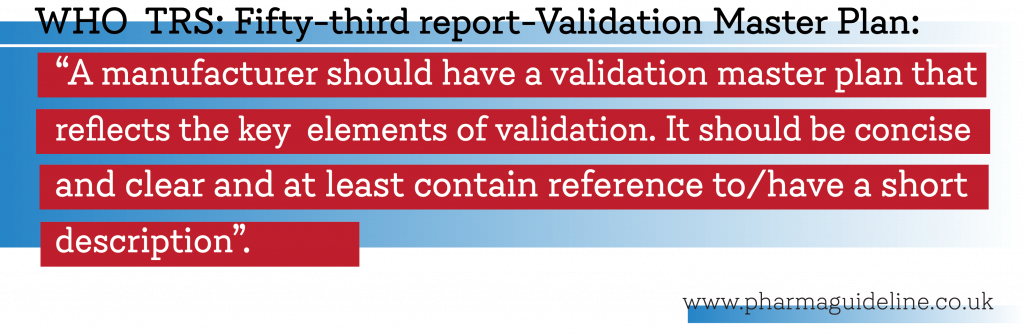
“A manufacturer should have a validation master plan that reflects the key elements of validation. It should be concise and clear and at least contain reference to/have a short description”.

validation master plan, validation WHO

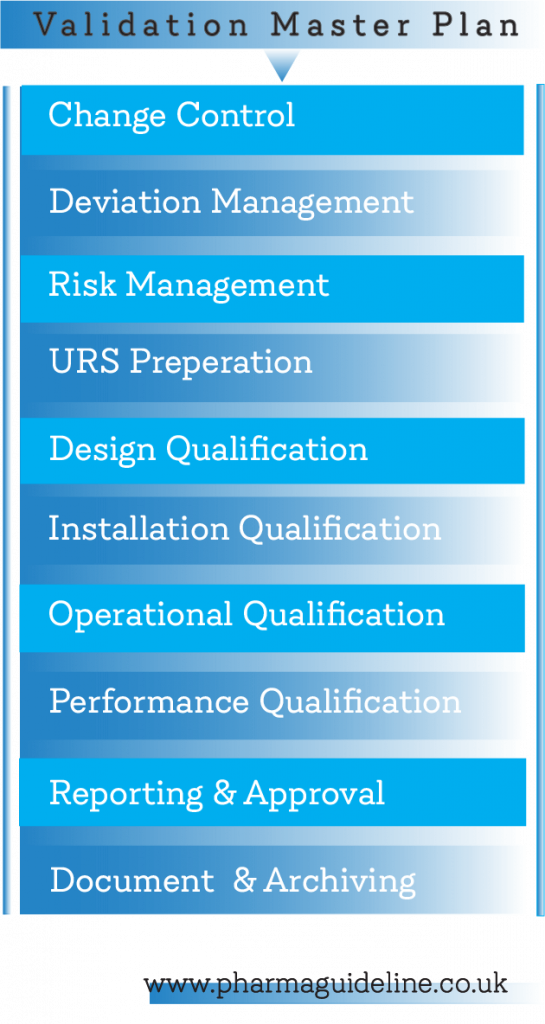
List of Major content of VMP as per WHO GMP guideline-

  • Analytical method validation
  • Change control
  • Cleaning validation
  • Computerized system validation
  • Deviation management
  • Equipment & instrument qualification
  • Outsourced services
  • Personnel qualification
  • Premises qualification
  • Process validation
  • Validation matrix
  • Validation policy
  • References
  • Risk management principles
  • Roles and responsibilities
  • Scope of qualification & validation
  • Training
Conclusion

A well described VMP is the true asset of the firm as well as the critical document to avoid the regulatory noncompliance. An incomplete VMP always brought more 483 with subsequent warning letters from FDA. A standard VMP must be more precise, to the point and actual to the system, process, and procedure.

Every sentence of the VMP must be “may”, “may be”, “should be” etc. free, sentence must be in active form in present tense. A well decorated VMP implies the organization positive image as well as quality products avoiding non-compliance, deviation etc.

Validation Master Plan, How to write for a GMP compliance firm Read More »