High blood pressure, or hypertension, remains one of the most significant preventable contributors to disease and death worldwide. When left undetected and untreated, hypertension can lead to serious complications including myocardial infarction, stroke, and renal failure. Most patients require two or more different antihypertensive medications to effectively control their blood pressure. This comprehensive guide examines the most effective medications available for treating high blood pressure in 2025, including both well-established therapies and recent innovations that are changing the treatment landscape.
Understanding Hypertension Treatment Guidelines
Current medical guidelines provide specific thresholds for initiating pharmacological treatment of hypertension, which vary based on age and comorbidities. According to the Eighth Joint National Committee (JNC 8) guidelines, in the general population of adults 60 years and older, pharmacologic treatment should be initiated when systolic pressure reaches 150 mm Hg or higher, or when diastolic pressure is 90 mm Hg or higher. For adults younger than 60 years, treatment should begin at 140/90 mm Hg or higher.
For patients with hypertension and diabetes, pharmacologic treatment should be initiated when blood pressure is 140/90 mm Hg or higher, regardless of age. These treatment thresholds reflect the balance between the benefits of blood pressure reduction and potential risks of medication, though more recent guidelines from organizations like the European Society of Cardiology (ESC) have defined even lower targets in their 2024 update.
Effective hypertension management typically begins with a single medication but often progresses to combination therapy if target blood pressure is not achieved within one month. In such cases, physicians may increase the dosage of the initial medication or add a second medication from a complementary class.
[1] First-Line Medications for Hypertension
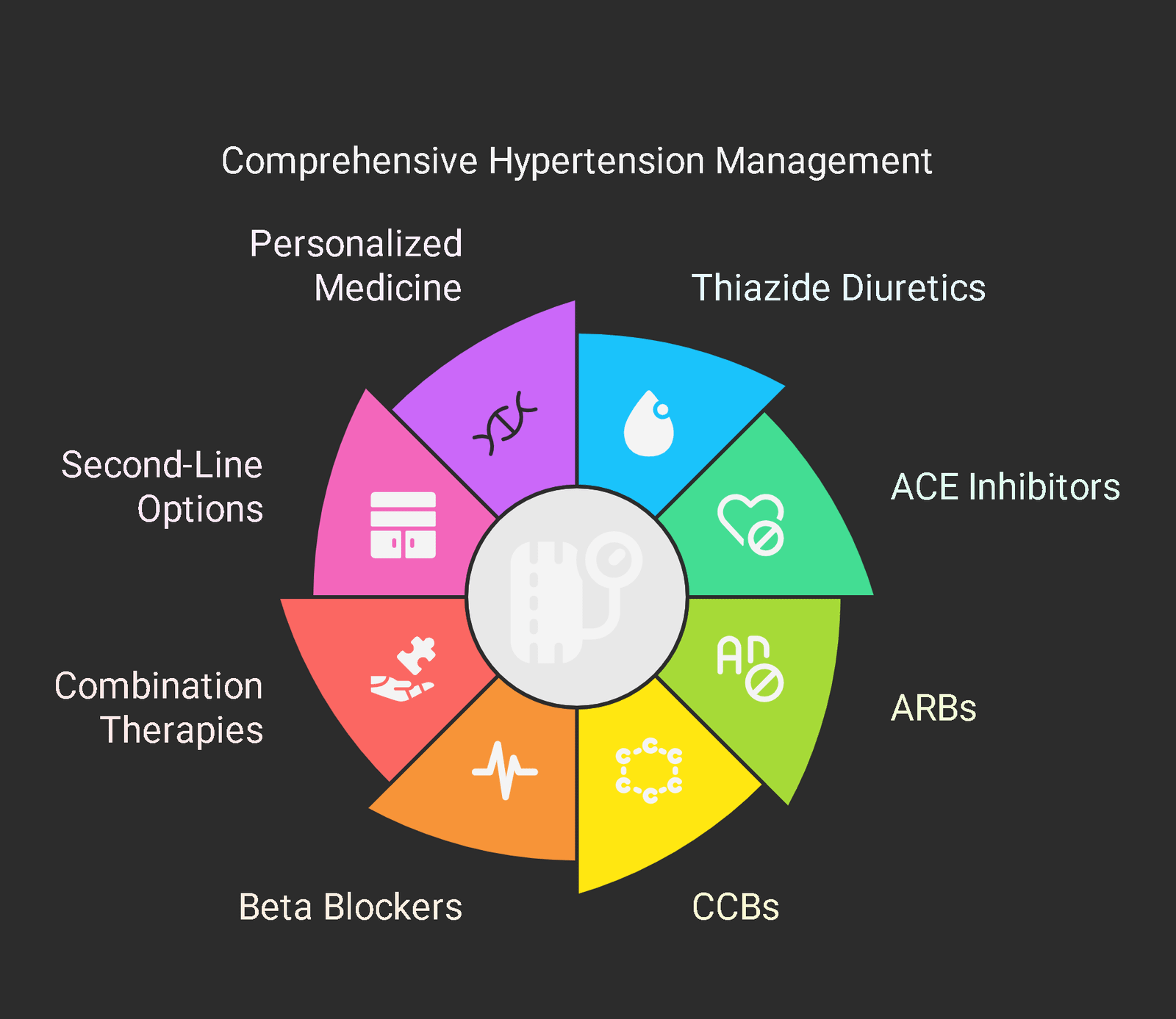
Several classes of medications have established themselves as first-line options for treating hypertension, each with unique mechanisms of action and specific advantages for different patient populations.
Thiazide Diuretics
Thiazide diuretics, such as hydrochlorothiazide (HCTZ), are among the most commonly prescribed medications for hypertension. These medications work by helping the kidneys eliminate sodium and water from the body, reducing blood volume and consequently lowering blood pressure. According to user reviews from Drugs.com, hydrochlorothiazide has received a high rating of 4.9 out of 10, suggesting generally positive patient experiences with this medication.
Thiazide diuretics are particularly effective for many patients, relatively inexpensive, and have a long track record of safety. The JNC 8 guidelines recommend thiazide diuretics as an initial treatment option for both black and non-black patients with hypertension. However, they may affect electrolyte levels and can increase blood glucose, making monitoring necessary, especially in patients with diabetes or at risk for developing the condition.
Angiotensin-Converting Enzyme (ACE) Inhibitors
ACE inhibitors like lisinopril and enalapril work by preventing the formation of angiotensin II, a hormone that narrows blood vessels. By blocking this hormone’s production, ACE inhibitors allow blood vessels to relax and widen, reducing blood pressure. Lisinopril has received a rating of 4.9 out of 10 according to 557 reviews on Drugs.com.
These medications are particularly beneficial for patients with certain comorbidities such as heart failure, previous heart attack, or diabetic kidney disease. According to the JNC 8 guidelines, ACE inhibitors are recommended as a first-line option for non-black patients with hypertension. The most common side effect is a persistent dry cough, which occurs in approximately 5-20% of patients.
Angiotensin II Receptor Blockers (ARBs)
ARBs such as losartan and valsartan work similarly to ACE inhibitors but through a different mechanism. Rather than preventing the formation of angiotensin II, they block the hormone’s effects on blood vessels directly. This difference in mechanism means that ARBs typically don’t cause the dry cough associated with ACE inhibitors, making them an excellent alternative for patients who cannot tolerate ACE inhibitors.
User ratings for ARBs are generally positive, with losartan receiving a 4.4 out of 10 rating based on 564 reviews and valsartan scoring 5.5 out of 10 from 146 reviews. The JNC 8 guidelines recommend ARBs as a first-line option for non-black patients with hypertension, particularly those who cannot tolerate ACE inhibitors.
Calcium Channel Blockers
Calcium channel blockers (CCBs), including amlodipine (Norvasc), diltiazem, and verapamil, prevent calcium from entering the cells of the heart and blood vessel walls. This action helps blood vessels relax and widen, reducing blood pressure. CCBs are particularly effective for older patients and black patients with hypertension.
Amlodipine has received a rating of 3.8 out of 10 based on 726 reviews, while its brand-name version Norvasc has a rating of 4.1 out of 10 from 93 reviews. According to the JNC 8 guidelines, calcium channel blockers are recommended as a first-line option for both black and non-black patients with hypertension.
Beta Blockers
Beta blockers such as metoprolol (Toprol-XL), atenolol (Tenormin), and propranolol (Inderal LA) work by blocking the effects of adrenaline on the heart. This slows the heartbeat and reduces the force of heart contractions, which lowers blood pressure. While current guidelines generally position beta blockers as second-line agents for uncomplicated hypertension, they remain valuable first-line options for patients with specific coexisting conditions like coronary artery disease or heart failure.
User ratings for beta blockers vary, with metoprolol receiving a 5.2 out of 10 rating from 290 reviews, atenolol scoring 6.6 out of 10 from 130 reviews, and Toprol-XL rated at 6.4 out of 10 from 39 reviews. These relatively high ratings suggest many patients have positive experiences with these medications despite their potential side effects, which can include fatigue, cold extremities, and sleep disturbances.
Combination Therapies for Resistant Hypertension
Many patients with hypertension require multiple medications to achieve adequate blood pressure control. The JNC 8 guidelines recommend that if target blood pressure is not reached within one month of initiating therapy, the dosage of the initial medication should be increased, or a second medication should be added.
Combination therapy offers several advantages, including more significant blood pressure reduction than higher doses of a single agent, reduced likelihood of dose-dependent side effects, and complementary mechanisms of action. Effective combinations often pair medications from different classes to achieve synergistic effects. For example, a thiazide diuretic combined with an ACE inhibitor or ARB often provides excellent results. The hydrochlorothiazide/lisinopril combination has received a rating of 5.4 out of 10 based on 77 reviews.
Similarly, combining a calcium channel blocker with either an ACE inhibitor or ARB is another effective approach. These combinations target different pathways involved in blood pressure regulation, providing more comprehensive control. Fixed-dose combination pills, which contain two or more medications in a single tablet, can simplify treatment regimens and improve adherence, an important factor in successful hypertension management.
[2] Second-Line and Specialized Medications
When first-line medications are insufficient or not tolerated, several second-line options are available for treating hypertension.
Aldosterone Antagonists
Aldosterone antagonists like spironolactone (Aldactone) and eplerenone (Inspra) block the effects of aldosterone, a hormone that increases sodium reabsorption and potassium excretion by the kidneys. These medications help the body eliminate excess sodium and water while retaining potassium, which can help lower blood pressure. Spironolactone has received a rating of 5.0 out of 10 based on 51 reviews. These medications are particularly useful in resistant hypertension, which persists despite the use of three or more antihypertensive medications.
Alpha Blockers and Alpha-Beta Blockers
Alpha blockers work by preventing the hormone norepinephrine from tightening the muscles in the walls of smaller arteries and veins, allowing blood vessels to remain open and relaxed. While not typically used as first-line agents for hypertension, they may be beneficial for men with hypertension and benign prostatic hyperplasia.
Alpha-beta blockers like carvedilol (Coreg) and labetalol (Trandate) block both alpha and beta receptors, providing a dual mechanism to lower blood pressure. Carvedilol has received a rating of 4.1 out of 10 based on 109 reviews. These medications are particularly useful in specific situations such as hypertensive emergencies or in patients with coexisting conditions like heart failure.
Central-Acting Agents and Vasodilators
Central-acting agents such as clonidine (Catapres) and methyldopa work in the brain to decrease nerve signals that narrow blood vessels. Clonidine has received a rating of 6.0 out of 10 based on 116 reviews. While effective, these medications are typically reserved for resistant hypertension due to their side effect profile.
Direct vasodilators like hydralazine (Apresoline) and minoxidil act directly on the muscles in the walls of arteries, preventing them from tightening. Hydralazine has received a rating of 2.7 out of 10 based on 81 reviews, suggesting patients may experience more side effects with this medication. These agents are typically used in combination with other antihypertensives and are often reserved for difficult-to-control hypertension.
Breakthrough Medications: The Latest Developments
The landscape of hypertension treatment continues to evolve with the development and approval of new medications that offer alternative mechanisms of action for patients who do not respond adequately to established therapies.
Aprocitentan (Tryvio)
In March 2024, the FDA approved aprocitentan (Tryvio), an endothelin receptor antagonist, for the treatment of hypertension in combination with other antihypertensive medications. This approval is specifically for lowering blood pressure in adult patients whose hypertension is not adequately controlled by other medications.
The approval was based on the phase 3 PRECISION study, which demonstrated that aprocitentan significantly reduced systolic blood pressure compared to placebo. The 12.5 mg dose reduced systolic blood pressure by 3.8 mmHg more than placebo, with similar reductions in diastolic blood pressure. Most of the blood pressure-lowering effects occurred within the first two weeks of treatment.
Tryvio represents an important addition to the antihypertensive arsenal, particularly for patients with resistant hypertension. As an endothelin receptor antagonist, it works through a different mechanism than other antihypertensive drug classes, potentially offering benefits for patients who have not responded well to available treatments.
Personalizing Hypertension Treatment
The selection of antihypertensive medications should be individualized based on several factors, including the patient’s age, ethnicity, comorbidities, and potential side effects. According to the JNC 8 guidelines, initial antihypertensive treatment should include a thiazide diuretic, calcium channel blocker, ACE inhibitor, or ARB in the general non-black population. For the general black population, initial treatment should include a thiazide diuretic or calcium channel blocker.
Patients with specific comorbidities may benefit from particular medication classes. For example, ACE inhibitors and ARBs are preferred for patients with chronic kidney disease due to their renoprotective effects. Beta blockers and ACE inhibitors are beneficial for patients with prior myocardial infarction or heart failure. Calcium channel blockers may be preferred for elderly patients with isolated systolic hypertension.
The emerging concept of “implementation hypertension” strategies, as mentioned in recent literature, emphasizes the need for a more personalized approach to hypertension management that accounts for individual patient characteristics and preferences. This approach acknowledges that while guidelines provide general recommendations, treatment must ultimately be tailored to each patient’s unique circumstances.
Monitoring and Adjusting Treatment
Effective hypertension management requires regular monitoring and adjustment of treatment as needed. If the target blood pressure is not reached within one month after initiating therapy, the JNC 8 guidelines recommend increasing the dosage of the initial medication or adding a second medication from a different class.
Home blood pressure monitoring has become an increasingly important component of hypertension management, allowing for more frequent measurements and detection of white coat hypertension or masked hypertension. Regular healthcare provider visits remain essential for monitoring not only blood pressure but also for assessing medication side effects, checking laboratory values when appropriate, and evaluating overall cardiovascular risk.
The evolution of hypertension guidelines reflects the dynamic nature of this field. The upcoming release of new Japanese Society of Hypertension guidelines in 2025 will likely provide further refinement of treatment recommendations based on the latest evidence. Healthcare providers must stay informed about these developments to provide optimal care for patients with hypertension.
The management of hypertension has advanced significantly in recent years, with a growing array of effective medications available to control blood pressure and reduce cardiovascular risk. From established first-line options like thiazide diuretics, ACE inhibitors, ARBs, and calcium channel blockers to newer agents like aprocitentan (Tryvio), healthcare providers have many tools at their disposal for personalizing treatment to individual patient needs.
Successful hypertension management often requires combination therapy, with most patients needing two or more medications to achieve target blood pressure levels. The selection of antihypertensive medications should be guided by evidence-based guidelines while considering individual patient characteristics, comorbidities, and preferences. With proper medication selection and regular monitoring, the vast majority of patients with hypertension can achieve adequate blood pressure control, reducing their risk of serious cardiovascular complications and improving overall health outcomes.
As treatment approaches continue to evolve, the focus on personalized medicine in hypertension management will likely increase, potentially incorporating genetic factors, biomarkers, and other patient-specific characteristics to optimize medication selection and dosing. This personalized “implementation hypertension” strategy represents the future of hypertension management, promising even better outcomes for patients with this common but manageable condition.