sop

Sampling Tools Cleaning and Storage SOP

Sampling Tools Cleaning and Storage; Purpose:

Sampling Tools Cleaning and Storage; The purpose of this procedure is to describe the instruction of cleaning and storage of sampling tools.

Sampling Tools Scope:

This SOP is applicable to sampling tools used for Quality Control Laboratory and Microbiology Laboratory at XX Pharmaceuticals Ltd.

Definitions/Abbreviation:

[][]SOP: Standard Operating Procedure: A written authorized procedure, which gives instructions for performing operations.
[][]QC: Quality Control.

Responsibilities:

[][]The roles and responsibility is as follows:
[][]Laboratory Attendant, QC & Microbiology
[][]To prepare of cleaning solution.
[][]To clean and store all sampling tools by following SOP.
[][]Executive, QC & Microbiology
[][]To ensure that this procedure is followed.
[][]To maintain the records properly as per SOP.

Manager, Quality Control

[][]To ensure that this procedure is kept up to date.
[][]To confirm that the SOP is technically sound and reflects the required working practices.
[][]Arrange training on the SOP to all concerned personnel.
[][]To ensure implementation of the SOP after training.
[][]Schedule calibration of the instrument at the defined intervals.

Head of Quality Assurance

[][]Approval of the SOP.
[][]To ensure overall implementation of this SOP.

Procedure:

Precaution(s):
[][]Wear hand gloves, mask and protective clothing before cleaning of sampling tools.
[][]Be sure that the sampling tools are cleaned just after use.
[][]After cleaning of tools, be sure that the tools are free from any residual content of detergent or sample.
[][]During handling, sterilized gloves should be worn after sterilization of microbiology sampling tools.
Cleaning of Sampling Tools:

For scoop/spoon:

[][]Clean the sampling devices with potable water following by 0.5% soap or detergent solution.
[][]Finally rinse with purified water to remove the adhering material.
[][]Check the cleanliness physically and clean again if necessary.
[][]Dry in hot air oven for use in QC sampling.
[][]Sterilize at 2000C for 1 hour or autoclave at 1210C for 15 minutes for the sampling of Microbiology analysis.

For pipette (glass) and Glass Rods:

[][]Pass the running potable water through the pipette to remove the adhering material.
[][]Sink the pipette into 0.5% soap or detergent solution.
[][]Rinse with potable water to remove detergent.
[][]Finally rinse with purified water.
[][]Confirm that the tools are cleaned properly, clean again if it is necessary.
[][]Dry in hot air oven for use in QC sampling.
[][]Sterilize at 2000C for 1 hour or autoclave at 1210C for 15 minutes for the sampling of Microbiology.

Storage of Sampling Tools:

[][]After dry, remove the cleaned tools from the oven and wrap the dry tools individually with cleaned polybag.
[][]Ensure that there is no exposure of sampling tools after wrapping the cleaned dried tools with polybag.
[][]Finally keep it at closed condition.
[][]Affix the tag “CLEANED” label duly signed with date on the sampling tools.
[][]Use the tools within 7 days sampling of Chemical test and within 24 hours for sampling of microbiology test.

Sampling Tools Cleaning and Storage SOP Read More »
Sampling Booth Start-up, Operation and Cleaning

Sampling booth Purpose:

The purpose of this SOP is to describe the operation and cleaning procedure of Sampling Booth in order to comply with cGMP standard.

Sampling booth Scope :
The scope of the procedure is applicable to the Sampling Booth installed at the Warehouse of general block of XX Pharmaceuticals Limited.

Definitions/Abbreviation:

[][]SOP: Standard Operating Procedure
[][]QC: Quality Control

Responsibilities:

The Roles and Responsibilities are as follows:

Officer/Executive/Sr. Executive, Quality Control

[][]To ensure that this procedure is followed.
[][]To maintain the records properly as per SOP.

Executive, Warehouse

[][]To ensure that this procedure is followed.
[][]To check & ensure cleaning of sampling booth.

Manager, Quality Control

[][]To confirm that the SOP is technically sound and reflect the required working practice.
[][]To arrange the training on the SOP to all concerned personnel and to ensure the implementation of the SOP after training.

Head of Quality Assurance

[][]To approve the Document
[][]To ensure the overall implementation of the SOP.

Procedure

Precautions:
[][]The working person must follow safety procedures of works.
[][]For any trouble, disturbance switch OFF the Sampling Booth.
[][]Don’t sampling solvent and flammable liquid inside the sampling booth

Operation

[][]Check the Sampling Booth first physically.
[][]Check electric connection and mechanical set up.
[][]Machine switch on.
[][]Light on and blower on.
[][]Open the door.
[][]After completion desired work clean the Laminar Unit properly.
[][]Close the door and switch off main switch.
[][]Switch ON Sampling Booth.
[][]Switch ON Light.
[][]Switch ON the Laminar Air Flow.
[][]Increase or decrease air flow by pressing up/down button.
[][]Operate the Sampling Booth for 30 minutes before starting sampling.
[][]Record the machine operation start time & end time and other parameters on the  Equipment Log Book’

Cleaning

[][]Remove dust from the Sampling Booth with a vacuum cleaner and then clean with lint free cloth.
[][]Clean the booth with wet mop.
[][]Wipe the water with lint free cloth.
[][]After final cleaning affix the ‘CLEANED’ label.
[][]Record the cleaning status in the ‘Equipment Log Book’.

Download Here:

[][]Annexure I: Equipment Log Book

Sampling Booth Start-up, Operation and Cleaning Read More »

Instrument calibration Standard operating procedure

Instrument calibration Purpose:

Instrument calibration, This SOP ensures that all type laboratory instruments of QC, PD, IPQC, Microbiology and balances of Production department are appropriately calibrated and calibration status maintained on due time.

Scope :

This procedure is applicable for calibration frequency of all types of laboratory instruments installed in QC, PD, IPQC, Microbiology and balances of Production department of General Block of XX Pharmaceuticals Ltd.

Definitions :

[][]QC: Quality Control.
[][]ENG: Engineering department.
[][]PD: Product development.
[][]IPQC: In-process Quality Control.

Responsibilities:

The roles and responsibility is as follows:

Officer/ Executive

[][]Ensure that the instructions of this procedure are correctly followed.
[][]Ensure that all equipment’s are included in the Instrument list.
[][]Maintain and track the calibration schedule.
[][]Ensure that all equipment’s bear appropriate calibration label and are used after calibration.
[][]To verify the third party calibration report and raw data.

Manager, Quality Control

[][]Ensure that this procedure is kept up to date.
[][]Ensure that the calibration requirement are assessed and are fully documented for all pieces of the instrument.
[][]Ensure appropriate personnel from the section are trained on this procedure.
[][]Confirm that SOP is technically sound and reflects the required working practices.

Manager, Quality Assurance

[][]Approval of SOP.
[][]Approval of calibration frequency and calibration schedule.

Precaution(s):

[][]There are no significant hazards or special instructions relating to the process/activities described in this SOP.

Procedure:

[][]Calibrate the equipment regularly as per frequency stated in the instrument calibration frequency (prepared as per format in Annexure-I) and as per calibration due date stated in the instrument calibration schedule (prepared as per format in Annexure-II) for individual equipment.
[][]Review the instrument calibration frequency when new instrument is included.
[][]Review the instrument calibration schedule yearly.
[][]Mention the responsibility (Third Party / Supplier name) for external calibration and (calibrator name and department) for internal calibration.
[][]Calibrate the instrument within 3 days of calibration due for monthly calibration period, within 7 days of calibration due for 3 and 6 monthly calibration period and 15 days of calibration due for yearly calibration period.
[][]In case of any breakdown or replacement of any damaged part where calibration needs to be carried out, the calibration schedule will be reviewed accordingly.
[][]Executive/ Sr. Executive of respective department will intimate the Engineering department/ Supplier service engineer/ outside agencies for the calibration of the instruments/ equipments.
[][]Maintain all standards, reagents, instruments and equipments etc. required for calibration.
[][]Calibrate the instrument across the operating range at a frequency appropriate to the reliability and frequency of use. Tolerance must be specified and should reflect the manufacturer’s specification or process tolerance or whichever the tightest.
[][]Re-evaluate calibration requirement immediately if there is any change in the instrument in use.
[][]Calibration must be performed by trained personnel or by approved Third Party Service Engineer.
[][]Calibration record must include:
=>Equipment name, model number and instrument ID No.
=>The name of the person who carried out the calibration.
=>Date of calibration.
=>The date when calibration is next due.
[][]For calibration, use reference standards or reference instruments whose calibration is traceable.
[][]Store the calibration device, certified standard weight in a secure place.
[][]For internal calibration, affix the calibration sticker label “ CALIBRATED” (format of calibration labels should be as per SOP: Calibration management program, Ref. No. SOP/ENG/00Y/XX, where XX refers to current version no.), with performer initial, date of completion and calibration due.
[][]For external calibration, affix the calibration sticker provided by external calibrator with performer’s initial, date of completion and calibration due.
[][]If the instrument is found out of tolerance/ limit during calibration, a label ‘Out of calibration” will be affixed on the instrument (as per SOP: Calibration management program No. SOP/ENG/00Y/XX, where XX refers to current version no.).

Notify the relevant person/ department/ organization to repair (or replace if necessary) the instrument in a timely manner.


Download

Annexure I Instrument Calibration Frequency
Annexure II Instrument Calibration Schedule

Instrument calibration Standard operating procedure Read More »

Maintenance of ETP [Effluent Treatment Plant]-SOP

Maintenance of ETP: This SOP [Maintenance of ETP] will make as per SOP for SOP of the respective company/Organization. Font/line spacing/Margin/Page set up/Header/Footer etc. will change as per requirement of SOP for SOP.

Maintenance of ETP

1.0 Purpose:

The purpose of this SOP is to define the standard procedure of preventive maintenance of Effluent Treatment Plant [ETP] of XX Pharmaceuticals Ltd.

2.0 Scope: 

This Standard Operating Procedure applies to the Effluent Treatment Plant [ETP] of XX Pharmaceuticals Ltd.

3.0 Definitions/Abbreviation: 

ACF: Activated Carbon Filter

ETP: Effluent Treatment Plant

MGF: Multi Grade Filter

PAC: Poly Aluminum Chloride

PPE: Personal Protective Equipment

SOP: Standard Operating Procedure

4.0 Responsibilities: 

Engineering Department [Validation]:

Preparing the SOP & revise it when required

Engineering Department [Maintenance]:

To provide essential support for maintenance of the system.

To ensure that the operators are accountable to carry out the maintenance.

Operators

To perform the maintenance activities according to the SOP.

Head of Engineering

To confirm that the maintenance of ETP are done correctly.

Head of Quality Assurance

To ensure overall implementation of this SOP.

5.0 Revision Details

Sl. No./Version No./Effective Date/Change History to be add here

6.0 Annexure:

Annexure has been mentioned in bottom of the document with download link

Annexure-I: Maintenance log sheet of ETP

7.0 Procedure:

7.1 Precautions: All maintenance activities must be done safely in accordance with the necessities of the Plant Safety Declaration and the safety notices from place to place the plant. Specific consideration must be paid to the following:

  • Handle the chemicals by wearing PPE.
  • Ensure that the pumps are switched off before initiating any kind of maintenance.

7.2 System Description:

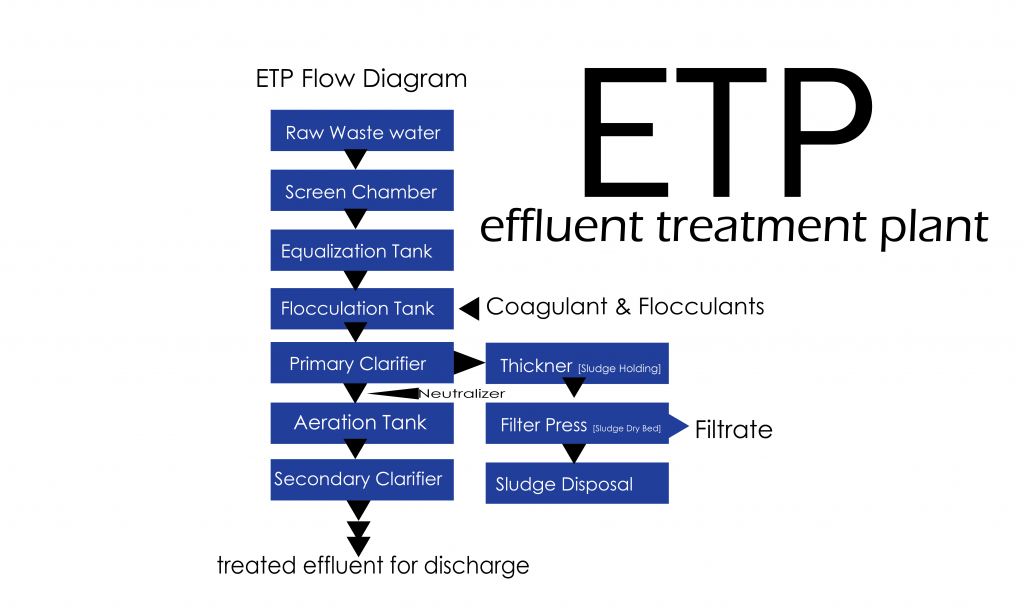
The capacity of ETP is 5000 Liter/hour. The effluents from the production department come into the neutralization and equalization tanks via bar screen chambers. In this bar screen chamber the floating material/solid material is being filtered. A dosing of lime is being delivered in the neutralization tank if pH correction is needed.

The effluents are aerated in this tanks with air which is delivered by the blowers. After being neutralized in the neutralization tank the effluents goes into the equalization tank & then the effluent is relocated to the flocculation tank through effluent transfer pumping system.


A dosing of PAC [Poly Aluminum Chloride] is delivered in the flocculation tank to flocculate all the effluents. Poly electrolyte dosing [PED] is delivered in the transferring pipe of effluents from flocculation tank to the lamella.

After lamella the effluent is passed to the aeration tank. In aeration tank the effluents are aerated with air. A dosing of NaOH[Sodium Hydroxide] is provided if it is required.


There is a buffer tank after the aeration tank where 1kg of urea will be delivered after every Two months of operation. There is a line under the buffer tank to transfer the sludge to underground sludge tank & then to sludge pit by sludge transfer pumping system.

Clear water from the Buffer Tank is stored in the clear water tank. There are two pumps to transfer the clear water to final storage tank through MGF [Multi Grade Filter] & ACF [Activated Carbon Filter]. One pump is used at a time.

7.3 Maintenance Procedure:

7.3.1 Maintenance of ETP will be performed according to the following check list:

Type of maintenance: Daily

Maintenance activities:

  • Clean the screen bar daily.
  • Clean the surrounding environment of ETP.

Type of maintenance: Weekly

Maintenance activities:

  • Clean the control panel.
  • Check the electrical control panel and electrical connection.

Type of maintenance: After 2 months

Maintenance activities:

  • Clean the dosing tank.

Type of maintenance: After 3 months

Maintenance activities:

  • Change the oil of blower/compressor.

Type of maintenance: Yearly

Maintenance activities:

  • Clean all the tanks
  • Change the gear oil
  • Clean the clear water tank

7.3.2 Fill up the log sheet (Annexure-I) after performing preventive maintenance of ETP.

Annexure:

Annexure-I: Maintenance log sheet of ETP

Maintenance of ETP [Effluent Treatment Plant]-SOP Read More »