What is the difference between Data and Information?
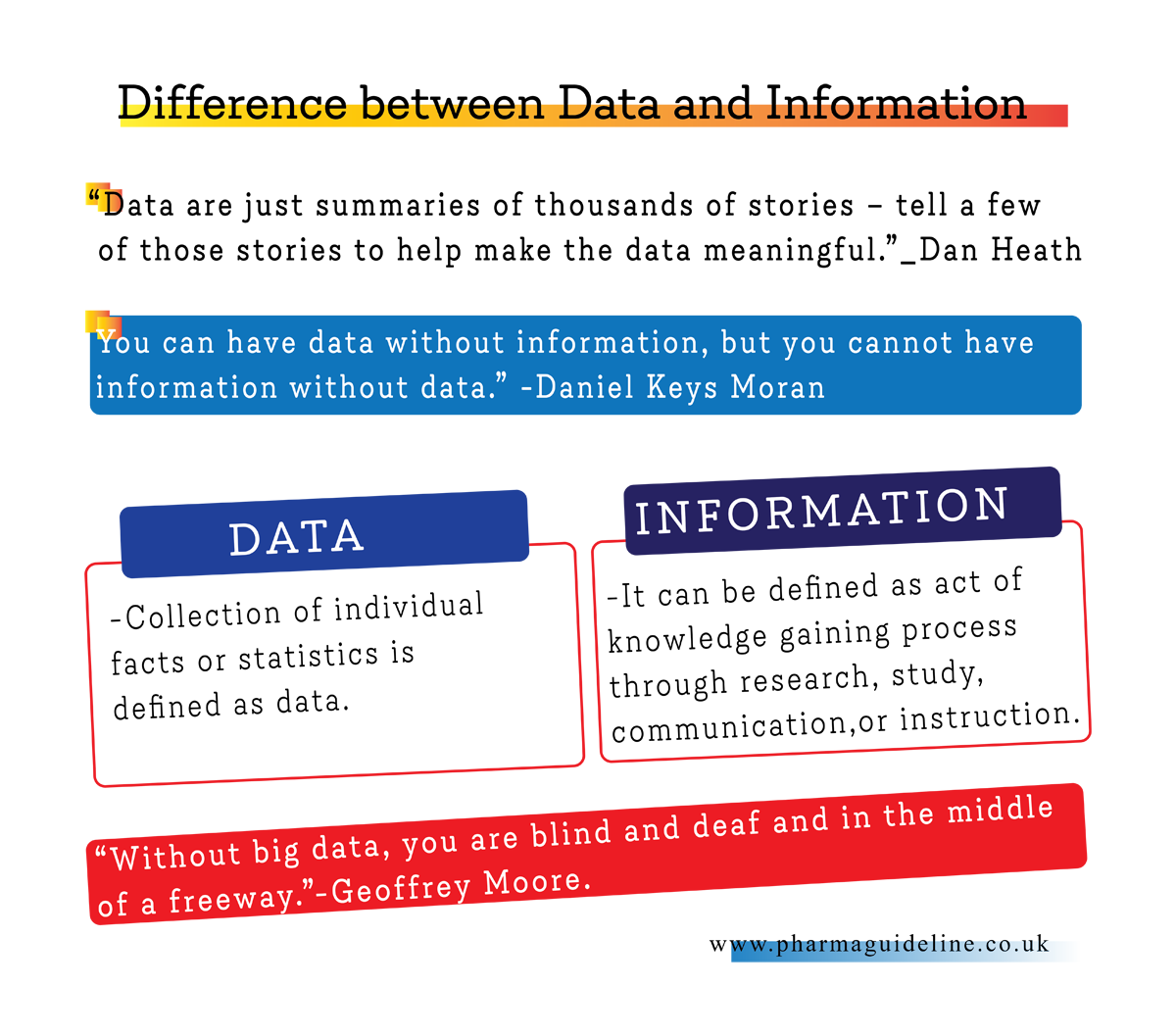
Most of the cases we think that “data” and “information” are same but they actually aren’t the same though they are often used interchangeably. There are elusive differences between these two components & their purposes of use. information is organization & interpretation of group of facts where Data is defined as individual facts. To identify and solve problems, you can use the data & information together. To drive a successful business, we can use these two components to accelerate the ultimate mission to reach the goal.
What Is Data?
Collection of individual facts or statistics is defined as data (Data is plural form of ”datum” but the term didn’t use in for daily expression. Data has its various type of form such as figures, text, observations, numbers, images, graphs, or symbols. Individual dates, prices, weights, addresses, ages, temperatures, distances, names, etc. can the example of data.
Data is simply defined as “facts & figures”. Each piece of data is a tiny fact that doesn’t mean abundant of its own. Data can be defined for singular fact or collection of facts. It comes from the Latin word ”datum”, mean “something given”. “datum” is technically correct singular form of data but is hardly used in public language. Its early usage dates back to 1600s. Over time “data” has become plural of “datum”.
Data doesn’t carry any significance or purpose, it’s the raw form of knowledge. To make it meaningful you have to interpret data. Bits & bytes are used to measured data which are units of information in context of computer storage & processing the same.
Data without analyzed, organized, and interpreted may even seem useless & data can be simple. Two types of data are depicted here-
[][]Quantitative data is in numerical form, like volume, weight, cost of an item. Its not descriptive.
[][]Qualitative data is descriptive, like sex, name, or cloth color of a person. It’s not but non-numerical.
What Is Information?
It can be defined as act of knowledge gaining process through research, study, communication, or instruction. Information is the totality of group of analyzed and interpreting data. A data is always the individual numbers, figures, or graphs whereas information is considering the perception of those items. In this era, we can mention that most of the sophisticated modern industry always maintain environmental monitoring through recording of Temperature & Relative Humidity, through out the year of the year and achieve it in a suitable position.
Information can be defined as “news or knowledge received or given”. Processed, interpreted & organized facts is information. It comes from the Latin word īnfōrmātiō, mean “formation or conception.”
This type of recoding doesn’t bear any significant meaning but if you organize, analyze the recoded data then you can easily realize the Environmental condition changes in specific season. You can trend the data to sort out the best matching, minimum maximum data etc. which useful to set up or install the best quality BMS [Building Management System] parameter. Without analyzing and organizing the data, it is the just piece of recording doesn’t denote any significant value. A well-organized data can help the others.
In basic terms, it can be concluded that data is unorganized explanation of raw facts from which information can be take out.
Significant Differences Between Data vs Information
[][]collection of facts is considered as Data where information puts all of those facts into context.
[][]Data is always raw & unorganized where information is processed and organized.
[][]Data points are individual & most of the time it is unrelated. Information relates these points and show the actual behind it.
[][]Without analyzed and interpretation data is totally meaningless, when it organized then it became meaningful information.
[][]Data is always independent but Information depends on data due to you can’t get any information without processing data.
[][]Numbers, graphs, figures, or statistics is the form of data. Information generally appears as language, words, thoughts, ideas etc.
[][]To base on data, you can’t make any decision but when information available at your hand you can make any decision. So, data are not enough to make any decision, information require to do the same.
[][]Data always defines figures & facts. It comprises of one entry or collection of diverse values. Information defines values & context together, resulting in approximately meaningful. It forms an organized & interconnected structure, from data, to interpret or link the whole.
[][]Example
=>For data examples, we can use Lance, M. Kiely, 4590 Neville Street, Terre Haute, IN 47807. The separator [commas] characterize each distinct fact that may or may not be linked to others.
=>In this example of information, Each fact narrates to other facts to form a concept, known as Lance M. Kiely. Creating this Lance M. Kiely entity allows people to reason, calculate, & do other influences.
Lance M. Kiely
4590 Neville Street
Terre Haute, IN 47807
Data vs. Information in Computers
If we consider computers, Data can be considered as INPUT on anything that instruct to computer to do or store. The OUTPUT of the computer which exhibit your computer after your instruction to computer.
As per statistics, data defined as raw information but term statistics is often used in place of information. Statistics interpret & summarize data.
In business, data are often raw numbers & information is a collection of separate data points which you use to realize what you’ve restrained.
[][]1.0
Data: typing the words “Dog videos” in your computer web search engine (INPUT).
Information: The list of search results which includes a variability of dog videos on the resulted browser page (OUTPUT).
[][]2.0
Data: 9994565566
Information: phone number (555)456-5566 of a person.
[][]3.0
Data: 46.07 & 789
Information: Molar mass & Density of Ethanol in g/mol & kg/m³
[][]4.0
Data: 70%
Information: Isopropyl alcohol in percentage
[][]5.0
Data: -16
Information: Freezing points of Vodka in Fahrenheit
Difference Between Data and Information
| Parameters | Data | Information |
|---|---|---|
| Content | Unrefined raw factors. | Refined in a meaningful way. |
| Characteristic | Data is considered property of a specific organization & is not offered for sale in the public. | Information is offered for sale to public. |
| Decision Making | Raw data is insufficient to make any decision. | Information is enough to make any decision. |
| Dependency | Data depends upon the sources for collecting method. | Information always depends upon data. |
| Design of Data | Data is never designed for specific need of user. | Information is always explicit to requirements & expectations because all extraneous facts & figures are detached, during transformation process. |
| Dependency level | Data never depends on Information. | Information constantly depended on Data. |
| Description | Helps to develop ideas or conclusions based on Qualitative or Quantitative Variables. | It is group of data which carries news and meaning. |
| Etymology | Data has comes from Latin word, datum, means “To give something.” The word “data” become plural of datum. | It comes from the Latin word īnfōrmātiō, mean “formation or conception.” |
| Example | 1.0 During word Tour Ticket sales on a specific Band. | 1.0 Sales report generate by region & venue gives information which venue perform best. |
| Example | 2.0 An example of data is a student’s Eye Color. | 2.0 The average Eye Color of a class is the information derived from the given data. |
| Format | Data found in the form of letters, numbers, or a set of characters. | Ideas and inferences |
| Feature | Data is a single unit & raw. It doesn’t have any meaning alone. | Information is artefact & group of data which jointly carry a logical meaning. |
| Interrelation | Collected Information. | Processed Information. |
| Knowledge level | Low-level of knowledge. | Second level of knowledge. |
| Meaning | Data does not have any definite persistence. | It conveys meaning that has been allocated by interpreting data. |
| Measuring unit | Measured in bits & bytes. | Measured in different meaningful unit like time, quantity, etc. |
| Meaning of base | Data is based on records & explanations and, which are deposited in computers or remembered by a individual. | Information is considered more consistent than data. It helps investigator to conduct a appropriate analysis. |
| Support for Decision making | Data can’t be used for decision making | It is extensively used for decision making. |
| Significance | Data collected by the researcher, may or may not be useful in different situation. | Information is useful & appreciated as it is readily accessible to the researcher for use. |
List of Examples of Data vs Information
differences between data and information, how these examples turn data into insights:
[][]An individual customer’s bill amount is data at a specific restaurant but after a certain period of time or after one day collection when the restaurant Manager or owner collect all the customer bill of that day or time, it can produce valuable information of the restaurant as it can produce which item of the restaurant is hot cake or what item is running well and what are not. After that the restaurant, can realize how they can maintain the inventory of a specific item and how to continue their service as well as to minimize the overhead, wadges, supplies etc.
[][]An individual customer service survey of a restaurant is a data but after a period of time when compile the all the survey, then it can produce valuable data regarding area of improvement of the restaurant such as customer service, price, cleaning, mannerism, hospitality, space, location, viewpoint etc.
[][]A single social media like on a media post is a data but when multiple social media item like comments, share, statistics etc. are compiled then the specific company can focus on the specific social media where they are performing best and where they are in worst condition. Comments from a social post of multiple social media is very useful to do the same. It helps the company to set their goal based on the comments collect from customer and it help to find out multiple idea from multiple customers.
[][]On their own, inventory levels are data. However, when companies analyze and interpret that data over a range of time, they can pinpoint supply chain issues and enhance the efficiency of their systems.
[][]Inventory management of the company for the different item is the data but when it collects for certain period of time it can be valuable information regarding the inventory item which can help the supply chain management system to run their activity appropriately.
[][]A Price of a specific item is a valuable data but when processing the data from multiple company can produce valuable information regarding market gap, advantage of the competitor, profit margin, bonus, discount, policy etc. for the specific item.
[][]Taste of Azithromycin Suspension is a data but when you collect different taste from different company product you can produce valuable information regarding taste that which taste is more acceptable to the end user i.e., mango/orange/strawberry/pineapple etc. from this activity you can collect valuable information and implement the same for your company product.
[][]Temperature readings all over the world for the past 10 years can be consider as data. When this data is organized, analyzed to find out global temperature condition is raising over the period of time, then this data changed to information.
[][]Number of visitors to a specific website by country of the word is an example of data. Finding out that the traffic source from Canada is decreasing while that from Austria is increasing is meaningful information.
[][]Often data essential to back up a claim or supposition consequent or inferred from it. Such as before a drug is approved by FDA, manufacturer must conduct clinical trials & must have submit lot of data to reveal that the drug is safe.
“Misleading” Data
[][]Due to the processing of data, interpreted & analyzed, this is very possible that it can be interpreted incorrectly. When this leads to specious conclusions, it can be said that data are misleading. Often this is the consequence of imperfect data or a lack of framework. Such as your investment in a mutual fund may be up by 7% & you may accomplish that fund managers did a great job. Nevertheless, this could be misleading if major stock market indices are up by 10%. In this case, the fund has floundered the market pointedly.
[][]In the year of 2007, Famous toothpaste company Colgate ran an ad campaign & stating that 80% of the dentists recommend Colgate Toothpaste for safe dental health. From this promotion, many consumers assumed that Colgate was the best choice for their safe dental health for daily use. But in practical, this wasn’t inevitably true. In reality, this is the well-known example of misleading data & information.
[][]Anchor Tucker Carlson presented a graph saying, number of Americans recognizing as Christians had distorted over last decade during one of Fox News’s broadcasts. Over the image above, a graph showing in 2009, Christian Americans is 77%, number decreased to 65% in the year of 2019. Now, if issue here is not noticeable enough, here the Y-axis in that chart starts from 58% & ends at 78%, making the 12% drop from 2009 to 2019 look way more substantial than it really is.
Sample size is the vital point to make any key decision for the organization. Making any decision data collected from 100 sample is more accurate data collect from 10,000 sample. Data collect from 100 sample is misleading compare to 10,000. A key decision shall be make from vast amount of sample.
[][]Federal Trade Commission (FTC) filed a lawsuit against car company Volkswagen , which claimed that car company had betrayed customers with advertising campaign it used to promote its allegedly “Clean Diesel” vehicles, according to a press release.
In the year of 2015, it was uncovered that Volkswagen had been cheating emissions tests for its diesel cars in US in the past 7 years. The Federal Trade Commission, alleged that “Volkswagen cheated consumers by selling or leasing more than 550,000 diesel cars based on the false claims that cars were low-emission & environmentally friendly.” For their false claim, the company was remarkably fine up to $61 billion for the violation of Clean Air Act.
[][]Red Bull, Energy drinks company was sued in 2014 their slogan “Red Bull gives you wings.” The company settled case by agreeing to pay out maximum of $13 million — including giving $10 to every US consumer who had bought their drink since 2002.
They claim that the caffeinated drink could improve consumer’s concentration & reaction speed; the tagline company use for last two decade went alongside marketing claims. One of the regular customers of Red Bull drink claim that that he had not developed “wings,” or shown any signs of enhanced intellectual or physical capabilities.
[][]In 2010, Kellogg’s widespread Rice Krispies cereal had a crisis when it was defendant of misleading consumers about product’s immunity-boosting properties. The Federal Trade Commission [FTC] ordered Kellogg to close all advertising which claimed, cereal enhanced a child’s immunity with “25 percent Daily Value of Antioxidants and Nutrients -Vitamins A, B, C and E,” affirming the claims were “dubious.”
[][]New Balance, the famous show making company [Owner, Jim Davis, own almost 95% total share of this company] was defendant of false advertising in 2011 over a sneaker range which claimed that it could help wearers to burn calories but it was subsequently found that there were no health assistances from wearing this sneaker range. From New Balance, they explain that using hidden board technology & it was advertised as calorie burners which activated the quads, glutes, hamstrings & calves. New Balance agreed to pay a settlement of $2.3 million on August 20, 2012.
How Businesses Can Leverage Data & Information
Is it come to the point to distinction between data vs information really matter for businesses? If any company that company collect accurate data then interpreting it and generate information and implement the same on right time on right place can realize the actual benefit for the company.
For example, a company might gather data about the performance of their ads or content. Running a successful add or content to the various platform can produce valuable data. From the data they can produce right information regarding product design, brochure generation, promotional activity, product awareness, customer demand and customer buying capacity.
This can also help to develop target customer, future offering, promotion, branding and developing multiple products for the company.
Right data can lead the organization to the right goal but to maintain the right set of data is very difficult. There are several blockades to create a data dependent better smart organizational culture. Different team of an organization may collect & maintain disparate sets of information. Hence a central database system is crucially need for the organization. Without a central database system, none one can earn the actual benefit and interpretation of data may fail. Data need to supervise by someone, without proper supervision data may not maintain its proper quality and generate poor data mislead the organization.
Any business depends on expressive data patterns to get information. There are dissimilarities between data and information. Business relies on meaningful data patterns to get information, in this article let’s explore the differences and similarities between data and information. Misinterpretation the difference between “data” & “information” sets up the stage for slip-ups. Like the six blind men in an Indian legend, trying to define an elephant, end up puzzling discrete facts, or data, as information or meaning.
In six blind men’s dilemma, individually complicates data (trunk or legs) for information (an elephant is like giant cow or an elephant is like a giant snake). Likewise, anyone can collect customer data & think they have the full customer information when they are actually not. Data & Information have specific implementation. To correctly recognize & use either one, you need to understand the change between data & information is.
To create an effective data driven organization, then you need to maintain the data source which must available across the group of qualified people who are technically sound to generate information from processed data maintaining appropriate protocol to assure the proper data quality.
Data is very critical to generate information and both these two items is crucial to make any decision for the organization.
DIKW [Data Information Knowledge Wisdom] Model
DIKW is the model used for discussion of data, information, knowledge, wisdom & their interrelationships. It denote functional or structural relationships between data, information, knowledge & wisdom.

Are data and information the same thing?
Data is based on observation & records which frequently store in computers or simply memorize it by individual. On the other hand, information denotes to be more consistent than data. In other words, it is a proper analysis which researchers or investigators conduct for converting data into information.
Data and information may be the same thing, From a content & format perspective. For example, you can point same values in two diverse columns on a spreadsheet. Nevertheless, data & information contents & formats do not have to match. In any case, you use data & information very in a different way.
If you want to sort out the value “New York, United States” You will filter data named “New York” under city and “United States” under country.
On the same spreadsheet, If you want to know if the Lance M. Kiely records mean the identical person. Then look at the information in both rows & see, across the columns:
Lance M. Kiely
4590 Neville Street
Terre Haute, IN 47807
You determine both Lance M. Kiely, living in New York, United States, mean the same customer thing from the information provided.
How do data and information differ?
Though Data & information may have the same values but from the creation & business usage they may differ. Data generally includes entries whereas Information contains context. Information comprise data with different contents & formats & be the same thing.
As per data perspective point, “United States,” “UNITED STATES,” and “U.S.A.” represent entirely different facts based on number of characters & formatting varies. Therefore, Lance M. Kiely, who lives in U.S.A., is not same customer as Lance M. Kiely, who lives in United States.
If we consider information viewing platform, the “United States,” “UNITED STATES,” & “U.S.A.” represent the same thing for geographical reason because someone with understanding of geography can point to the “United States” or the “U.S.A.” on a American Map.
The correct data and accompanying context make the United States and the U.S.A. contain meaning about a shared concept of that region, like culture, sports, and government. From the shared concept of that region, like culture, sports, and government make the data more accurate. Lance M. Kiely, who lives in U.S.A., with Lance M. Kiely lives in the United States, and consider creating the same object. Comparing with the other people lives in United States using additional data points like cultural activities in U.K.
Frequently Asked Questions
What is data? Explain with example.
Raw, unorganized, unprocessed facts are known as Data. All of the facts consider as data until it processed, organized such as all information writing on the paper is data until its processed & organized in suitable manner.
What is information?
Processed, organized data which is advantageous in providing useful facts is known as Information. For Ex. It can be concluded that if data are processed and organized in right way generate valuable piece of information.
What is valid information?
A reliable fact is considered as Valid information. Checked & verified information that is ready for use in a specific purpose.
What is the classification of Data?
Classification of Data
Data classification is a critical element of any information security & compliance program, especially if any organization stores big volumes of data. To understand the data security strategy, classification of data plays an important role providing information that where the sensitive data shall be stored. It provides valuable information regarding unused data & elimination of the same type reduce the maintenance cost for the organization.
Types of Data Classification
[][]Content-based classification inspects & interprets files to classify sensitive information.
[][]Context-based classification looks at location, application, creator tags & other variables as secondary indicators of subtle information.
[][]User-based classification depends on manual selection of each document by an individual.
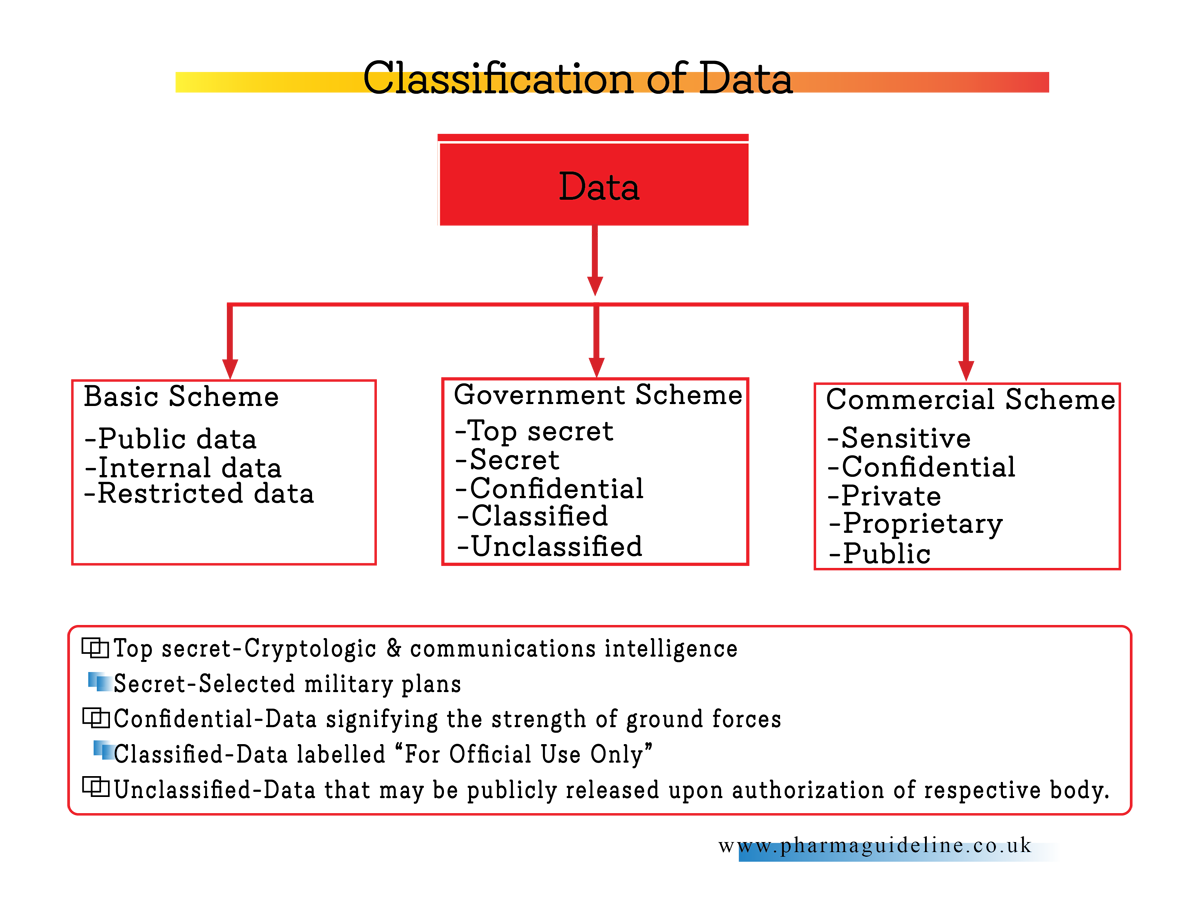
Basic Classification Scheme
The modest scheme is three-level classification:
[][]Public data
Data that can be freely revealed to the public. Examples include any company contact information & any browser cookie policy.
[][]Internal data
Data that has low security level but is not for public expose, like marketing research for a product.
[][]Restricted data
Highly subtle internal data. Expose to public platform create negative impact on operations and put the company at financial or legal risk. Restricted data entails the highest level of security protection at any cost.
Government Classification Scheme
Government agencies use three levels of sensitivity as top secret, secret and public but based on situation can be classified into five types
[][]Top secret-Cryptologic & communications intelligence
[][]Secret-Selected military plans
[][]Confidential-Data signifying the strength of ground forces
[][]Classified-Data labelled “For Official Use Only”
[][]Unclassified-Data that may be publicly released after authorization of respective body.
Commercial Classification
Typically, organizations that store & process commercial data use 4 levels to classify data: 3 private levels and one public level.
[][]Sensitive- Intellectual property, Secrete Formulation, PHI
[][]Confidential-Vendor contracts, employee reviews, Contract, Special Allowance
[][]Private-Customer names or images, Sensitive Video promotion
[][]Proprietary-Organizational processes, Quality System
[][]Public-Information that may be disclosed to anyone
What is the meaning of the two types of data?
The two types of data are qualitative & quantitative. Qualitative data is non-numerical data like eye color, skin texture, Hair color, Shoe color, Clothing color and more. On the other hand, quantitative data is in the form of numbers like the weight of books, number of apples, number bird and more.
What is the difference between Data and Information? Read More »