Microbiology

Laminar Air Flow Operating Procedure & its SOP

Laminar Air Flow Operating Procedure; Purpose

To confirm that the air are free from any microorganisms and any particle in order to favor of microbiological test.

Laminar Air Flow Operating Procedure; Scope

This SOP applies for operation and cleaning of Laminar Air Flow, Model: AHC-4D1 in Microbiology Section at XX Pharmaceuticals Ltd.

Definitions/Abbreviations

[] DOP: Dioctyl Phthalate

[] HEPA: High Efficiency Particulate Air

[] LAFWS: Laminar Air Flow Work Station

[] LAF: Laminar Air Flow

[] PAO: Poly-alpha-olefin

Responsibilities:

The roles and responsibility is as follows

Executive/ Senior Executive, Microbiology

Operation, cleaning and disinfection and daily performance check.

Manager, Microbiology
  • Confirm Operation, cleaning and disinfection and performance checking.
  • Confirm that SOP is technically informative & application of sound knowledge.
  • Confirm that Laminar Air Flow is suitable for working.
Head of Quality Assurance

Take initiative to Approval of SOP

Procedure:

Instructions
  • Do not wipe HEPA filter side of LAFWS.
  • Do not move rapidly in a sweeping motion during operation of LAF to minimize air turbulence.
  • Do not use any disinfectant containing chlorine-based substances as this may be corrosive of the stainless steel.
  • Do not use Bunsen burner & aerosol generating instruments whenever possible as they interfere with airflow.
  • Do not turn on UV lamp without the front cover setting.
Operating Procedure:
  • Switch on the main power.
  • Set the front cover & make sure that the clean bench is fully closed & the interlock is working effectively.
  • Press UV/Exit button to turn on the UV lamp. UV can only be turned on when fan and light both are off.
  • Wait for around 60 minutes.
  • After 60 minutes, remove front cover from LAFWS.
  • Turn on Fan/Up button to start fan.
  • Press to turn on Light/Down to illuminate light.
  • To turn electrical socket of inner cabin, Press Socket/Set button
  • Use 70% Ethanol/IPA to wipe the work surface.
  • Before continuing the work, Leave LAF for 10 minutes
  • After 15 minutes, wipe all materials with 70% ethanol before bringing them inside the LAF Hood.
  • Start the work.
  • Work in cleaned bench in a slow & controlled manner.
  • Move hands in & out of the work zone opening slowly.
  • Use 70% ethanol to wipe again the entire platform after end of the work,
  • Press Fan/Up button to turn off the fan.
  • Press Light/Down Turns off the light.
  • Set front cover and press UV/Exit button to turn on the UV lamp to decontaminate the work bench.
  • Switch off the UV/Exit to turn off the UV lamp after 30 minutes.

Cleaning Procedure

Work surface and wall

Clean work surface & walls with appropriate 5% Dettol/ Savlon solution.

Exterior surface
  • Use a damp cloth to clean the exterior surface, predominantly on the front & top in order to remove dust that accumulated there.
  • Use fresh with Sterile Purified Water (which is sterilized at 1210C for 15 minutes or filtered by 0.2 µm) to eliminate any remaining of cleaning agent.
  • Use MEK (Methyl-Ethyl-Ketone) solution to eliminate stubborn stains or spots on the stainless steel surface. In such cases, wash the stainless steel immediately afterwards with clean water and liquid detergent. Then use polyurethane cloth or sponge for washing.
Microbiological Performance Check
  • Check performance of HEPA filter by monitoring Particle count & Microbial count before conducting sterility test.
  • For non-sterile preparation, check performance of HEPA filter by monitoring the particle count & microbial count in every six months.
HEPA Filter Integrity Test
  • Check efficiency of HEPA filter by DOP (Dioctyl Pthallate)/PAO(Poly Alpha Olefin) test once in  a year.
Maintenance
  • If LAF exhibits any mechanical, electrical or any others difficulty, notify to the supplier or Engineering Department for repairs.

Laminar Air Flow Operating Procedure & its SOP Read More »
Working Guideline in Microbiology Laboratory & its SOP

Working Guideline in Microbiology Laboratory; Purpose

To confirm that microbiological best laboratory practice and special precautions are maintained in Microbiology laboratory in order to prevent laboratory & personal contamination.

Working Guideline in Microbiology Laboratory; Scope

This SOP applies for maintaining microbiological best laboratory practices and special precautions in Microbiology Laboratory at XX Pharmaceuticals Limited.

Definitions/ Abbreviation

None

Responsibilities:

The roles and responsibility is as follows

 Executive/ Senior Executive, Microbiology

Maintain microbiological best laboratory practices & special precautions.

Manager, Microbiology

Ensure microbiological best laboratory practices, special precautions and application of sound technical information.

Head of Quality Assurance

Take initiative to Approval of SOP

Procedure:

Media Preparation and Quality Control

Working Guideline in Microbiology Laboratory; Media Preparation
  • Choose correct media or components in making media based on the use of accepted sources or references for formula.
  • Check Certificate of Analysis describing expiry date, storage conditions etc.
  • Read instructions on the label carefully before media selection and preparation.
  • Follow if any special instruction such as heating, additives & pH adjustment etc.
  • Use always purified water for media preparation.
  • Record accurate weight of media & make up volume with purified water.
  • Dissolve media thoroughly into water prior to dispensing & sterilization.
  • Avoid overheating or less heating media.
  • Sterilize the media as per label of the container.
Media Storage
  • Label media properly with batch or lot numbers, preparation & expiry dates.
  • Store media according to manufacturer’s instructions.
  • Store prepared media under validated conditions.
  • Do not store agar at or below 00 Because freezing could damage the gel structure.
  • Protect stored media from exposure to light & excessive temperature.
  • Before prolonged storage, place into a sealed package or container to retard moisture loss.
  • Re-melt agar media in a hot water bath or by using free flowing steam only once.
Quality Control Testing of Media:
  • Check pH & growth promotion to confirm media efficacy.
  • Perform limited growth promotion test for each lot, if media is sterilized using a validated method.
  • Do not use media if any parameters do not comply.
  • Pre-incubate & 100% inspection prior to use the media.
  • Maintain double-wrapped condition for those media used in critical environmental monitoring.
Maintenance of Microbiological Cultures:
  • Handle with care microbiological cultures due to their pathogenicity and toxicity.
  • Use as standard culture from international recognized organization such as American Type Culture Collection (ATCC), National Collection of Type Culture (NCTC) or any other manufacturer.
  • Select Standard culture as freeze dried lyophilized condition in vial or ampoules form or ready to use condition with Certificate of Analysis.
  • Ensure identification of culture prior to its use.
  • Use only permitted method for culture maintenance.
  • Maintain storage and sub-culture as per standard operating procedure for standard culture maintenance.
  • Be care to prevent extreme sub-culturing working control cultures that increase the risk of contamination.
  • Preserve all typical culture at 2 to 8
  • Inoculate frozen stock monthly or weekly.
  • Discard any unused portion to minimize risk of loss of viability & contamination of the stock.
Maintenance of Laboratory Equipment
  • Perform standard validation practices such as Installation Qualification, Operational Qualification and Performance Qualification for equipment.
  • Calibrate equipment periodically.
  • Check performance of all equipment’s on a routine basis.
  • Maintain always approved protocol for IQ, OQ & PQ of equipment’s.
  • Clean & disinfect all equipment’s as per standard operating procedure for that equipment.
Laboratory Operation
  • Isolate items between sterility testing room & microbial limit test and bio-assay room.
  • Do not interchange item between those area without sterilization.
  • Sanitize carefully both hands with appropriate sanitizer.
  • Before entrance into the test room, wear garments, mask and gloves as appropriate.
  • Always use sterile garments, gloves and mask into sterility testing area.
  • Aseptically handle the items into microbial limit test room.
  • Disinfect all items with 70% IPA or any others suitable sanitizer, before transfer the items into testing room. Open growth plate only into bio-assay room or microbial testing room.
  • Aseptically collect the sample.
  • Identify contaminants at least genus level.
  • Use specific sample area to preserve all samples.
  • Isolate all contaminated samples to reduce the false-positive results.
  • Follow SOP for disposal of used media to discard all contaminants.
  • Clean & disinfect all area according to SOP of cleaning and sanitizing Quality Assurance Department.
  • Lessen the movement into microbial testing room and bio-assay room.
  • After completion of sterility, exit from sterility testing room.
  • Wear another set of sterile dress, gloves, mask If require to re-enter into sterility test room.
  • Wash both hands with liquid soap or any skin cleanser solution, after completion of test and before exit from Laboratory, Finally disinfect both hands.
Documentation
  • Prepare documents in approved format.
  • Preserve documents into specific file up to defined period.
  • Review & update all standard operating procedure, specification & analytical Method within defined period.
  • Verify the data & calculation.
Maintenance of Laboratory Records
  • After completion of each work, prepare record in approved format
  • Follow approved SOP to reflect how the test is actually performed.
  • Keep calibration record after Perform calibration of any equipment’s
  • Preserve all records after approval.
  • Do not discard any approved record without permission and proper justification.
  • Forward test result of raw materials, in-process & finished products to the respected department.
  • Achieve and protect all laboratory record against catastrophic loss.

Spillage Management

Spills:
  • Report immediately to the reporting authority after spillages of culture.
  • Do not touch any spilled cultures & surrounding debris( e. g. glass , cotton or wool plugs) with exposed hands.
  • Wear disposable gloves & disinfect area by covering spill with several layers of paper towel/ cloth soaked in a suitable disinfectant.
  • Leave for it for 15-30 minutes.
  • Using paper towels, sweep spill debris into dustpan.
  • Transfer all disposable materials to a suitable container e.g. an roasting bag/autoclave for autoclaving and disposal.
  • Decontaminate dustpan either by autoclaving or by soaking (at least 24 hours) in hypochlorite solution.
Broken glass
  • Sweep carefully into a suitable container.
  • Dispose in a puncture proof container.
Splashes on clothing and skin
  • Soak in disinfectant contaminated cloth.
  • Treat to splash on skin as soon as possible.
  • Wash thoroughly with soap & finally with hot water.
  • Disinfect the skin if necessary.

Working Guideline in Microbiology Laboratory & its SOP Read More »

Validation of Moist Heat Sterilizer by its best method

Validation of Moist Heat Sterilizer; Purpose

To validate Moist Heat Sterilizer by Biological Indicator.

Validation of Moist Heat Sterilizer; Scope

This SOP applies for validation of Moist Heat Sterilizer in Sterile Processing area and Microbiology Laboratory at XX Pharmaceuticals Limited.

Definitions/Abbreviation

Validation

Validation is the process to establish documented evidence, which provides a high degree of assurance that a specific process will consistently produce a product meeting its predetermined specifications & quality attributes.

Biological Indicator

Biological Indicator is a defined preparation of viable spores made from Bacillus stearothermophillus & Bacillus subtilis & has a particular spore count per indicator of not less than 104 and not more than 109 spores which is used to monitor the efficacy of sterilization process.

  • BI: Biological Indicator
  • ATCC: American Type Culture Collection
  • NCTC: National Type Culture Collection
Responsibilities

The roles and responsibility is as follows

Executive/ Senior Executive, Microbiology

Preservation of Biological Indicator, perform Moist Heat Sterilizer validation and report preparation.

Manager, Microbiology

Ensure Moist Heat Sterilizer Validation, documentation and application of sound technical information.

Head of Quality Assurance

Take initiative to Approval of this SOP

Procedure

Instructions
  • Biological Indicator is usually non-pathogenic but all microorganisms are unscrupulous pathogen. So before handling it, wear protective items such as sterile wear sterile latex free gloves, laboratory coat & eye protection (if required).
  • Discard all items after autoclave.
  • At the end of work, leave all used items at designated containers safely.
  • Make sure that all personal ornaments, cell phone are left to prevent unauthorized contamination, before entrance into the test room.
Handling of Biological Indicator
  • Check expiry date of Biological Indicator (Bacillus stearothermophilus, ATCC-7953).
  • Discard it after autoclaving if expiry date is exceeded
  • Observe Certificate of Analysis of Biological Indicator.
  • Ensure that the paper strip is fully intact.
  • Preserve always BI at 250C or as per manufacturer instructions.
  • Do not preserve it at freezer.
Validation Frequency

Perform the validation once in six months interval.

Exposure of Indicator:
  • Carry out validation as per test schedule.
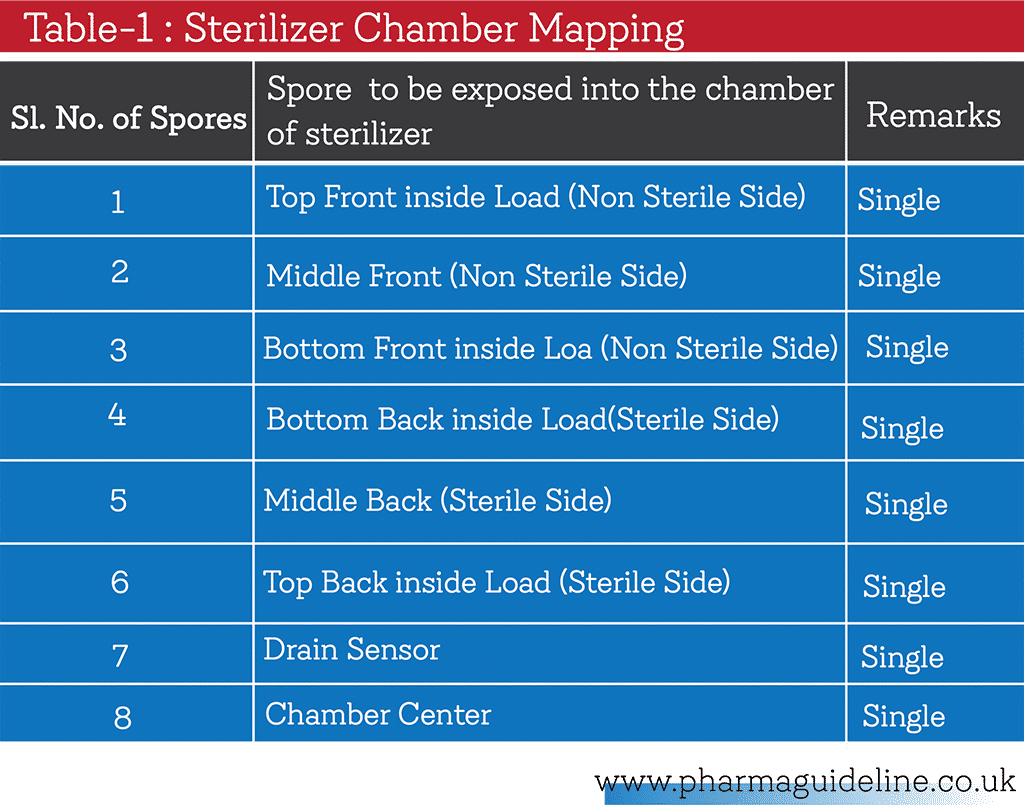
  • Map the chamber with most critical area for exposure of Biological Indicator.
  • Define location & label on each Biological Indicator.
  • Place spore strip of Biological Indicator of Bacillus stearothermophilus (ATCC 7953) at 8 points as per chamber mapping, table-1.
  • Complete sterilization cycle along with product to be sterilized or empty sterilizer.
Analysis of Indicator

After sterilization, Cut cover paper aseptically & transfer paper strip into separate test tube containing 9 ml of sterile Tryptone Soya Broth including a positive control & negative control.


Validation of Moist Heat Sterilizer


Incubation of Indicator:

Incubate all strips including positive & negative control at [50 to 55]0C for 7 days.

Interpretation of Result

Observe indicator strip after 7 days for growth. Turbidity of culture media indicates positive growth. Sterilizer is valid if the following criteria are met:

  • No growth found in exposed all indicator strip
  • No growth found in negative control indicator strip.
  • Growth found in positive control indicator strip.
Repeat validation if following result is found
  • Growth found in one or more than one exposed indicator strip
  • Growth found in negative control indicator strip.
  • No growth found in positive control strip.
The sterilizer is invalid if the following result are found
  • Growth found in one or more than one exposed indicator strip
  • No growth found in negative control indicator strip.
  • Growth found in positive control indicator strip.
Correction Action:
  • If growth found in anyone indicator strip in repeat test, inform test result to concerned department and Engineering Department for corrective action.
  • After corrective action, Engineering Department shall inform to Microbiology Lab. for the repeat test.
  • Microbiology Section shall perform the complete test.
Report Preparation

Report the validation in Moist Heat Sterilizer Validation Report, Annexure-I.

Download Annexure Here:

Annexure I Moist Heat Sterilizer Validation Report

Validation of Moist Heat Sterilizer by its best method Read More »

Validation of Dry Heat Sterilizer; perform it best way

Validation of Dry Heat Sterilizer; Purpose

To validate Dry Heat Sterilizer by Biological Indicator & endotoxin Indicator.

Validation of Dry Heat Sterilizer; Scope

This SOP applies for validation of Dry Heat Sterilizer in Sterile Processing area and Microbiology Laboratory at XX Pharmaceuticals Limited.

Definitions/Abbreviation
Validation

Validation is the process to establish documented evidence, which provides a high degree of assurance that a specific process will consistently produce a product meeting its predetermined specifications & quality attributes.

Biological Indicator

Biological Indicator is a defined preparation of viable spores made from Bacillus stearothermophillus & Bacillus subtilis & has a particular spore count per indicator of not less than 104 and not more than 109 spores which is used to monitor the efficacy of sterilization process.

Endotoxin Indicator

Endotoxin Indicator are designed for monitoring depyrogenation process or validation or which may be measured by comparing the levels of endotoxin before and after a depyrogenation cycle using LAL reagent . USP[United State Pharmacopoeia]  suggests that a depyrogenation cycle should be reduce the endotoxin  by at least 1000 fold ( 3- log reduction ) in endotoxic activity as measured by LAL method.

Endotoxin

It is the component of cell wall of certain bacteria which type of bacteria is known as gram negative bacteria. Endotoxin induce strong immune response and enhance release of cytokine.

[] ATCC: American Type Culture Collection

[] BI: Biological Indicator

[] CSE: Control Endotoxin Standard

[] EI: Endotoxin Indicator

[] λ: Lambda(Lysate Sensitivity)

[] LAL: Limulus Amebocyte Lysate

Responsibilities

The roles and responsibility is as follows

Executive/ Sr. Executive, Microbiology

Preservation of all Indicator, perform Dry Heat Sterilizer validation & report preparation.

Manager, Microbiology

Ensure Sterilizer Validation, documentation and application of sound technical information.

Head of Quality Assurance

Take initiative to approval of this SOP

Procedure:

Instructions
  • Biological Indicator is usually non-pathogenic but all microorganisms are unscrupulous pathogen. So before handling it, wear protective items such as sterile wear sterile latex free gloves, laboratory coat & eye protection (if required).
  • CSE[Control Standard Endotoxin] is pyrogenic in humans. Care should be exercised when handling to avoid ingesting it.
  • Use caution if handling hot vials. Wear gloves or wait until vials are cool.
  • Before transferring BI[Biological Indicator] from Microbiology Laboratory, disinfect whole surface of all apparatus with the help of 70% IPA or any others disinfectants.
  • Leave it at designated containers safely.
  • Ensure that waste container is tightly capped until autoclaving.
Handling of Biological Indicator & Endotoxin Indicator :
  • Use BI[Biological Indicator] for sterilization cycle validation & EI[Endotoxin Indicator] for Depyrogenation cycle validation.
  • Read insert package carefully for instruction of use.
  • Check expiry date of Biological Indicator (Bacillus subtilis, ATCC-9372) and Endotoxin Indicator.
  • Discard it after autoclaving if expiry date is exceeded.
  • Observe Certificate of Analysis of all indicators.
  • Ensure BI[Biological Indicator] paper strip & EI [Endotoxin Indicator] vial is intact.
  • Preserve always BI at 250C and at [2 to 8]0C for EI.
  • Do not preserve it at the freezer.
Culture Media Sterilization :
  • Prepare required amount of CSDM [Casein Soyabean Digest Medium] for the test & distribute [15 to 20] ml of medium in different test tubes.
  • Sterilize media at 1210C for 15 minutes.
  • Preserve those at [2 to 8]0C for use.
Validation Frequency
  • Perform the validation once in six months.
Exposure Condition:
  • Carry out validation as per test schedule.
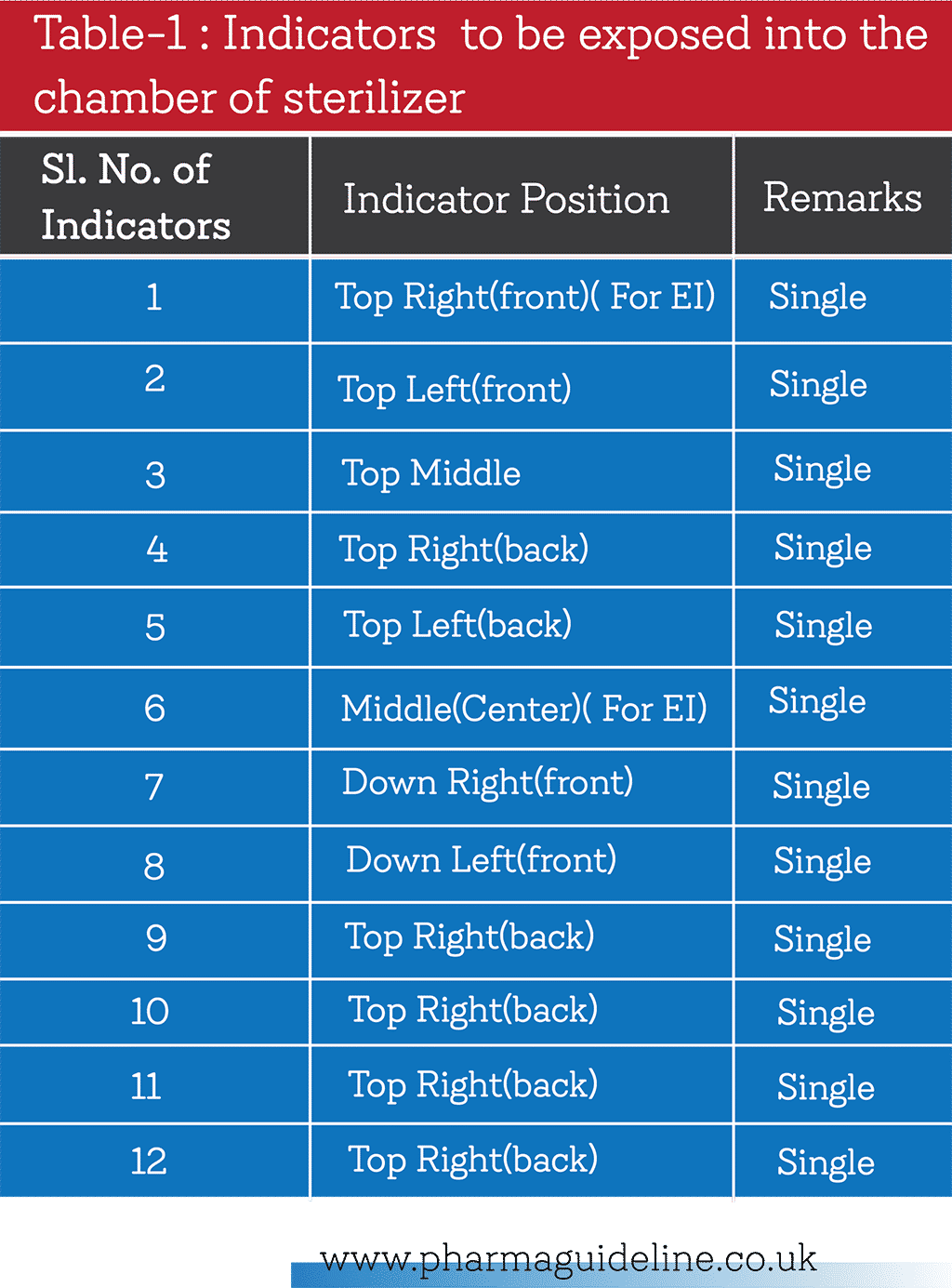
  • Map chamber with most critical area for exposure of BI[Biological indicator] or EI[Endotoxin Indicator].
  • Define location & label each BI or EI.
  • Place EI at 4 points & BI at 12 points as per chamber mapping, mentioned on Table-1.
  • Complete sterilization cycle along with product or empty sterilizer.
  • After sterilization, transfer all indicators to Microbiology Laboratory.
BI[Biological Indicator] Assay
  • Perform whole analysis under Laminar Air Flow workstation.
  • Aseptically open envelopes of BI[Biological Indicator] test strips.
  • Place each test strips including negative control and positive control strips in individual tubes containing [15 to 20]ml of TSB.
  • Identify all tubes.
Incubation of Biological Indicator
  • Incubate the BI strips at [300 to 35]0C for 7 days.
Interpretation of Result

Observe BI[Biological Indicator] tube daily for growth. Growth should occur in positive control tube within 48 hours. The turbidity indicates positive growth of tubes. Sterilizer is valid if following criteria are met:

  • No growth found in exposed all tubes.
  • No growth found in negative control tube.
  • Growth found in positive control tube.
Repeat validation if following result is found :
  • Growth found in one or more than one exposed tube.
  • Growth found in negative control tube.
Sterilizer is invalid if following result are found
  • Growth found in one or more than one exposed tube.
  • No growth found in negative control tube.
  • Growth found in positive control tube.
EI Assay Procedure of LAL Test(Gel Clot Method) :
  • Use the LAL reagent sensitivity 0.125 EU/ml for this assay.
  • Reconstitute each EI vial with 1.0 ml LAL water including Positive control & vortex at least five minutes and then dilute 1:8 by using LAL water at least duplicate.
  • Make a control series (2 λ, λ, λ/2, λ/4) if a new lot of Endotoxin indicator or LAL reagent is used. Otherwise test at λ (Lysate sensitivity) only.
  • Carry out LAL test for exposure vials, positive control and negative control as per Standard Operating Procedure for Bacterial Endotoxin Test.
Incubation of Indicator
  • Incubate all LAL test tubes including positive & negative control at [37±1]0C for [60±1] minutes.

Validation of Dry Heat Sterilizer


Interpretation of Result
  • A more exact calculation of endotoxin reduction is made by finding the end-point of the positive control, by ten-fold & then two fold dilution, & subtracting the logarithms of the exposed vial from the logarithms of the positive control.

Use the logarithm of lamda for the endotoxin concentration in exposed vials when there are negative LAL test results for the undiluted solutions.

The sterilizer is valid if the following criteria are met
  • No clot formed in all exposed tube
  • No clot formed in negative control tube
  • Clot formed in positive control tube
Repeat validation if the following result is found
  • Clot formed in one or more than one exposed tube
  • Clot formed in negative control tube
  • Not clot formed in positive control tube
The sterilizer is invalid if the following result is found
  • Clot formed in one or more than exposed tube
  • No clot formed in negative control tube
  • Clot formed in positive control tube
Corrective Action:
  • If endotoxin found in anyone exposed vial in the repeat test, inform the test result to concerned department & Engineering Department for corrective action.
  • After corrective action, Engineering Department or concerned department shall inform to Microbiology Lab. to perform the validation again.
  • Microbiology Section shall perform the complete test.
Report Preparation

Report the validation in Dry Heat Sterilizer Validation Report by Biological Indicator, Annexure-I and Dry Heat Sterilizer Validation Report by Endotoxin Indicator, Annexure-I

Download All Annexure Here:

Annexure I:  Dry Heat Sterilizer Validation Report by Endotoxin Indicator

Annexure II: Dry  Heat Sterilizer Validation Report by Biological Indicator

Validation of Dry Heat Sterilizer; perform it best way Read More »

Micropipette; Operation, Cleaning and Calibration Procedure

Micropipette; Purpose

To initiate that the procedure is suitable for ideal operation, cleaning and calibration of Micropipette for use in microbiology test.

Scope

This SOP applies for Operation, Cleaning & Calibration of Micropipette, Model: 8-105-00-9 & 8-106-00-9 in Microbiology Section at XX Pharmaceuticals Limited.

Definitions/Abbreviations

N/A

Responsibilities

The roles and responsibility is as follows

Executive/ Senior Executive, Microbiology

Operation, Cleaning and Calibration of Micropipette.

Manager, Microbiology
  • Ensure Operation, Cleaning, Calibration and application of sound technical information.
  • Review that SOP is technically informative.
Head of Quality Assurance

Take initiative to Approval of SOP

Procedure:

Instructions
  • Keep Micropipette always at vertical position on the respective stand.
  • Never sink Micropipette into water.
  • Never reset or adjust the volume.
  • Care should be taken during pipetting that solutions do not enter into Micropipette.
  • Do not try to volume highly viscous solution by this device.
  • Do not use hot solution in this device.
Operation Procedure
  • Check is calibration status of Micropipette. If Micropipette is not calibrated, calibrate it before use.
  • Set desired volume by turning red colored setting screw button at clock wise for increasing and anticlockwise for decreasing the volume.
  • Set micropipette tips on bottom side in tight condition.
  • After setting desired volume, observe display digit.
  • Draw desired volume of solution by pressing red colored setting screw in single punch.
  • Rinse tips least three times with solution at first time.
  • Deliver total volume by pressing same button at double punch.
  • Draw total volume of the solution.
  • Press setting screw for delivery the solution.
  • After use, always keep it on the stand at vertical position.
Cleaning Procedure
  • Clean outer surface with dry cloth.
  • Use 70% IPA solution to disinfect outer surfaces except display of Micropipette.
  • Clean Micropipette before & after use.
Calibration Procedure
  • Set Micropipette reading as 100 µL for Model: 8-105-00-9 & 500 µL for Model: 8-106-00-9.
  • Set tips with Micropipette properly.
  • Take distilled water of temperature at 250C±10C into a beaker.
  • Weigh & tare another 100 ml beaker.
  • Draw 100 µL or 500 µL of distilled water by Micropipette & deliver it into tarred beaker.
  • Record weight of distilled water.
  • Repeat same procedure up to nine times.
  • Calculate the accuracy(% of error) & Precision(% CV) as below :
  • Accuracy (% error) = Mean Value – Reference value/Reference value x 100
  • Precision (% CV) = Standard deviation/mean x 100.
  • Record the result in Micropipette Calibration Record, Annexure-I.
  • Calibration Frequency: Perform the calibration once in a year.
Maintenance

If Micropipette shows any error or any mechanical fault, inform to the supplier or Engineering Department for maintenance, after repairing or maintenance, recalibrate it before use.

Download Annexure Here:

Annexure I Micropipette Calibration Record

Micropipette; Operation, Cleaning and Calibration Procedure Read More »

Antimicrobial preservative effectiveness test & its SOP

Antimicrobial preservative effectiveness test; Purpose

Antimicrobial preservative effectiveness test; To confirm that the concentration of Antimicrobial Preservatives used in different drug preparations are able to kill or destroy or inhibit or prevent or terminate the growth of microorganisms and thus make the product stable throughout its declared shelf life.

Antimicrobial preservative effectiveness test; Scope

This SOP is applicable for Oral liquids tests at Microbiology Laboratory in XX Pharmaceuticals Ltd.

Definition/Abbreviation:  
Preservative:

Antimicrobial preservatives are the substances added to different dosage forms or products to protect or defend them from microbial growth or from different microorganisms that are introduced unintentionally during or succeeding in the manufacturing process.

[] ATCC: American Type Culture Collection

[] SDA: Sabouraud Dextrose Agar

[] TSA: Tryptone Soya Agar

Responsibilities:

The roles and responsibilities are as follows:

Lab Attendant

Sample collection

Executive/ Sr. Executive, Microbiology

Sample collection, analysis of preservative test & respective test report preparation.

Manager, QC/Microbiology
  • Ensure sampling, analysis, documentation & application of sound technical information.
  • Review of this SOP and confirm that the whole procedure is technically sound.
Head of Quality Assurance
  • Take initiative to Approval of this SOP.
  • To ensure the overall implementation of this SOP

Procedure:

Instructions
  • Use Bio-safety Cabinet to Perform tests of Antimicrobial preservative effectiveness of products.
  • Before preparation of media and conduct antimicrobial preservative effectiveness test, Wear a mask, Hand gloves and headgear Bring the media to the boil to dissolve completely before autoclave.
  • Mix well before pouring the substances.
  • Cool the broth media at room temperature (250C) and the agar media at 500C & for use as per the requirement of the test.
Media & Biochemical Preparation

As per Media preparation for Media, preparation SOP prepare the same.

Inoculum Preparation:
  • Remove the vial of pellets from refrigerated storage & allow equilibrating to the room condition.
  • Warm hydrating & diluting fluids to [34 to 38]0C, before use.
  • To achieve a concentration of about 108 cfu per ml, transfer pellets to hydrating fluid.
  • Immediately place the microbial suspension into a [34 to 38]0C incubator for 30 minutes
  • To assure complete hydration, immediately following incubation, vortex the hydrated material to achieve a homogenous suspension.
Inoculation of Microbial Suspension to Product
  • To give inoculums of 105 to 106 microorganisms per ml of product and mix well, inoculate the product to be examined, each with a suspension of the test organisms.
  • The volume of the suspension of inoculums does not exceed 1 percent of the volume of the product.
  • Maintain the inoculated product at the temperature range from [20 to 25]0C and protected it from light.
  • According to the type of the product, Remove 1 ml sample from each container at suitable intervals & determine the number of viable microorganisms using the Pour plate method.
Suitability of counting method for non-sterile products

As per suitability of counting method for suitability of Microbial count, method SOP perform the same.

Test Sample Preparation
  • Aseptically accurately measured 1 ml sample to be transferred from each inoculated product container to a market sterile capped dilution tube containing 9 ml of sample diluent & mix well. The ratio of this dilution is 1:10.
  • Aseptically accurately measured 1 ml sample to be transferred from 1:10 dilution to a second dilution tube containing 9 ml of sterile diluent and mix well. This is the ratio of this dilution is 1:100.
  • Continue this dilution up to 10-5 or as essential levels.
Plating and incubation:
  • Take two sterile petri plates then Take 1 ml quantity sample from each dilution.
  • Maintain the temperature not more than 450C, then For Bacterial count pour 15 to 20 ml of sterile TSA medium into each plate being at and mix well.
  • Maintain the temperature not more than 450C, For Fungal count, pour 15 to 20 ml of sterile SDA medium into each plate being and mix well.
  • Pour two plates with TSA & SDA medium each with 1 ml diluents as the negative control.
  • After solidification incubate them at [20 to 25]0C for 5 to 7 days for the fungal count and [30 to 35]0C for 3 to 5 days for the bacterial count.
Acceptance Criteria
  • For Oral Liquid & Other than Antacids
  • For Bacteria (S. aureus, E.coli & P. aeruginosa)
  • Not less than 1.0 log reduction from the initial count at 14 days.
  • No increase from the 14 days counts at 28 days.
For Fungi (C. albicans, A. brasiliensis)
  • No escalation from the initial calculated count at 14 and 28 days.
For Oral Liquid Antacids Preparation
  • For Bacteria (E.coli, P. aeruginosa, S. aureus)
  • No upsurge from the initial calculated count at 14 and 28 days.
For Fungi (C. albicans, A. brasiliensis)
  • No increase from the initial calculated count at 14 and 28 days.
[Reference of acceptance criteria: USP 41]

Download All Annexure Here:

Annexure I: Preservative Efficacy Test Report Oral Liquid Preparation
Annexure II: Preservative Efficacy Test Report Oral Liquid Antacids Preparation

Antimicrobial preservative effectiveness test & its SOP Read More »

Validation of Laminar Air Flow and Its SOP

Validation of Laminar Air Flow; Purpose

To validate Laminar Air Flow in order to support of processing area and Microbiology Test.

Validation of Laminar Air Flow; Scope

This SOP applies for validation of Laminar Air Flow used in Processing area and Microbiology Section XX Pharmaceuticals Ltd.

Definitions/Abbreviation :

Validation: Validation is the established documented evidence, which provides a high degree of assurance that a specific process will consistently produce a product meeting its predetermined specifications & quality attributes.

DOP Test: Dioctyl Pthalate is a combustible non-toxic colorless oily liquid with slight odor. This chemical is used in HEPA filter integrity test at vaporized condition by DOP Test Meter.

[] HEPA : High Efficiency Particulate Air

[] CSDA : Casein Soyabean Digest Agar

[] SDA    : Sabouraud Dextrose Agar

[] LAF    : Laminar Air Flow

 Responsibilities

The roles and responsibility is as follows

Executive/ Senior Executive, Microbiology

Perform Microbiology Air monitoring of Laminar Air Flow & report preparation.

Executive/ Senior Executive, Engineering

Perform Air Velocity Test, DOP test and report preparation.

Microbiology/ Assistant Manager, Engineering

Ensure Laminar Air Flow Validation, documentation and application of sound technical information.

Head of Quality Assurance

Take initiative to Approval of SOP

Procedure:

Instructions
  • Wear protective items such as sterile latex free gloves, laboratory coat and eye protection (if required).
  • Disinfect whole surface of all apparatus with the help of 70% IPA or any others disinfectants before transferring into Laminar Air Flow.
  • Make sure that all personal ornaments, cell phone are left to prevent unauthorized contamination, before working under Laminar Air Flow.
Microbiological Monitoring
  • Start Laminar Air flow at least before 30 minutes of validation.
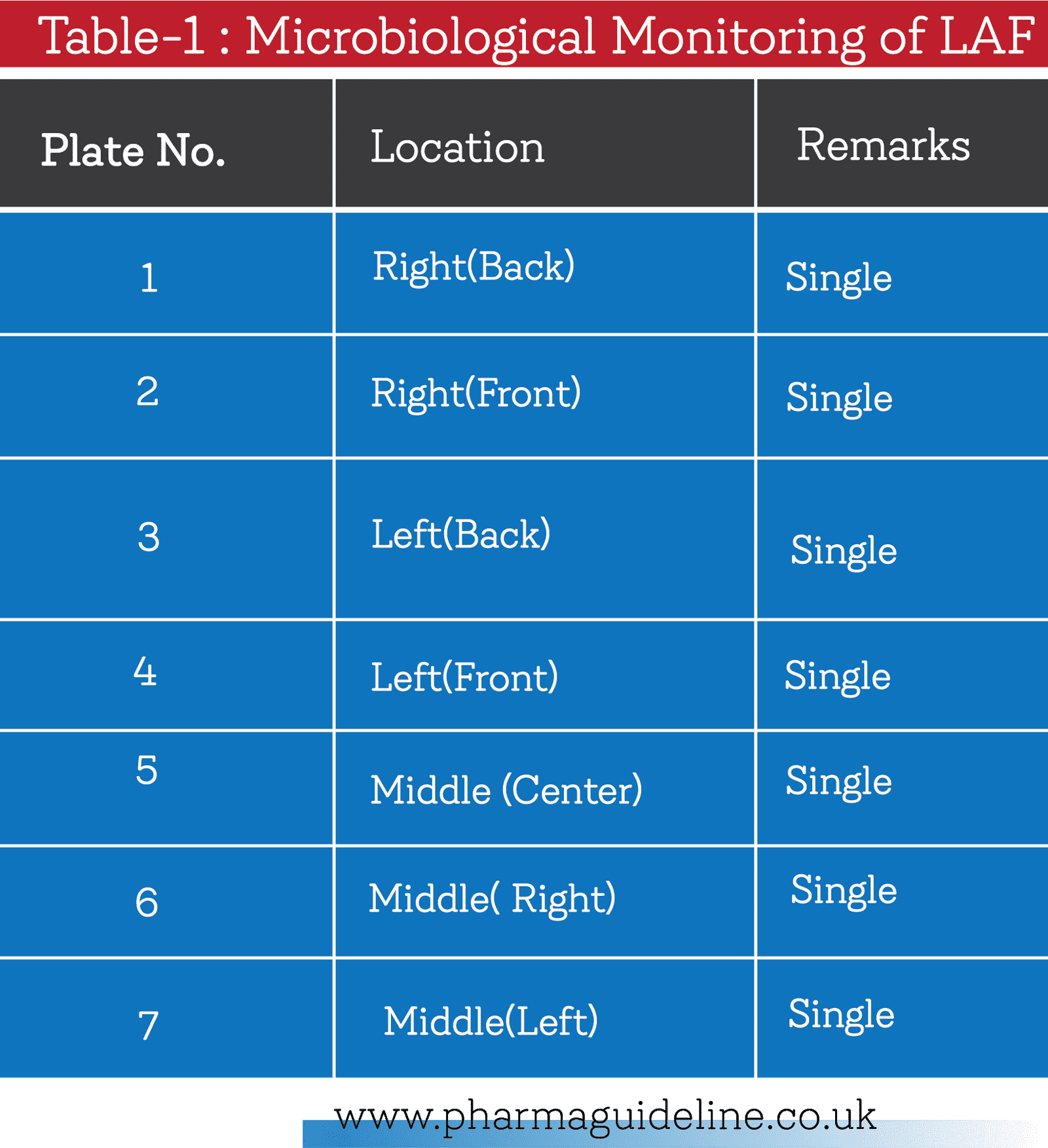
  • Select sampling point as mentioned on Table-1.
  • Expose sterile CSDA and SDA plate for 30 minutes under LAFWS at different location as per sampling points.
  • After sampling, cover all plates with the glass lids.
  • Incubate all CSDA plate at (30 to 35)0C for 72 hours and SDA plate at (22 to 25)0C for 5 days including positive control & negative control plate.
  • After incubation, count the CFU per plate.
  • Report in Laminar Air Flow Validation Report, Annexure-I.
  • Perform this test yearly.
 Detection of Air Velocity
  • Disinfect outer surface of Anemometer with the help of 70% IPA before transferring into LAF.
  • Measure distance 6” from HEPA.
  • Take air flow reading of HEPA of LAF by moving smoker from left to right & top to down.
  • Check that any deviation of reading found for air velocity. If found mark that point.
  • Report Air Velocity & Filter Integrity Test Report of Laminar Air Flow, Annexure-II.

Filter Integrity Test

  • Set DOP Test Meter with DOP test port of LAF.
  • Run machine as per SOP of DOP Test Meter.
  • Take air by smoker of DOP Test & record the reading.
  • Check any deviation of reading.
  • Report Air Velocity & Filter Integrity Test Report of Laminar Air Flow, Annexure-II.
Validation Frequency

Perform LAF Validation once in a year.

Validation of Laminar Air Flow


Corrective Action:

[] If growth obvers in anyone plate, inform the test result to concerned department & Engineering Department for corrective action.

[] If the test result found out of specification in Air Velocity Test or Filter Integrity Test, Engineering department shall take necessary action.

[] Microbiology Section and Engineering Department shall perform the complete test.

Download All Annexure Here:

Annexure I Air Velocity & Filter Integrity Test Report of Laminar Air Flow Biosafety Cabinet
Annexure II Laminar Air Flow Bio-safety Cabinet Validation Report

Validation of Laminar Air Flow and Its SOP Read More »

Microbial Examination of Empty Bottle, Cap & Stopper

Microbial Examination of Empty Bottle, Cap & Stopper; Purpose

To confirm that the bacterial & fungal count & specified microorganisms into empty bottle during filling are within In-house specification.

Scope

This SOP is applicable for microbiological test of empty bottle during filling in Microbiology Section at XX Pharmaceuticals Ltd.

Definitions/Abbreviation

[] CSDA: Casein Soyabean Digest Agar

[] CSDM: Casein Soyabean Digest Medium

[] SDA  :  Sabouraud Dextrose Agar

[] TAMC: Total Aerobic Microbial Count

[] TYMC: Total Yeast & Mould Count

Responsibilities

The roles and responsibility is as follows

Executive, Microbiology

Sample collection, analysis and documentation.

Manager, Microbiology/Quality Control

Ensure analysis of empty bottles, documentation and application of sound technical information.

Head of Quality Assurance

Take initiative to Approval of this SOP

Procedure

Instructions
  • When enter into the test area, wear sterile latex free gloves, mask, laboratory coat & eye protection (if required).
  • Make sure that all personal ornaments cell phone are left to prevent unauthorized contamination, before entrance into test area.
  • Move always gently and never move vigorously into the test area.

General Requirements for the test

Glass Apparatus
  • Sterilized 90 mm Glass Petridish
  • Screw capped Conical Flask 100 ml
  • Screw Capped Test Tube
  • Volumetric Flask 1000 ml
  • Volumetric Flask 500 ml
  • Pipette 2 ml, 10 ml
Media and Reagents
  • Casein Soyabean Digest Agar(CSDA)
  • Casein Soyabean Digest Medium(CSDM)
  • Mac-Conkey Broth
  • MacConkey Agar
  • Neutralized Peptone
  • Sabouraud Dextrose Agar
Others Requirements
  • Surgical Gloves
  • Surgical Cotton
  • 70% IPA or ethanol

Enumeration Method(TAMC & TYMC)

This test quantifies the enumeration of mesophillic bacteria & fungi that may grow under aerobic conditions.

Test Conditions
  • Disinfectant both hands, bottles surface, Laminar Air Flow workstation with 70% IPA or 70% ethanol before starting test.
  • Carry out the test under Laminar Air Flow to avoid contamination.
Culture Media Preparation
  • Prepare different culture media as per requirement.
  • Weigh accurate amount mentioned in the manufacturer label into appropriate flask.
  • Bring to boil completely to dissolve media.
  • Sterilize at 1210C for 15 minutes or as per manufacturer label.
  • Store prepared culture media in air tight flask at 2 to 80
Stock Buffer Solution
  • Take 34 g of Potassium Dihydrogen Phosphate[KH2PO4] in a 1000 ml volumetric flask.
  • Dissolve in 500 ml of Purified Water, adjust to pH 7.2 ± 0.2 & dilute to 1000ml with Purified Water.
  • Dispense 90 ml into each screw capped flask.
  • Sterilize at 1210C for 15 minutes.
  • Store prepared buffer at 2 to 80C for a validated period.
Glassware Cleaning & Sterilization
  • Clean all glassware by 1% detergent initially & then rinse with sufficient tap water.
  • Rinse finally with sufficient Purified Water to remove residual content of detergent.
  • Sterilize all glassware at 2000C for 1 hour.
Sample Size
  • Collect 5 empty sealed bottles from each batch during filling of the products at three stages of Starting, Middle and Ending of operation.

Test Method

  • Carry out anyone from the following mentioned method
Pour plate method
  • Transfer all bottles under Laminar Air Flow.
  • Deseal the cap of all bottles.
  • Add 10 ml sterile meat peptone or phosphate buffer pH 7.0 ± 0.2.
  • Cap the bottles & shake well to mix properly.
  • Mark all petridish as product name, batch number, plate name (CSDA/ SDA) and bottle number & test date.
  • Take 1 ml of rinsing solution from each bottle & pour into two 90 mm sterilized petridish.
  • Add 15-20 ml CSDA into one plate & add 1 ml SDA into another plate.
  • Maintain same manner for the rest 4 bottles.
  • Mix sample with the media by tilting & rotating the plate.
  • Allow to solidify all plates & invert after solidification.
  • Incubate CSDA at 30 to 350C for 3 to 5 days & at 20 to 250C for 5 to 7 days.
  • After incubation, calculate number of cfu per bottle.
Negative Control

Use the diluents as sample in place of test preparations and follow the steps mentioned steps.

Membrane Filtration Method
  • Prepare sample as per Pour Plate Method
  • Filter whole rinsing solution of all bottles individually through 0.45 µm and transfer the filter paper to the surface of CSDA slant for bacterial count and SDA slant for yeast & mold count.
  • Invert plates & incubate all CSDA plates at 30 to 350C for 3 to 5 days & SDA plates at 20 to 250C for 5 to 7 days.
  • After incubation, count the colony of each plate.
  • Calculate number of cfu per bottle.
Negative Control

Use the diluents as sample in place of test preparations and follow the steps mentioned steps.

Surface spread Method
  • Spread not less than 0.1 ml of rinsing solution on surface of two CSDA & two SDA Plate.
  • Dry all plates under Laminar Air Flow work station.
  • Incubate CSDA at (30 to 35)0C for 3 to 5 days & at (20 to 25)0C for (5 to 7) days.
  • After incubation, calculate number of cfu per bottle.
Negative Control

Use the diluents as sample in place of test preparations and follow the steps mentioned steps.

Interpretation of the results
  • The bottles are passed if the observed count is less than specified count.
  • The product is failed if the observed count is greater than specified count of that product.
Test Control
  • Negative control must be negative growth. If found growth in negative control, the test is invalid.

Test for Specified Microorganisms

Suitability of Test Method
  • Add each test strain separately not more than 100 cfu at the time of bottle test mixing with culture media as per standard operating procedure of Suitability of Microbial Count Method.
  • The test is suitable if growth found the specific microorganisms. The test is not suitable if no growth found the specific microorganisms. In that case, add any neutralizer or increase dilution for removal any inhibition of product.
 Test for E. coli
  • Add 10 ml of test sample to 90 ml of CSDM. Incubate at (30 to 35)0C for 18 to 24 hours.
  • Shake the container and transfer 1 ml of CSDM to 100 ml of MacConkey Broth.
  • Incubate at (42 to 44)0C for 24 hours.
  • Sub culture on MacConkey Agar plate from MacConkey broth.
  • Incubate at (30 to 35)0C for (18 to 72) hours.
  • The product complies with the test for E. coli if no red colonies are present with precipitated zone & the biochemical tests are negative.
Test Report Preparation

Microbial Examination Report of  Cap & Stopper, Annexure-I.

Microbial Examination Report of Empty Bottle, Annexure-II.

Download All Annexure Here

 Microbial Examination Report of Cap & Stopper Annexure-I.
 Microbial Examination Report of Empty Bottle Annexure-II.

Microbial Examination of Empty Bottle, Cap & Stopper Read More »

Microbiology Analysis of Surface Swab and its SOP

Microbiology Analysis of Surface Swab; Purpose:

To confirm that the processing area & processed equipment’s are free from any intolerable microorganisms & total aerobic count are within specification.

 Microbiology Analysis of Surface Swab; Scope:

This SOP applies to detect or count of bacteria and Yeast/Mold in Non-sterile Processing, Sterile Processing Area & Testing area of Microbiology laboratory at XX Pharmaceuticals Ltd.

 Definition:  

Swab test & Finger Printing are to check with a view to take timely corrective measures for maintaining a favorable manufacturing environment, minimizing the risk of contamination of the products.

Responsibilities:

The roles and responsibility is as follows

Executive/ Senior Executive, Microbiology

Sample collection, analysis of swab and document preparation

Manager, Microbiology

Confirm sampling, analysis, documentation & application of updated technical information.

Head of Quality Assurance

Take initiative to Approval of this SOP

Procedure:

Instructions
  • Disinfect with the help of 70% IPA/Ethanol the whole outer surface of machine & all apparatus.
  • Wear gloves, mask & sterilized garments before entrance into aseptic area.
  • Minimize the movement into aseptic area or others sampling area.
Swab Test of Garments/Floor/Wall/Equipment
Sterilization of Swab Kits and Culture Media
  • Prepare swab kits with cotton bud as per requirement.
  • Roll tightly a small amount of cotton of surgical grade at one end of the glass rod.
  • Place cotton bud in a narrow test tube.
  • Plug end of test tube with the help of non-absorbent cotton.
  • Prepare CSDA [Casein Soybean Digest Agar], CSDB [Casein Soybean Digest Broth] according to the requirement of the test. Distribute 50ml of CSDB in each conical flask.
  • Sterilize media & test tubes containing cotton bud & Template steel plate at 1210C & 15lbs pressure for 15 minutes in an autoclave.
Swab Collection
  • Select a steel template of 5 x 5 cm. size.
  • Sterilize steel template by alcohol flaming before the test
  • Wipe cotton bud slowly & firmly in interior direction of steel template on the surface, selected for test.
  • Rotate cotton bud against direction of the overall wiping movement.
  • Repeat process for three times.
Collected Sample Preservation
  • Perform test within 30 minutes after collection of sample.
  • Preserve sample at 2 to 80C at not more than 12 hours if test is not performed within 30 minutes.
 Test Method
  • Place swab immediately in a bottle containing 50ml of CSDB.
  • Pull cotton free in the medium.
  • Shake bottle containing swab for sometime in a shaker.
  • Pour 1ml of diluent into sterile petridishes with aid of a sterile pipette.
  • Add 20 to 25ml of Tryptone Soy Agar at about 45 to 500C to the plate.
  • Mix medium with sample by rotating petridish.
  • Allow medium to solidify & then keep plate for incubation at 370C for 48 hours.
  • After incubation period count number of colonies either by colony counter or visual inspection.
  • Carry out the test in every week.
Interpretation of Test Result
  • Report swab test if test result found in Swab Test Report, Annexure-I.
  • If test result found out of specification, repeat the test.
  • Recollect swab sample from same area or same person.
  • Carry whole test as previously performed
  • If test result found within specification as per table-1, report the test result in Annexure-I.
Personnel Finger Printing :
Culture Media Preparation and Sterilization
  • Prepare CSDA [Casein Soybean Digest Agar] for the test according to the requirement of the test following the instructions of the respective manufacturer.
  • Autoclave medium at 1210C & 15lbs pressure for 15 minutes.
  • Pour approximately (20 to 25) ml of medium in each plate after autoclaving.
  • Allow medium to solidify & then keep in refrigerator until use.
  • Dry surface of agar media.
  • Do not use prepared plate after 72 hours.
  • Take medium aseptically to respective department.
Collection of Finger Print
  • Take finger print of both the hands, of each person working in the aseptic area in the separate plate.
  • Mark each plate with person’s name, area /room no., hand (right/left) and date.
  • Aseptically bring plates back to microbiology laboratory
  • Incubate plates at (30 to 35)0C for 48 hours.
  • After incubation count number of colony forming unit formed on each plate either by visual examination or by colony counter.
  • Carry out test every week for sterile process operator & once in a month for Non-sterile process operator.
 Interpretation of Test Result
  • Report swab test if test result found in Swab Test Report, Annexure-I.
  • If test result found out of specification, repeat the test.
  • Recollect swab sample from same area or same person.
  • Carry whole test as previously performed
  • If test result found within specification as per table-1, report the test result in Annexure-I.
Out of Specification

If test result found out of specification, send test report to concerned Sectional Head for corrective action.

After corrective action, repeat the test for specific area or person.

Download the All Annexure Here

Annexure 1 Swab (Microbial) Test Report
Annexure II Finger Print Test Report

Microbiology Analysis of Surface Swab and its SOP Read More »

Maintain and preserve of standard culture and its SOP

Maintain and preserve of standard culture; Purpose

To maintain & preserve the standard culture in order to use in specific microbiology test.

Maintain and preserve of standard culture;Scope

This SOP applies to preserve & maintain stock standard culture in Microbiology Laboratory of at XX Pharmaceuticals Ltd.

Definitions

Standard Culture

Standard culture is a specific microorganism of a specific strain that is recognized by BP/USP/Eur. Ph.  and certified by  ATCC/NCTC or any other standard culture bank. That culture is used in the different microbiological test such as Growth Promotion Test, Biological Assay of Antibiotics, Sterilizer Validation, Antimicrobial Preservative Effectiveness Test, Microbial Count suitability Test & Sterility Test Validation.

  • ATCC: American Type Culture Collection
  • NCTC: National Type Culture Collection
Responsibilities
Executive/ Senior Executive, Microbiology
  • Preparation of Culture Media, sub-culture, preservation and record keeping.
  • Follow the instructions of this procedure correctly.
Manager, Microbiology
  • Ensure that this procedure is kept up to date.
  • Ensure culture maintenance activities & proper documentation
  • Ensure appropriate personnel from the section are trained on this procedure.
  • Confirm that SOP is technically sound & reflects the required working practices.
Head of Quality Assurance

Take initiative to approval of this SOP

Procedure:

Instructions
  • Standard microorganisms are usually non-pathogenic but those are unscrupulous pathogen. So before handling it, wear protective items such as sterile latex free gloves, laboratory coat and eye protection (if necessary).
  • Move always gently. Don’t move vigorously into the test area.
  • Disinfect the whole surface with the help of 70% IPA or any others suitable disinfectants. After completion of sub-culture or transfer of pellets.
  • Take away all used items those are directly contacted with standard micro-organisms and Leave it at designated containers safely.
  • Confirm the waste container is tightly capped until autoclaving.
  • Never touch the apparatus directly in open hands those are used.
  • Make sure that all personal ornaments, cell phone are left before entrance into the test room, to prevent unwanted contamination.
Sterilization of Apparatus & Glassware:
  • Sterilize all glassware plus Latin Square Plate and others heat stable apparatus at 2000C for 60 minutes in hot air oven using a validated process.
  • Use the glassware when the temperature reduce to 400
Preparation of Culture Media:
  • Select media & diluents as per instruction of BP or USP.
  • Prepare required amount of Culture media of CSDA [Casein Soybean Digest Agar] & CSDB [Casein Soybean Digest Broth] and SDA [Sabouraud Dextrose Agar] as per indication by manufacturer instructions.
  • Bring to boil to dissolve it completely.
  • Distribute 10 ml of the media into each screw capped test tube.
  • Sterilize at 1210C for 15 minutes.
  • Cool media approximately to (45 to 50)0
  • Allow to solidify agar media to prepare slant.
  • Transfer broth media flasks into the test room.
  • Dry surface of agar slant keeping into Laminar Air flow or Bio-safety Cabinet.
  • Incubate sterilized CSDA [Casein Soyabean Digest Agar]/broth at (30 to 35)0C for 48 hours and SDA [Sabauroud Dextrose Agar] for 5 days at (22 to 25)0C for checking sterility of the media.
  • After incubation observe each test tube for growth. If no growth found, the media is suitable for use.
  • Store media at (2 to 8)0C into refrigerator until it use.
Preparation of Standard Microorganism:
Test Conditions

[] Disinfectant the surface of all equipments including LAF or BSC.
[] Rub hands with the help of 70% IPA.
[] Always maintain aseptic condition during handling of standard microorganisms.

Inoculation Technique
  • Opening of Standard Culture vial/ampoule
  • Read carefully label’s instructions of standard culture vial/ampoule.
  • Aseptically break the ampoule/vial under Laminar Air Flow.
  • Remove pellets from vial/ampoule aseptically as per instruction of the label.
  • Tight the container for the next time use after removing pellets.
Inoculation of Standard Microorganisms:
  • Label on the each tube with the name of standard culture.
  • Reconstitute standard culture pellets as per instructions of manufacturer.
  • Aseptically Transfer 1 or 2 pellets of dehydrated culture of bacteria and fungus in the test tubes containing CSB.
  • Incubate test tubes containing bacterial culture at (30 to 35)0C for 3 days and the tubes containing fungi culture at (20 to 25)0C for 5 days. This will serve as mother culture.
  • After incubation, observe the growth of standard culture that should be turbid or settle growth.
  • Transfer & streak from the broth culture on surface of agar slant.
  • Incubate test tubes containing CSA at (30 to 35)0C for 3 days & the SDA tubes containing fungi culture at 20 to 250C for 5 days.
  • Observe good growth, then preserve it at (2 to 8)0C in refrigerator with proper labeling.
  • Discard previous culture by autoclaving at 1210C for 30 minutes.
  • Subculture microorganism to freshly prepared culture media once in a month.
Preparation of spore suspension:
  • Transfer sterilized media under Laminar Air Flow or Bio-safety Cabinet.
  • Keep plate for incubation at 350C for 7 days.
  • After incubation period take out culture with aid of sterilized glass beads & pre-sterilized diluents (0.001 g/L containing Manganese sulfate) by rotating plate.
  • Pour culture suspension along with few of those glass beads in a 100ml flask containing 50ml of sterilized diluents.
  • Heat culture suspension at 700C for 30 minutes or 800C for 10 minutes in a water bath.
  • Cool suspension & then keep inside a refrigerator not exceeding at 40C
  • Don’t use spore suspension more than 60 days.
Preparation of standard culture suspension (Vegetative form):
  • Prepare culture suspension by regular subculture on Nutrient Agar slant or Sabouraud Dextrose Agar.
  • Before using a culture maintained in a slant, subculture the organism in another slant containing a specified medium.
  • Keep the slant for incubation at (30 to 35)0C for bacteria for (24 to 30) hours and at (20 to 25)0C for fungi for (3 to 5) days.
  • Store slant in the refrigerator not exceeding at 40C if not used immediately.
  • Don’t use this suspension at more than 7 days.
Stock Maintenance of Standard Microorganisms:
  • Check expiry date before use of standard microorganisms.
  • Don’t use if the expiry date is exceeded & discard it after autoclaving.
  • Raise requisition for standard culture before exceed of expiry date.
 Report Preparation

Maintain Register of standard culture maintenance Record, Annexure-I.

Download Annexure:

Download the annexure here: Standard Culture Maintenance Record

Maintain and preserve of standard culture and its SOP Read More »