Filter cleaning procedure, The purpose of this SOP is to define the cleaning procedure of filters of various process machines of Production, Product Development and Warehouse departments.
Scope:
This Standard Operating Procedure applies to the fluid bed dryers, coating machines, dust collectors of tablet compression machine, laminar air flow unit, dispensing and sampling booths of production, product development and warehouse department which are located of XX Pharmaceuticals Ltd.
Definitions / Abbreviation:
[][]FBD: Fluid Bed Dryer. [][]HEPA: High Efficiency Particulate Air. [][]EHS: Environment Health and Safety. [][]PPE: Personal Protective Equipment. [][]SOP: Standard Operating Procedure. [][]W.C: Water column (pressure unit). [][]PD: Product Development. [][]PAO: Poly Alpha Olefin.
Responsibilities:
[][]The roles and responsibilities are as follows:
Engineering (Validation) Department
[][]Preparing the SOP and revise it when necessary.
Engineering (Maintenance) Department
[][]To provide necessary support to the technician for cleaning the filters. [][]To check that the filters are properly cleaned/changed. [][]To check that the log book is properly filled.
Technician
[][]To clean/change the filters when necessary.
Head of Engineering
[][]To ensure filters are cleaned/changed according to the SOP.
Head of Quality Assurance
[][]To approve the SOP. [][]To ensure overall implementation of this SOP.
Procedure:
Precautions:
[][]All operational work must be done safely in accordance with the requirements of the Plant Safety Statement and the safety notices around the plant. Specific attention must be paid to the following: [][]Use all Personal Protective Equipments such as goggles, masks, hand gloves etc. during cleaning/changing the filters. [][]Disconnect the electrical power before opening the filters. [][]Ensure all utilities before doing any kind of cleaning/changing task.
Cleaning and Changing procedure:
[][]Filters of FBD: There are five types of filters in FBD such as pre filter, medium filter, HEPA filter, product retaining filters and the cartridge filters of dust collector. [][]To clean the cartridge filters and pre filters following procedures are followed:
Dismantle the filter from the filter housing.
[][]Clean the filters using compressed air at a pressure of 1-2 bar. [][]Then take the filters to the filter cleaning area and keep the filters drowning in the potable water for 2-3 hours. [][]Then take out the filters from the water and partial drying is done by blowing compressed air at a pressure of 1-2 bar. [][]After that, dry the filters under the sunlight. [][]Finally, compressed air is used after sunlight to remove any dirt from the filters. [][]Fix the filter into the filter housing. [][]The pre filters are cleaned after every 15 days. An exchange is only required, if dirt is visible or any part of the filter is worn out. [][]The cartridge filters are cleaned if the differential pressure is equal to or more than 4 in. of W.C. An exchange is only required, if dirt is visible or the differential pressure does not decrease after cleaning or any part of the filter is worn out. [][]The medium filters and HEPA filters of inlet air handling unit are checked on every 3 months. Change the filters if the differential pressure is equal to or more than 4 in. of W.C. [][]The product retaining filters are cleaned through production SOP. [][]Filters of Coating machine: There are four types of filters in the coating machine such as: pre filter, medium filter, HEPA filter and cartridge filters of dust collector [][]The cleaning procedure of pre filter and cartridge filter of dust collector is as same as it is described in the previous section The filters are cleaned after every 15 days. An exchange is only required, if dirt is visible or any part of the filter is worn out. [][]An exchange of the filters is only required, if dirt is visible or the differential pressure does not decrease after cleaning or any part of the filters is worn out. [][]The medium filter and HEPA filters of inlet air handling unit are checked every 3 months. Change the filters if the differential pressure is equal to or more than 4 in. of W.C. [][]Filters of Dust Collector of Tablet Compression machine: They are cleaned using compressed air at a pressure of 1-2 bar after each batch of operation. Full cleaning (as per the procedure described in the previous section is done after 5 batches of operation.
Filters of Dispensing and Sampling Booth:
[][]There are pre filter, medium and HEPA filters in dispensing and sampling booths. [][]The pre filters are cleaned on every month according to the procedure described in the previous section. [][] The medium filters are cleaned using compressed air at a pressure of 1-2 bar when the differential pressure across the filter is equal to or more than 250 Pa. [][]An exchange is only required, if dirt is visible or the differential pressure does not decrease after cleaning or any part of the filter is worn out. [][]The HEPA filters are changed when the differential pressure across the filter is equal to or more than 400 Pa.
Filters of Laminar Air Flow unit of Dialysis Fluid area:
[][]There are two types of filters in the Laminar Air Flow unit such as: Pre filter and HEPA filter. [][] The cleaning procedure of pre filter is as same as it is described in the previous section . [][]The pre filter will be cleaned after every 15days. [][]The HEPA filter will be checked on every month and will be changed if the differential pressure exceeds 250 Pa. [][]An exchange is only required, if dirt is visible or any part of the filters is worn out. [][]The filter integrity test (PAO test) of all the HEPA filters will be performed on every year. [][]The filters will be changed in case of failure to meet the acceptance criteria of this test.
The technician will fill up the log books of filter cleaning/changing after cleaning or changing the filters.
Color Coding, The purpose of this SOP is to define the color coding procedures of utility lines of XX Pharmaceuticals Ltd.
Color Coding, Scope:
This SOP covers the color coding procedure of utility lines in Production, PD, QC and Microbiology area of of XX Pharmaceuticals Ltd.
Definitions / Abbreviation:
[][]SOP: Standard Operating Procedure. [][]PW: Purified Water [][]CA: Compressed Air [][]WFI: Water For Injection [][]Elec: Electric line [][]PoW: Potable water [][]HW: Hot potable water [][]NT: Nitrogen line [][]PD: Product Development [][]CWFI: Cold Water For Injection
Engineering (Validation) Department
[][]Preparing the SOP and revise it when necessary. [][]Identification of the utility lines with the assistance of Engineering persons.
Engineering (Maintenance)
[][]To put on the labels on respective utility lines.
Respective department
[][]To ensure that the labels are properly maintained. [][]To inform the engineering department if any label is torn or harmed by any means.
Head of Engineering
[][]To ensure that all the utility lines are properly labeled.
Head of Quality Assurance
[][]To approve the SOP. [][]To ensure overall implementation of this SOP.
Annexure:
N/A
Procedure:
Cleaning and Changing procedure:
[][]The list of utility lines which are to be marked is as follows: [][]Purified water Potable water [][]Cold Water For Injection [][]Hot potable water [][]Water for injection [][]Compressed air Pure steam [][]Nitrogen line [][]Electric cable
The color coding procedure of each line is described below:
Purified water:
[][]All Purified Water lines must be tagged using an arrow head, Dark green colored tag. The length and width of the tag will be 18 cm and 3.0 cm respectively. “PURIFIED WATER” must be written in the middle of the tag and the font would be Cambria, bold, and black color on white background as well. The sample of the tag is shown below:
Potable Water:
[][]All Potable Water lines must be tagged using an arrow head, light green colored tag. The length and width of the tag will be 18 cm and 3.0 cm respectively. “POTABLE WATER” must be written in the middle of the tag and the font would be Cambria, bold and black color on white background as well.
Hot Potable Water:
[][]All Hot Potable Water lines must be tagged using an arrow head, light green colored tag and it will be surrounded by a red color band along its periphery. The length and width of the tag will be 18 cm and 3.0 cm respectively. “HOT POTABLE WATER” must be written in the middle of the tag and the font would be Cambria, bold black color on white background as well.
Water For Injection:
[][]All WFI lines must be tagged using an arrow head, dark green colored tag and it will be surrounded by a red color band along its periphery. The length and width of the tag will be 18 cm and 3.0 cm respectively. “WATER FOR INJECTION” must be written in the middle of the tag and the font would be Cambria, bold and black color on white background as well.
Compressed air:
[][]All Compressed Air lines must be tagged using an arrow head, dark blue colored tag. The length and width of the tag will be 18 cm and 3.0 cm respectively. “COMPRESSED AIR” must be written in the middle of the tag and the font would be Cambria, bold and black color on white background as well.
Pure Steam:
[][]All Pure Steam lines must be tagged using an arrow head, ash colored tag. The length and width of the tag will be 18 cm and 3.0 cm respectively. “PURE STEAM” must be written in the middle of the tag and the font would be Cambria, bold and black color on white background as well.
Nitrogen:
[][]All Nitrogen lines must be tagged using an arrow head, light blue colored tag. The length and width of the tag will be 18 cm and 3.0 cm respectively. “NITROGEN” must be written in the middle of the tag and the font would be Cambria, bold and black color on white background as well.
Electric line:
[][]All electric lines must be tagged using an arrow head, red colored tag. The length and width of the tag will be 18 cm and 3.0 cm respectively. “ELECTRIC CABLE” must be written in the middle of the tag and the font would be Cambria, bold and black color on white background as well.
Cold Water For Injection:
[][]All Cold Water For Injection lines must be tagged using an arrow head, dark green colored tag and it will be surrounded by a light blue color band along its periphery. The length and width of the tag will be 18 cm and 3.0 cm respectively. “WATER FOR INJECTION” must be written in the middle of the tag and the font would be Cambria, bold and black color on white background as well.
Chilled Water:
[][]All Chilled water lines must be tagged using an arrow head, blue colored tag. The length and width of the tag will be 18 cm and 3.0 cm respectively. “CHILLED WATER” must be written in the middle of the tag and the font would be Cambria, bold and black color on white background as well.
Pure Steam condensate:
[][]All Pure Steam condensate lines must be tagged using an arrow head, dark green colored tag and it will be surrounded by a yellow color band along its periphery. The length and width of the tag will be 18 cm and 3.0 cm respectively. “PURE STEAM CONDENSATE” must be written in the middle of the tag and the font would be Cambria, bold and black color on white background as well.
[][]All the tags will be put on the utility lines by the respective engineer. [][]The tag will be maintained properly by the respective departmental persons. If the tag is torn or harmed by any means, the engineering department must be informed to replace it.
AC Store Room, The purpose of this SOP is to define the standard operating and maintenance procedure of AC store room in order to ensure its smooth & trouble-free operation.
AC Store Room, Scope:
This Standard Operating Procedure applies to the AC store rooms of XX Pharmaceuticals Ltd.
Definitions / Abbreviation:
[][]AC: Air Conditioner.
Responsibilities:
[][]The roles and responsibilities are as follows:
Engineering (Validation) Department
[][]Preparing the SOP and revise it when necessary.
Engineering (Maintenance) Department
[][]To provide necessary support for smooth operation & maintenance of AC room. [][]To ensure that the operators are responsible to carry out the operation and maintenance work and regular checking of the critical components and logbooks. [][]To develop a list of spare parts based on the manufacturer’s recommendations and to forward the list to the Planning and Procurement department with a request to place order as required.
Operators
[][]To operate the AC room according to the SOP. [][]To do the maintenance according to the check list and fill up the maintenance log book.
Manager, Engineering
[][]To ensure that the operation and maintenance of air compressor are done properly. [][]To approve any maintenance/plans related to the compressor.
Manager, Quality Assurance
[][]To ensure overall implementation of this SOP.
Procedure:
Precautions:
[][]All operation and maintenance work must be done safely in accordance with the requirements of the Plant Safety Statement and the safety notices around the plant. Specific attention must be paid to the following: [][]Use personal protective equipment before doing any kind of maintenance. [][]Persons switching on the machines shall take adequate precautions to ensure that there is no one doing any kind of maintenance of machine. [][]Switch off the power before doing maintenance.
[][]Keep the door shut while the AC is running.
System Description:
[][]There are two split type AC in the AC store room to maintain the desired temperature. The capacity of each AC is 2.5 ton. Each cooling unit consists of one indoor unit and one out door unit. The operation of AC is remote controlled. The desired temperature is set using the remote. [][]Two ACs do not run at a time. While one runs another one stands by.
Operating Procedure:
[][]Starting of AC of AC store room: [][]Insert the plug of AC into the power socket and switch ON the power. [][]Press the button on the remote to switch ON the AC. [][]Set the desired temperature by pressing up and down arrow key. [][]Select the AUTO or COOL mode by pressing the button.
During Operation:
[][]During operation the temperature of AC store room is controlled automatically in automatic mode. [][]The AC of AC store room is kept running 24 hrs. When one AC runs another one stands by.
Stopping procedure:
[][]Press button to switch OFF the AC. [][]Unplug the plug from the power socket.
Maintenance Program:
Monthly Maintenance
[][]Check the current consumption of Compressor. [][]Clean the filter. [][]Clean the evaporator coil by blower. [][]Clean the outdoor unit. [][]Check and clean the blower. [][]Check the refrigerant pressure. The pressure should be 50 – 60 psi. If the gas pressure is lower, recharge with new refrigerant. [][]Check for any icing over the evaporator coil.
Cold Room, The purpose of this SOP is to define the standard operation and maintenance procedure of Cold room in order to ensure its smooth & trouble-free operation.
Cold Room, Scope:
This Standard Operating Procedure applies to the Cold rooms which are located at General and Cephalosporin Block.
Definitions / Abbreviation:
[][]N/A.
Responsibilities:
[][]The roles and responsibilities are as follows:
Engineering (Validation) Department
[][]Preparing the SOP and revise it when necessary.
Engineering (Maintenance) Department
[][]To provide necessary support for smooth operation & maintenance of cold room. [][]To ensure that the operators are responsible to carry out the operation and maintenance work and regular checking of the critical components and logbooks. [][]To develop a list of spare parts based on the manufacturer’s recommendations and to forward the list to the Planning and Procurement department with a request to place order as required.
Operators
[][]To operate the cold room according to the SOP. [][]To do the maintenance according to the check list and fill up the maintenance log book.
Head of Engineering
[][]To ensure that the operation and maintenance of air compressor are done properly. [][]To approve any maintenance/plans related to the compressor.
Manager, Quality Assurance
[][]To ensure overall implementation of this SOP.
Procedure:
Precautions:
[][]All operation and maintenance work must be done safely in accordance with the requirements of the Plant Safety Statement and the safety notices around the plant. Specific attention must be paid to the following: [][]Use personal protective equipment before doing any kind of maintenance. [][]Persons switching on the machines shall take adequate precautions to ensure that there is no one checking or working on the control panel of the machine. [][]Keep the door shut during operation.
System Description:
[][]The Cold room of both Cephalosporin and General Block has been manufactured by Frigair. [][]The raw materials are stored in the room at a temperature of 2 – 8 ⁰C. There is a split type AC of capacity 5 ton to maintain the temperature. [][]The indoor unit contains evaporator, blower etc. [][] The outdoor unit contains compressor, condenser, oil separator, filter dryer etc. There is a data logger to monitor the temperature of cold room for 24 hrs.
Operating Procedure:
Starting of Cold room:
[][]Switch ON the main switch. The Yellow and blue indicator will be ON. [][]Then switch ON the blower by turning the switch to ON position. The blue indicator light will be ON. [][]After 5 minutes compressor will be ON automatically. The BLUE indicating light will be ON. [][]To set the required lower temperature, press the SET button. Then press up and down arrow button to set the required temperature. [][] The temperature band is programmed as 5.5⁰C i.e if the lower temperature is set at 2.5 ⁰C, the higher temperature will be automatically set at 8.0⁰C.
During Operation:
[][]During operation check for any alarm. If the compressor and blower trip then the trip light will be ON and buzzer will give alarm. [][]If the temperature of cold room becomes very much lower, the CC Heater will be ON and compressor will be OFF. [][]In that case, the CC heater indicating light will be ON. [][]In case of icing, the compressor, blower will be OFF and CC heater will be ON. The Defrost indicating light will be ON. [][]Check the temperature in the display of monitor. [][]Check the data logger. Change the page once a week because one page is used for a week.
Stopping procedure:
[][]Switch off the compressor by turning the switch to OFF position. The indicating light will be OFF. [][]Then switch off the blower by turning the switch to OFF position. The indicating light will be OFF. [][]Switch off the main switch. The Yellow and Blue indicating light will be OFF.
Maintenance Interval/ Maintenance action to be taken
Daily Maintenance
>>Check for any alarm.
>>Check whether all the equipments operate sequentially.
Weekly Maintenance
>>Clean the outdoor unit.
>>Clean the blower.
>>Clean the drain pan of indoor unit.
Monthly Maintenance
>>Check the refrigerant pressure.
>>The pressure should be 50 – 60 psi.
>>If the gas pressure is lower, recharge with new refrigerant.
Instrument calibration, This SOP ensures that all type laboratory instruments of QC, PD, IPQC, Microbiology and balances of Production department are appropriately calibrated and calibration status maintained on due time.
Scope :
This procedure is applicable for calibration frequency of all types of laboratory instruments installed in QC, PD, IPQC, Microbiology and balances of Production department of General Block of XX Pharmaceuticals Ltd.
[][]Ensure that the instructions of this procedure are correctly followed. [][]Ensure that all equipment’s are included in the Instrument list. [][]Maintain and track the calibration schedule. [][]Ensure that all equipment’s bear appropriate calibration label and are used after calibration. [][]To verify the third party calibration report and raw data.
Manager, Quality Control
[][]Ensure that this procedure is kept up to date. [][]Ensure that the calibration requirement are assessed and are fully documented for all pieces of the instrument. [][]Ensure appropriate personnel from the section are trained on this procedure. [][]Confirm that SOP is technically sound and reflects the required working practices.
Manager, Quality Assurance
[][]Approval of SOP. [][]Approval of calibration frequency and calibration schedule.
Precaution(s):
[][]There are no significant hazards or special instructions relating to the process/activities described in this SOP.
Procedure:
[][]Calibrate the equipment regularly as per frequency stated in the instrument calibration frequency (prepared as per format in Annexure-I) and as per calibration due date stated in the instrument calibration schedule (prepared as per format in Annexure-II) for individual equipment. [][]Review the instrument calibration frequency when new instrument is included. [][]Review the instrument calibration schedule yearly. [][]Mention the responsibility (Third Party / Supplier name) for external calibration and (calibrator name and department) for internal calibration. [][]Calibrate the instrument within 3 days of calibration due for monthly calibration period, within 7 days of calibration due for 3 and 6 monthly calibration period and 15 days of calibration due for yearly calibration period. [][]In case of any breakdown or replacement of any damaged part where calibration needs to be carried out, the calibration schedule will be reviewed accordingly. [][]Executive/ Sr. Executive of respective department will intimate the Engineering department/ Supplier service engineer/ outside agencies for the calibration of the instruments/ equipments. [][]Maintain all standards, reagents, instruments and equipments etc. required for calibration. [][]Calibrate the instrument across the operating range at a frequency appropriate to the reliability and frequency of use. Tolerance must be specified and should reflect the manufacturer’s specification or process tolerance or whichever the tightest. [][]Re-evaluate calibration requirement immediately if there is any change in the instrument in use. [][]Calibration must be performed by trained personnel or by approved Third Party Service Engineer. [][]Calibration record must include:
=>Equipment name, model number and instrument ID No.
=>The name of the person who carried out the calibration.
=>Date of calibration.
=>The date when calibration is next due. [][]For calibration, use reference standards or reference instruments whose calibration is traceable. [][]Store the calibration device, certified standard weight in a secure place. [][]For internal calibration, affix the calibration sticker label “ CALIBRATED” (format of calibration labels should be as per SOP: Calibration management program, Ref. No. SOP/ENG/00Y/XX, where XX refers to current version no.), with performer initial, date of completion and calibration due. [][]For external calibration, affix the calibration sticker provided by external calibrator with performer’s initial, date of completion and calibration due. [][]If the instrument is found out of tolerance/ limit during calibration, a label ‘Out of calibration” will be affixed on the instrument (as per SOP: Calibration management program No. SOP/ENG/00Y/XX, where XX refers to current version no.).
Notify the relevant person/ department/ organization to repair (or replace if necessary) the instrument in a timely manner.
HEPA filter, High-Efficiency Particulate Air/ High-Efficiency Particulate Arrestance Filter / High-Efficiency Particulate Absorbing Filter is known as HEPA filter denote higher degree of efficiency. The efficiency level denote the grade of the HEPA filters. There are several grades of HEPA filters available as per their area of application.
A standard HEPA filter must remove the particles from the air at least 99.5%[EU standard] or 99.97%[ASME,US.DOE] having particle diameter equal to 0.3 μm and subsequently increase efficiency with particle diameter greater than or equal to0.3 μm.
All type of standards HEPA filter generally retain particle and microorganism like dust, pollen, dirt, moisture, virus (0.02-0.3 μm), bacteria (0.2-2.0 μm), Bacillus subtilis, submicron liquid aerosol (0.02-0.5 μm), Penicillium citrinum, Aspergillus niger, Clostridia, Staphylococcus epidermidis, Bacilli, Bacteroidia, photocatalytic oxidation (PCO) etc.
HEPA filters use in wide area since its commercialization at 1950 where need to control contamination-
Aerospace industry
Cosmetic industry
Materials dispensing area
Electronics
Food Industry
Hard disk drives mfg. industry
Hospitals
Medical devices
Microbiological Lab
Nuclear Plant
Pharmaceuticals
Sterile products mfg. facility
Semiconductor industry
Vaccine and blood products mfg. area
Vehicle industry
Type of HEPA filters
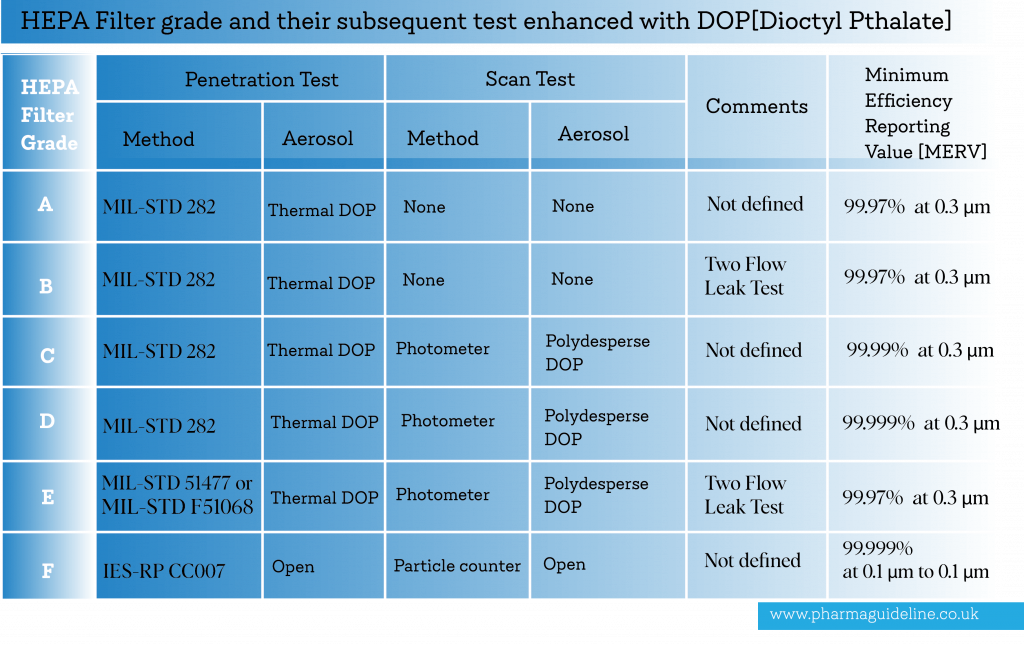
Generally HEPA filters can be classified as [A], [B], [C], [D], [E] and [F]. Types testes are demonstrates on the following table.
How it works?
All type of HEPA filters are generally composed of mat where fibers are randomly arrange, these fibers are actually set of poly propylene or fiberglass varies diameter between 0.5 and 2.0 micrometers. Frequently use tangled bundles of fine fibers to prepare these filters. Air passes through the convoluted pathway crated by the tangled bundles of fine fibers.
Actually this fibers act like sieve which retain the big particles which subject to try pass through it. Most time the smaller particles can’t hold its motion when they are passed with air, in result the small particle crush with the fibers. As per Brownian motion, the small particle possess the little materiality to move randomly with air as these particles are suffered to bombard action.
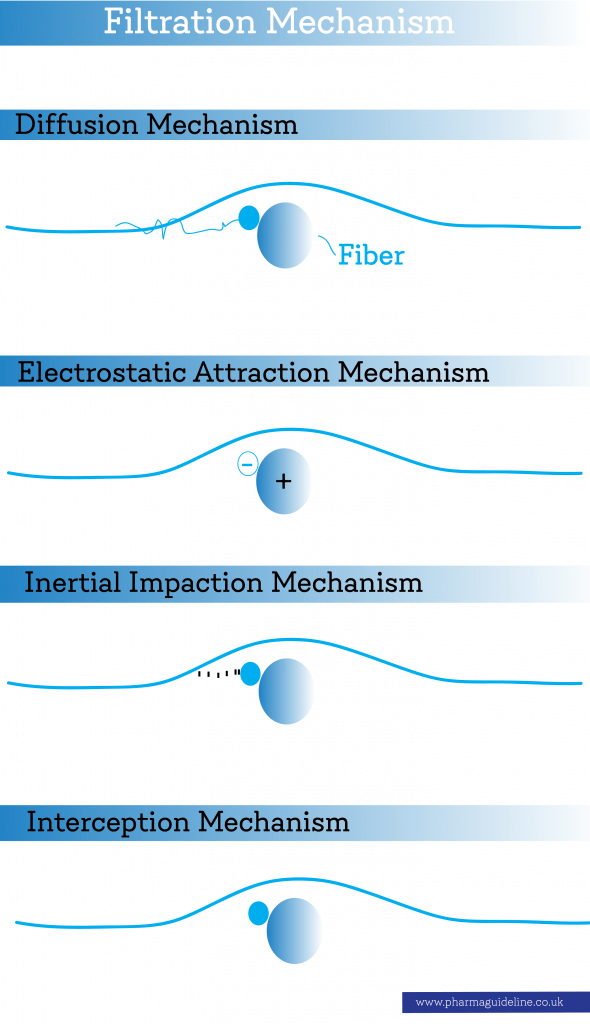
As the small particles crush with the fibers, here the key factors are mainly filter thickness, fiber diameter and velocity of the air. The air space between the HEPA filter subject to greater than or equal to 0.3 μm provide high level of efficiency. In sieves or membrane filters, particles which are less than the pore or openings can pass through but in HEPA filters the particles are attached to the fibers. There are several mechanisms has been identified which play the major role trap the particle to the pore.
Diffusion
All the particles under 0.3 μm retained by the HEPA filter in diffusion method. This the main theme of the Brownian motion where smaller particle below or equal to 0.1 μm in diameter are hindered and trapped in the filter. This mechanism is not prominent is low velocity of air.
Interception
Particles which are subject to flow in a line come with same radius/diameter of a fiber and adhere to it, this is very prominent to mid-size particle and which are retain by this process.
Impaction
Particles with higher diameter subject to unable to pass the fibers and directly retain on them, the effect increase subsequently with the air velocity.
Particle having size at or below 0.1 μm diameter, diffusion method is predominant and particle above0.4 μm predominant to impaction and interception. The MPPS [Most Penetrating Particle Size] is 0.21 μm, here the impaction and interception are remarkably inadequate. And this this point consider the weakest point of HEPA filter. The classification of the HEPA filters remarkably depend on the particle retention capacity at or below or equal to 0.3 μm particle size.
What is Gas filtration?
All types of HEPA filters are designed to retain particles but HEPA filters are unable to retain odor and gases molecules. HEPA filters can’t filter the odor or gases molecules. Alternative have been developed by British Armed Forces[BAF]. To filter the chemical vapors, organic compounds, volatile compounds, pet, cigarette, or flatulence odors, activated carbon filter or other filters are used.
HEGA [High Efficiency Gas Adsorption] filters plays the major role here, composed of Carbon cloth filters which is more efficient than granular activated carbon form. This filters [HEGA] designed by BAF to face chemical warfare.
Effective Usage of HEPA filter with Pre-filter
In a common air handing unit, a pre-filter[Carbon activated] use with the HEPA bag filter to extend the usage life/shelf life of more expensive HEPA filter. At the first stage of the filtering the pre-filter, removes the almost all type of dust, hair, particle from the air. Particles which can’t remove by pre-filters or escape from it then the fine particles remove by the HEPA filters in AHUs[air handling units].
Specifications of HEPA Filter
HEPA filters are defined by the US, DOE[United States Department of Energy] in almost all American industry which removes at least 99.97% of particulate at 0.3 μm in diameter. At the standard volumetric air flow, the minimal resistance of the air flow or pressure drop is around 0.044 psi[300 pascals].
In EU, filters are classified based on MPPS [Most Penetrating Particle Size] as HEPA, EPA, and ULPA where the average efficiency defined as “Overall” and the specific point efficiency defined as “Local”.
Marketing View Regarding HEPA Filter
Now a days some of the company highlighted the term “True HEPA” supposed to give assurance to the end user/customer to confirm that their filter is the original HEPA filter. This term “True HEPA” has no significant scientific value or no legal meaning. Some of the company marketed as designed as”99% HEPA”,”HEPA-style””HEPA-like,” “HEPA-type,” etc. which didn’t comply the HEPA standard[99.97% efficiency] and this type of material may not have the original test certificate of may not undergo any type test like filter integrity test.
Safetyconsideration of HEPA Filter
Mid-size particles ranges between 0.15 µm and 0.2 µm is considered hardest to filter through HEPA. The mechanism of working of HEPA filter is totally different from Ionic filters and Ozone filters which work through negative ions and ozone gas respectively. So HEPA plays a great role in pulmonary side-effects like asthma and allergies which are much lower with HEPA filters.
Where the HEPA filters subject to use in commercial grade, it is better practice to change the HEPA filter in every six month to hold its efficiency at desired level of work but if it use in residential purpose then it may be change in every two to three years. In the period of time, the efficiency of HEPA filters decrease day by day and failing to change the same in due to create hazard to the machine or system and particulate contamination spread day by day.
Applications of HEPA filters
Biomedical
HEPA filters generally remove the air borne particle, bacteria, virus and various type of organism resulting infections. High energy ultraviolet light units or panels with anti-microbial coating integrated HEPA filters are specially use to serve medical purpose to kill the live bacteria and virus which trapped by the filter media. Airborne disease transmission successfully protect by the special design HEPA filter which efficiency declared as 99.995%.
Heating, ventilation, and air conditioning[HVAC]
HVAC [Heating, ventilation, and air] technology uses HEPA filters to remove airborne particulate, dust, microorganism etc. in indoors and vehicle, greatly use in sensitive pharmaceutical product manufacturing where subject to clean room class. To ensure better environment and better health, HVAC play a major role various organization who are concern this activities.
COVID-19
HEPA filters plays a great role to get entrapped SARS‑CoV‑2 Airborne droplets which size approximately 0.125 µm even if they are present on the floor. Various type of HEPA incorporated mask are available at the current market which is the best solution to prevent the pandemic situation for personal use.
Motor vehicles
HEPA filters is using in the latest car, “Tesla Mode X” using HEPA filters since 2016 and now their update “Model S” also using the additional HEPA filter.
Vacuum cleaners
HEPA filters are also use in many well designed vacuum cleaners as a part of their filtration systems. This option of the vacuum cleaners plays beneficial role for the patients having asthma and allergy problem due to HEPA filters traps fine particles reduce to size 0.1 µm which is mainly responsible to induce asthma and allergy. Before using the Vacuum cleaner integrated with HEPA filters, check the filter efficiency [at least 99.97%] unless authorized. HEPA like, True HEPA, HEPA are not the actual term to declared standard HEPA efficiency.
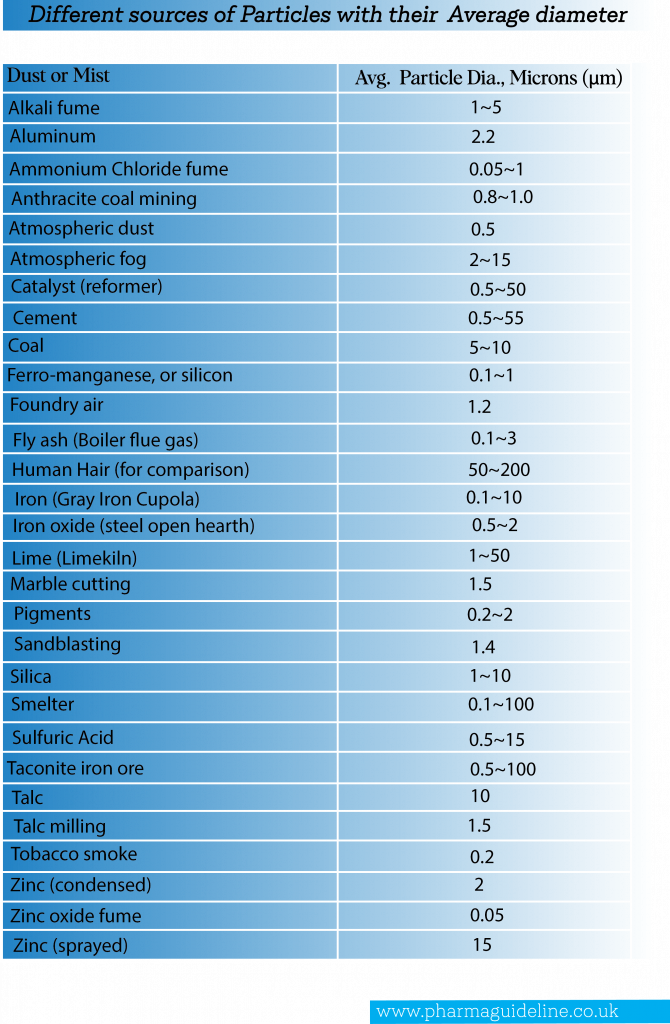
A powerful motor is essential to provide adequate cleaning power due to the high density of the HEPA filters. A vacuum cleaners containing washable HEPA filters subject to more expensive. A standard high quality HEPA filter generally trapped the particles having 0.3 µm in diameter where a natural human hair is 50 to 150 microns in diameter. So a HEPA filter traps the particle which are reduce to several hundred times smaller than the standard width of Human hair.
Sometimes, is remarkably noticeable that some of the manufactured declared HEPA 4/HEPA 3/HEPA 2 etc. without proper explanation behind them. This is actually declares their MERV [Minimum Efficiency Reporting Value] rating. This the ability of the air cleaner filter to remove the particle, dust, and microorganism etc. which passes with air through the filter. The MERV scale distributed between 1 and 16 which declare the efficiency of the filters remove particle between 10 to 0.3 µm in size.
Vehicles
Airlines
All types of modern airlines uses HEPA filters to reduce contamination in the air. As most of the air in air plane cabin is recirculated, so this is crucial to filter the air using high grade of HEPA filters to avoid cross contamination.
Maximum quantities of standard pressurized aircraft brought air from the outside and circulate it the cabin exhausted it through the outflow valves in the rear side of the respective aircraft. Almost 60% of air comes from outside of the plane and 40% cabin air passes through the HEPA filters in well-designed aircraft.
What are drawback of HEPA filters?
Every filtration technology has the shortcomings that no filter can pass the 100% contamination free air. The efficiency is almost 99.9997% not 100% same for HEPA filters. Besides this the HEPA filter has the following two types of drawback which can dissatisfy to you to buy a HEPA filter/HEPA filter integrated equipment’s-
Insignificant Pollutants Can Escape Filter:
HEPA filters are effectively act on the particle size at equal to or above 0.3 µm, there various type of microorganism which particles are reduce <0.1µm can easily pass the HEPA filters. So using HEPA filters you can trap/remove all type of organism, this myth is actually invalid. The smaller particulate cause the serious health hazard for the patient/personnel who are previously suffering from asthma or allergic problem. Alternative technology should be used to face this tiny size particles.
Various type of Mold & Bacteria Growth on Filter:
When bacteria and mold gather on the air system on the HEPA filter, this accumulate organism have the potential chance to grow in geometric order. As the number of the microorganism tend to grow outside the filter then the health hazard outside the controlled environment growth day by day. To solve this issue, a UV light integrated HEPA filter to be use to kill the mold and bacteria at your indoor environment.
So what is the best alternative of HEPA filters?
The best alternative of HEPA filters are ULPA [Ultra-low Penetration Air] filters. HEPA filters remove particles size equal to or above 0.3 µm having efficiency of 99.97% where ULPA filters remove particles size equal to or above 0.12 µm having efficiency of 99.999%.
Can HEPA filters be Wash or Reuse?
All type of HEPA filters can’t wash. Some of the HEPA filter can be wash and some are not. If your HEPA filter labelled with“Washable” then you can wash the HEPA filter but a non-washable HEPA filter may be wash by appropriate way.
To rinse a HEPA filter decrease its efficiency and proper study didn’t found that how much efficiency loss upon rinsing the HEPA filters. Moreover, this has been proved that upon rinsing the HEPA filter, its efficiency loss due to losing/damaging of fiber occur in this time.
During cleaning of HEPA filter, if individual face lack of awareness, fall in serious health hazard upon accidentally taking some of pollutants from HEPA filter. After cleaning, drying activity must complete for a long time. Check the same before use as the wet filter is the great source of mold.
HEPA filters can be reuse if you can clean it properly. Use a vacuum cleaner to clean the filter rather than rinse it. Even non washable filter can be clean this way, proper measures to be taken before cleaning the HEPA filter. Avoid direct touching it. If you rinse your filter, the dry the filter properly by placing it outdoor. Before placing, shake the it to remove the water properly. Set it at outdoor in such way that it get air from all direction and faster the drying process.
After washing the filter may withheld its efficiency maximum 99.7% and you can was your filter every six months or once in a year but it is the best practice to replace the same. Some of the filter labelled with “Permanent” then you can’t wash it, just replace it.
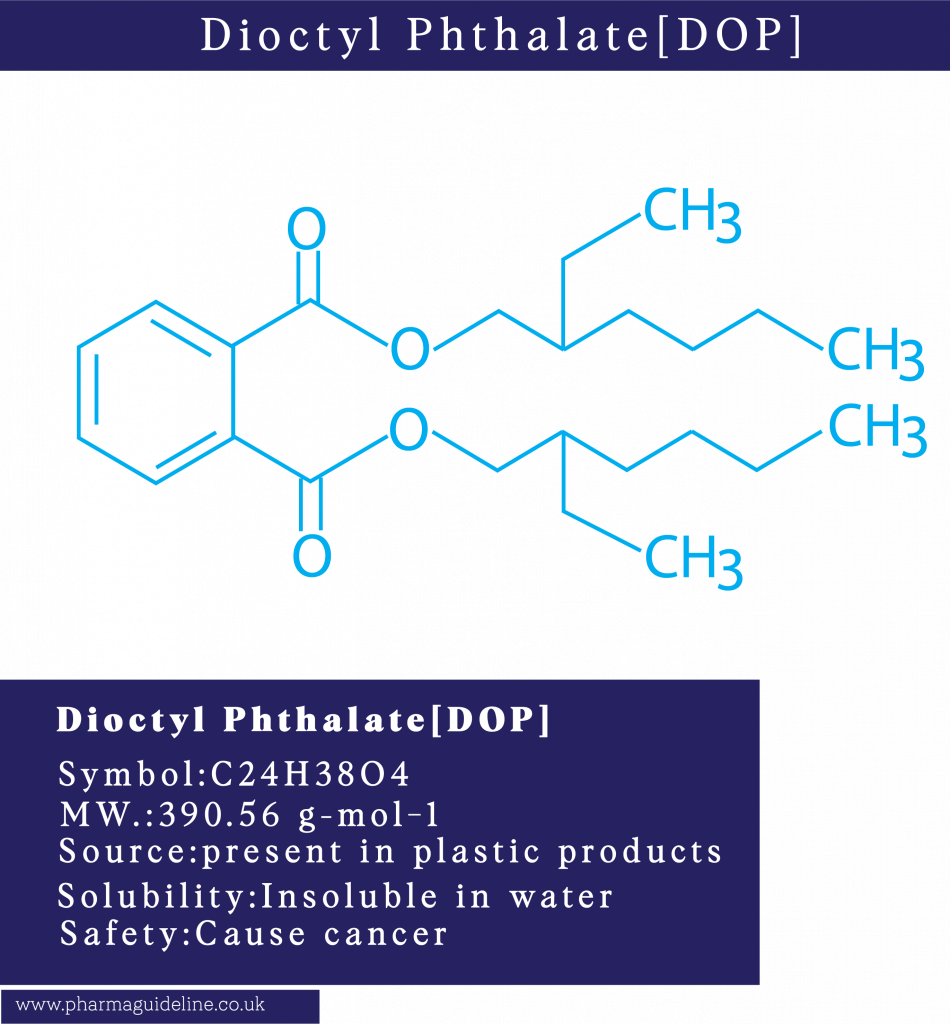
Poly Alpha Olefin (PAO) is used in in HEPA filter integrity during validation of HVAC system in different pharmaceuticals. This is the best alternative of DOP which was previously used for the same purpose as PAO is subject to use. DOP was using long time for HEPA filter integrity test during HVAC qualification.
International Agency for Research on Cancer (IARC) has classified DEHP/DOP as carcinogenic 2B substance According to evidence from rodent studies which has also been identified carcinogen (cause cancer) for the human. For this reason scientist was trying to replace DOP for similar materials for a long time.
In 2021, JICA[Japan Air Cleaning Association] introduce a guideline to substitute the DOP[Dioctyl phthalate] with PAO[Poly Alpha Olefin]. PAO provides the same performance as provided by DOP additionally doesn’t provide any harmful/carcinogenic effect to human.
Food and Drug Administration[FDA] stated that the alternative aerosols are also suitable but it shouldn’t promote the microbial growth in the respective area. Generated aerosol ranges from PAO[Poly Alpha Olefin] is 0.1 to 1.0μm.
The aerosol generator, generate the PAO aerosol and subsequently passed through the HEPA[High-Efficiency Particulate Absorbing/High-Efficiency Particulate Arrestance/ High Efficiency Particulate Air having six types A, B, C, D, E & F] filter and then with the help of a Photometer the integrity is checked as 99.97% particle contains size 0.3 μm shouldn’t pass to the HEPA filter.
Chemically, PAO is the polymer of alpha-olefin which is the class of Olefins those contains double bond between first and second carbon of the polymer chains. Poly Alpha Olefin is the mixture of dimers, trimers and tetramers of 1-octane, 1-decane and 1-dodecane in chemically.
Poly alpha olefin is a polymer of alpha-olefin. Alpha-olefin is a class of olefins those have a double bond between first and second carbons of the polymer chains. PAO contains better lubrication properties and having greater viscosity compare to mineral oils. Poly-alpha-olefins have good lubrication properties and greater viscosity than mineral oils.
Poly alpha olefins are also used as a coolant in radiators and synthetic lubricants. Generally, the declared shelf life of PAO is 10 Years but when subject to open the container, the shelf life down to only one year. This is the best practice to protect PAO from direct exposure of sunlight and protect from UV light.
Why DOP[Dioctyl phthalate] banned?
Due to carcinogenic effect for human using of DOP [Dioctyl phthalate] was banned in pharmaceutical company, additionally DOP has the following significant effect which is also the major cause to ban the DOP.
Endocrine disruption
Causes endocrine disruption in male, act as androgen antagonist subsequently effect on reproductive system. Exhibits insignificant levels of reproductive function in adolescent males in Prenatal phthalate exposure. Chromatin DNA integrity and Sperm motility expressively reduce in PVC pellet plant where presence of higher airborne concentrations of DOP. Subsequent study has been proved that the significant exposure of DOP reduce the Chromatin DNA integrity and Sperm motility in men.
Development
Several studies have been shown that significant exposure of DOP has been change the sexual function and development in rats and mice. During pregnancy, excessive exposure of DOP disrupt development and placental growth in mice which cause premature birth, low birthweight, and fetal loss. Advanced levels of anxiety during puberty and hypertrophy of the adrenal glands may arise if excessive DOP exposure occur in neonatal mice through lactation.
Obesity
Intestinal lipases convert DOP to MEHP upon DOP ingestion then MEHP absorbed. MEHP is considered for the obesogenic effect. DOP is the possible disruptor for the thyroid function which have already verified by human studies and rodent studies. Subsequent exposure of DOP is significantly relevant with plasma thyroxine levels and patient with hypothyroidism inclined to to weight gain.
Cardiotoxicity
A minor dose of DOP predominately effect the activity of mice. The duration of the exposure of and clinical dose of DOP has the significant effect of the behavior of cardiac cell at culture. Cell face the slow propagation speeds with fractured wave fronts.
Maintenance of ETP: This SOP [Maintenance of ETP] will make as per SOP for SOP of the respective company/Organization. Font/line spacing/Margin/Page set up/Header/Footer etc. will change as per requirement of SOP for SOP.
1.0 Purpose:
The purpose of this SOP is to define the standard procedure of preventive maintenance of Effluent Treatment Plant [ETP] of XX Pharmaceuticals Ltd.
2.0 Scope:
This Standard Operating Procedure applies to the Effluent Treatment Plant [ETP] of XX Pharmaceuticals Ltd.
3.0 Definitions/Abbreviation:
ACF: Activated Carbon Filter
ETP: Effluent Treatment Plant
MGF: Multi Grade Filter
PAC: Poly Aluminum Chloride
PPE: Personal Protective Equipment
SOP: Standard Operating Procedure
4.0 Responsibilities:
Engineering Department [Validation]:
Preparing the SOP & revise it when required
Engineering Department [Maintenance]:
To provide essential support for maintenance of the system.
To ensure that the operators are accountable to carry out the maintenance.
Operators
To perform the maintenance activities according to the SOP.
Head of Engineering
To confirm that the maintenance of ETP are done correctly.
Head of Quality Assurance
To ensure overall implementation of this SOP.
5.0 Revision Details
Sl. No./Version No./Effective Date/Change History to be add here
6.0 Annexure:
Annexure has been mentioned in bottom of the document with download link
Annexure-I: Maintenance log sheet of ETP
7.0 Procedure:
7.1 Precautions: All maintenance activities must be done safely in accordance with the necessities of the Plant Safety Declaration and the safety notices from place to place the plant. Specific consideration must be paid to the following:
Handle the chemicals by wearing PPE.
Ensure that the pumps are switched off before initiating any kind of maintenance.
7.2 System Description:
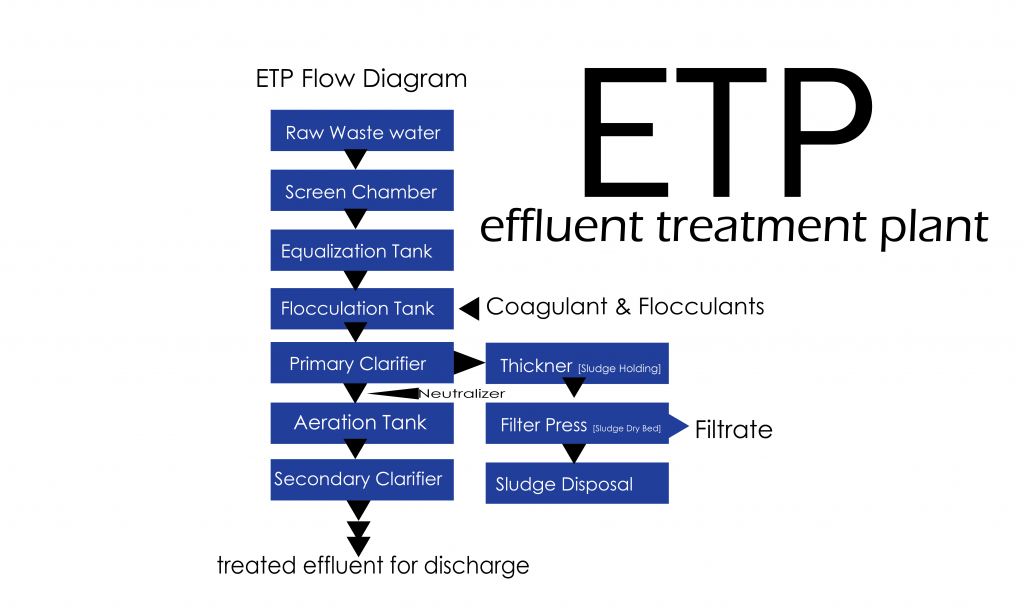
The capacity of ETP is 5000 Liter/hour. The effluents from the production department come into the neutralization and equalization tanks via bar screen chambers. In this bar screen chamber the floating material/solid material is being filtered. A dosing of lime is being delivered in the neutralization tank if pH correction is needed.
The effluents are aerated in this tanks with air which is delivered by the blowers. After being neutralized in the neutralization tank the effluents goes into the equalization tank & then the effluent is relocated to the flocculation tank through effluent transfer pumping system.
A dosing of PAC [Poly Aluminum Chloride] is delivered in the flocculation tank to flocculate all the effluents. Poly electrolyte dosing [PED] is delivered in the transferring pipe of effluents from flocculation tank to the lamella.
After lamella the effluent is passed to the aeration tank. In aeration tank the effluents are aerated with air. A dosing of NaOH[Sodium Hydroxide] is provided if it is required.
There is a buffer tank after the aeration tank where 1kg of urea will be delivered after every Two months of operation. There is a line under the buffer tank to transfer the sludge to underground sludge tank & then to sludge pit by sludge transfer pumping system.
Clear water from the Buffer Tank is stored in the clear water tank. There are two pumps to transfer the clear water to final storage tank through MGF [Multi Grade Filter] & ACF [Activated Carbon Filter]. One pump is used at a time.
7.3 Maintenance Procedure:
7.3.1 Maintenance of ETP will be performed according to the following check list:
Type of maintenance: Daily
Maintenance activities:
Clean the screen bar daily.
Clean the surrounding environment of ETP.
Type of maintenance: Weekly
Maintenance activities:
Clean the control panel.
Check the electrical control panel and electrical connection.
Type of maintenance: After 2 months
Maintenance activities:
Clean the dosing tank.
Type of maintenance: After 3 months
Maintenance activities:
Change the oil of blower/compressor.
Type of maintenance: Yearly
Maintenance activities:
Clean all the tanks
Change the gear oil
Clean the clear water tank
7.3.2 Fill up the log sheet (Annexure-I) after performing preventive maintenance of ETP.
Breakdown Maintenance: This SOP [Breakdown Maintenance] will make as per SOP for SOP of the respective company/Organization. Font/line spacing/Margin/Page set up/Header/Footer etc. will change as per requirement of SOP for SOP.
1.Purpose
The purpose of this SOP is to define the procedures involved in conducting and handling breakdown maintenance activities of the equipments/machines of XX Pharmaceuticals Limited.
2.Scope
This Standard Operating Procedure applies to all equipments/ machines of GMP all area of XX Pharmaceuticals Ltd.
3.Definitions / Abbreviation:
BM: Breakdown Maintenance
SOP: Standard Operating Procedure
QA: Quality Assurance
4. Responsibilities
The responsibilities are as follows:
Initiating Department:
To inform Quality Assurance, Head of Plant Operations and Engineering Department for the breakdown maintenance of linked equipments, machines or utility rest area.
To fill up the breakdown maintenance memo and backup the carbonated copy.
To put the status label “UNDER MAINTENANCE” on the machine.
To check related machines, equipments or utility services along with Quality Assurance personnel after completion of BM Activities.
Engineering Department/Maintenance Department
To receive the BM Memo and arrange for be present the breakdown maintenance.
To assess the cause of breakdown and resolve the problems.
To oversee the BM job and update necessary record.
To fill up the BM History form for each machine after completion of Breakdown Maintenance.
To preserve the BM related documents.
Technician
To execute the breakdown maintenance by following the appropriate safety precautions
Quality Assurance
To evaluate and select disposition or further operation of products/batches under bearing
To inform Validation Department [Engineering End] to perform requalification or recalibration of the machine/equipment if it is required.
To certify that actionable and recommendation are closed.
Validation Department (at Engineering End)
To perform requalification or recalibration of the equipment/machine if it is necessary.
To issue the Breakdown Maintenance Memo for the individual sections.
Head of Engineering
To monitor actions of engineering personnel who perform the Breakdown Maintenance activities and to provide technical provision and assistance with documentation supplies.
To assessment the history files of equipment’s maintenance annually and at the time of incidence of major failures and to identify the repeated component of failures or other events.
To confirm that the equipment maintenance history files are secured in the Engineering Department.
Head of Quality Assurance
To confirm overall implementation of this SOP
5.Revision Details
Sl. No./ Version No./ Effective Date/ Change History to be add here
6. Procedure
Precautions: All maintenance work must be accomplished safely in agreement with the requirements of the Plant Safety Declaration and the safety notices around the plant. Specific consideration must be paid to the following-
Personal Protective Equipment [PPE] and clothing appropriate to the job must be worn.
Equipment must be electrically inaccessible and locked out where potential.
“Under Maintenance” status label must be attached on the machine during BM activities.
“Shifting in Progress for Maintenance Work” status label must be attached on the machine at the time of shifting for maintenance activities.
6.1 Concerned Department
6.1.1 In case of equipment, machine or utility breakdown, the related departmental personnel will label it with ‘UNDER MAINTENANCE’ status label.
6.1.2 The BM Memo will be a pre-printed, bi-layer, self-carbonated paper which will be filled up by the related departmental personnel and the original copy will be sent to the Engineering Department to evaluate and be present at the problem. The carbonated copy will be store by the relevant department.
6.1.3 The pre-printed serial no. of each page of “BM Memo” will be considered as the “BM Memo” number.
6.2Quality Assurance Department
6.2.1 Quality Assurance personnel would estimate the breakdown to assess the influence on product quality, safety, efficacy matters and take decision whether the product would be disposed.
6.2.2 Quality Assurance will inform the Validation Team [at Engineering End] after completion of breakdown maintenance to execute the requalification or recalibration of that machine if it is necessary.
6.2.3 Quality Assurance may hold the production batches if any harmful impact occurs till further study.
6.3 Engineering Department
7.3.1 Engineering personnel will receive the “BM Memo” and evaluate the reason and resolve the problems.
6.3.2 Before initiating the maintenance activities, detach unwanted services [‘LOTO Procedure’ to be followed] from the safety point of view.
The breakdown maintenance activities will be carried out according to the equipment handbook (if required) under the supervision of maintenance supervisor/Line In-charge.
6.3.3 A tag “Shifting In Progress For Maintenance” will be put on the machine during shifting to the workshop for maintenance Activities.
6.3.4 After completion of BM activities, relink the utility services and take the usage trial in presence of relevant departmental personnel and Quality Assurance personnel. After successful trial, engineering department will deliver the machine to the relevant department.
6.3.5 Engineering department shall assess the need for requalification or recalibration in discussion with Quality Assurance and document the identical in the memo. Quality Assurance in turn shall inform to production and validation team[at Engineering End] for recalibration or requalification.
6.3.6 Preventive maintenance calendar can be changed based on the rate of breakdown of a specific machine.
6.3.7 Engineering department will maintain the data record of the breakdown activities with trend analysis.
6.3.8 After finishing the breakdown maintenance activities engineering/maintenance person will fill up the “Breakdown Maintenance History Form” of that “Machine/Equipment/System” and store all breakdown related documents in Engineering Department.
6.3.9 If the Area is out of any possible harm and found okay, routine operation will be started after Quality Assurance Inspection with adequate cleaning.
6.3.10 Photocopy of all approved forms will be used. Computer generated copies of all related form can be used with proper note, mentioning in the footer-
‘’This is the computer generated form and similar in that of original form”
Audit Checklist for Engineering Department: Here is the tentative Audit Checklist Engineering Department. You can follow the checking point during auditing process at Engineering and Maintenance Department.
Approved Departmental Organogram.
Area monitoring for Temperature/Relative Humidity/Differential Pressure.
BMS[Building Management Systems] Operation Record Logbook/Data Backup/Data storage/Authorized User List
Breakdown Maintenance Record.
Boiler Certificate and Boiler Operator Registration Number.
Buffer stock of Filter with identification Mark.
Calibration Tag with due date on equipment’s.
Compressed Air Validation Record.
Deviation Management Record.
Departmental Objective.
Dust collector SOP, Record, Disposal and Operation Logbook.
Drawing of Technical Floor and Production Floor[With Man/Machine Flow].
Equipment’s Calibration schedule with frequency.
ETP process flow diagram.
Filter Integrity Test Record.
Filter Changing record.
HVAC Validation Record.
Incinerator Operation Logbook/Third party agreement for Incineration.
IQ, OQ, PQ record for new equipment’s.
List of Personnel and their Job description.
List SOP’s.
List of Equipment’s.
List of Spare Parts.
Labelling of all critical machine/Line/Instruments e.g. Boiler, Underground Water Line, Diesel Tank, Gas Cylinder etc.
Logbook for Operation of ETP.
Marking of Clean and Unclean Filter.
Maintenance & Service Card/Record
Personal Protective Equipment list for maintenance of any equipment’s.
Previous Audit Report.
Previous Audit Pending Issue.
Preventive Maintenance Schedule.
Record keeping during CAPA procedure.
Retention Time of documents.
RSD[room schematic diagram] and RDS[Room Data Sheet] record.
Sanitation Record of Water system.
SOP for LOTO [Lock Out, Tag Out] Procedure.
SOP for Color Code.
SOP display on working place/Area/Machine Location.
Status label for equipment’s/Critical Spare parts/ Clean Filters.
Storage Record of critical Spare Parts.
Third party Agreement for Calibration of Equipment’s.
Training Record of Personnel.
Training Need Assessment.
Temperature Mapping.
Under Maintenance /Under Installation/Out of order Identification Label.
Yearly Calibration Schedule with frequency.
Yearly Training Calendar.
Work Permit Record for equipment’s maintenance.
Water System Drawing with user point identification.
Water sampling point Identification.
This all about the Audit Checklist for Engineering Department [but not limited to]. You can treat this list as Internal Audit/ Self-Inspection Checklist or any checklist to find out the lacking of respective department.

![DOP[Dioctyl phthalate]](https://pharmaguideline.co.uk/wp-content/uploads/2021/07/PAO-up-1024x949.png)