
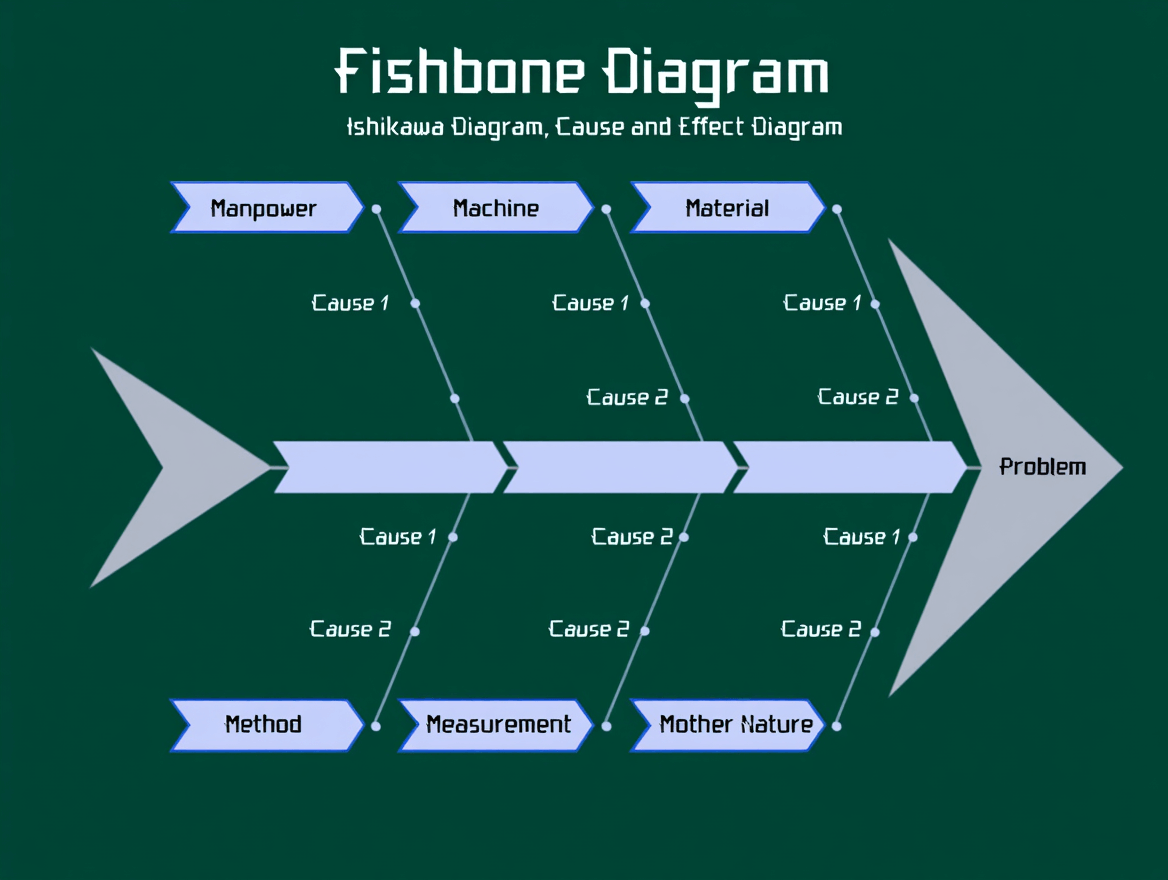
A Fishbone Diagram (also called Ishikawa Diagram or Cause-and-Effect Diagram) is a visual tool used to systematically identify and organize all possible causes of a specific problem or effect. It was developed by Dr. Kaoru Ishikawa in the 1960s.
The diagram looks like a fish skeleton:
- The “head” of the fish is the problem/effect you want to solve.
- The “bones” branching off the spine are the major categories of causes.
- Smaller bones branching off are the specific causes within each category.
Why use it?
- Forces teams to think through all possible causes (not just the obvious ones)
- Prevents jumping to conclusions
- Encourages cross-functional collaboration
- Very useful in root cause analysis (RCA), quality improvement, Six Sigma, Lean, etc.
How to Create and Use a Fishbone Diagram (Step-by-Step)
- Define the problem clearly
Write it in a box on the right (the “head”). Be specific.
Example: “Customer complaints about late deliveries increased by 40% in Q3” - Draw the main spine
A horizontal arrow pointing to the problem. - Identify major cause categories (the big bones)
Common categories (the 6 Ms for manufacturing, or adapt to your industry):- Man (People)
- Method (Processes)
- Machine (Equipment/Technology)
- Material
- Measurement
- Mother Nature (Environment)
For service/industry, people often use:
- People, Policies, Procedures, Plant/Technology, etc.
- Brainstorm all possible causes
Ask “Why does this happen?” repeatedly (5 Whys technique helps).
Write each cause as a branch off the relevant category. - Go deeper
For each cause, ask “Why?” again and add sub-causes (smaller bones). - Analyze and prioritize
Circle the most likely root causes (use voting, data, Pareto, etc.). - Develop action plan
Address the confirmed root causes.
Practical Case Study: Restaurant Getting Complaints About Cold Food
Problem (Head of the fish):
“Customers frequently complain that food arrives cold” (complaints rose from 3 to 18 per week)
Fishbone Diagram Categories Used:
We used 6 categories suitable for a restaurant:
- People (Staff)
- Servers forget to check food temperature before leaving kitchen
- New staff not trained on urgency
- Kitchen and serving staff not communicating
- Too few servers during peak hours → delay
- Processes (Methods)
- No standard procedure for checking food temperature
- Food waits too long on the pass before being served
- Tickets not prioritized correctly during rush
- No “food ready” notification system between kitchen and floor
- Equipment (Machines)
- Heat lamps broken or insufficient
- Plates not pre-heated
- Delivery trays too small → food stacked and cools faster
- Old warming drawers not maintaining temperature
- Materials
- Some dishes (e.g., pasta) cool faster than others
- Large portion sizes take longer to eat → perceived as cold
- Environment (Mother Nature/Place)
- Dining room AC set too low near some tables
- Long walking distance from kitchen to farthest tables
- Draft from entrance door
- Measurement (or Management)
- No tracking of time from “food ready” to “delivered to table”
- No temperature checks logged
- No customer feedback analyzed by dish/table location
Root Causes Identified After Investigation (circled on the diagram):
- Heat lamps were broken for 3 weeks (maintenance backlog)
- No policy to pre-heat plates
- Average time from kitchen to table was 4.5 minutes during peak (target should be <2 min)
- Servers overloaded: 1 server handling 9 tables instead of max 6
Actions Taken:
- Repaired/replaced heat lamps same week
- Implemented plate pre-heating in salamander broiler
- Added a runner position during peak hours
- Created a simple checklist: food temperature >60°C before leaving pass
- Installed digital ticket system with timers
Result:
Cold food complaints dropped from 18 to 2 per week within one month.